You’ve been offered an internship. There’s just one catch — it doesn’t pay. Should you take it anyway for the experience, or is that a trap dressed up as an opportunity? This is one of the most common dilemmas Indian students face, and the honest answer is: it depends — on the law, on the company, and on what you’re actually getting in return. Here’s how to think it through clearly.
The Legal Reality: What Indian Law Actually Says
Most students assume there’s a law forcing companies to pay interns. There isn’t — at least not a direct one. Indian labour law does not formally define the terms ‘intern’ or ‘trainee,’ which means internships fall into a legal grey zone rather than a clearly regulated category.
The closest regulated framework is the Apprentices Act, 1961, which governs apprenticeships specifically and does mandate a government-revised stipend for apprentices. But a large share of internships in India — especially those done as part of a college curriculum — don’t fall under this Act at all. If your internship is a mandatory academic requirement, employers are generally not obligated to pay you, and many don’t. If you’re a fresher taking an internship outside any academic requirement, the situation is more debated: several HR and legal commentators argue that non-payment in that context sits on far shakier ethical ground, even though enforcement is inconsistent.
There’s also active pressure for reform. A public interest litigation has reportedly been filed seeking a ban on unpaid internships lasting longer than four weeks unless they’re tied to a structured academic requirement, along with a proposal for a government body to monitor internship practices. Nothing has become law yet, but it signals that the current grey zone may not last forever.
| The short version • No blanket law requires companies to pay interns in India. • Apprentices under the Apprentices Act, 1961 must be paid a government-set stipend — but most ‘internships’ aren’t legally apprenticeships. • Curriculum-mandated academic internships are the least likely to be paid, and this is broadly considered acceptable. • Reform is being actively discussed, including proposals to cap unpaid internship duration. |
How Common Are Unpaid Internships in 2026?
More common than most students expect, and not limited to small companies. According to Internshala’s 2025 internship report, roughly 35% of internship listings in India offer no stipend at all, and another 25% pay below ₹3,000 a month. Unpaid roles show up across prestigious employers too — media houses, think tanks, NGOs, and government-linked institutions among them — often justified by the exposure and brand name involved.
On the paid side, the picture is more encouraging than it might seem: Internshala’s broader trends data put the average internship stipend at around ₹8,000 a month, with top offers reaching ₹1 lakh a month at large companies, and about 22% of internships nationally converting into a pre-placement offer (PPO).
| Metric | Figure |
| Internships offering no stipend | ~35% |
| Internships paying under ₹3,000/month | ~25% |
| Average internship stipend (all sectors) | ~₹8,000/month |
| Top-end stipends at large companies | Up to ₹1,00,000+/month |
| Internships that convert into a PPO | ~22% |
Figures based on Internshala’s Internship Trends and 2025 sector reports; actual pay varies significantly by company, city, and role.
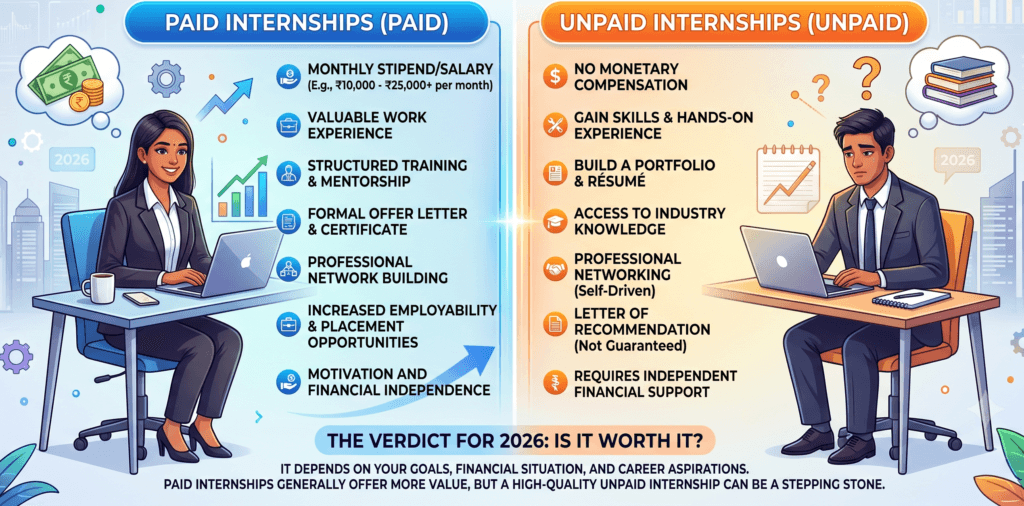
The Case for Paid Internships
- It signals the company values your work, not just your willingness to work for free.
- You can actually afford to take it — travel, food, and city rent in metros make unpaid roles genuinely inaccessible for students without family financial support.
- Paid internships more often come with structured mentorship, defined deliverables, and real accountability on both sides — a company paying you has more incentive to use your time well.
- A stipend, however small, gives you a concrete data point for salary negotiation later.
When an Unpaid Internship Might Still Be Worth It
Unpaid doesn’t automatically mean exploitative. There are situations where it can still be a reasonable trade:
- It’s a mandatory academic requirement, and the alternative is not completing your degree on time.
- The organisation is a genuinely small nonprofit, research lab, or early-stage startup with real budget constraints — not a well-funded company treating unpaid labour as a cost-saving strategy.
- The role offers direct, hands-on skill-building you can’t easily get elsewhere, with a named mentor and a defined learning outcome, not just ‘shadowing.’
- The duration is short and clearly bounded (a few weeks, not several months) and doesn’t require you to relocate or take on costs you can’t absorb.
Outside of these situations, unpaid work that closely resembles a regular employee’s job — fixed hours, real deliverables, ongoing responsibility — is harder to justify, regardless of what it’s called.
Red Flags: When ‘Unpaid’ Crosses Into Exploitation
| Watch for these warning signs • You’re doing the same work as a full-time employee, for the same hours, with no stipend and no defined learning component. • The internship has no fixed end date, or keeps getting extended with vague promises of a future paid role. • You’re asked to pay any fee — for ‘training,’ ‘registration,’ or ‘guaranteed placement.’ Legitimate employers never charge candidates for the chance to work. • There’s no internship letter, offer letter, or written scope of work — nothing that would let you prove the internship happened if you needed to. • You’re denied a certificate or reference at the end despite completing the work as agreed. |
A Quick Decision Framework
Before accepting an unpaid internship, run it through these questions:
- Can I actually afford to do this — travel, food, rent — without financial strain for the full duration?
- Is there a named mentor and a clear learning outcome, or am I just filling a labour gap?
- Is the duration clearly bounded, with a fixed end date in writing?
- Will I get a certificate, reference, or LinkedIn recommendation regardless of what happens after?
- If I said no, would this org replace me with another unpaid intern instantly — meaning I’m doing job-shaped work, not learning-shaped work?
If most of your answers point in the wrong direction, the internship is more likely to cost you than build you — even if the brand name looks good on a resume.
If You Decide to Take an Unpaid Internship Anyway
- Get everything in writing — duration, role, and what you’ll receive at the end (certificate, LOR, PPO consideration).
- Set your own boundary on hours — don’t let an unpaid role expand into a full-time unpaid job.
- Track your work in a simple log — projects, tools used, outcomes — so you can convert it into strong resume bullet points later.
- Ask directly about stipend at the next review point; many ‘unpaid’ internships become paid or PPO-track once you’ve proven your value.
- Balance it — if you take one unpaid role for brand value, prioritise paid opportunities (like PMIS or the companies covered in our companies-hiring-interns guide) for your next one.
Final Word
There’s no single right answer to paid versus unpaid — the honest framework is to ask what you’re actually getting, not just what the company is called. A well-structured unpaid internship at a genuine early-stage startup can teach you more in eight weeks than a passive, unpaid ‘shadowing’ role at a big brand. And a small stipend at a lesser-known company can still be a better deal than a big name that expects free full-time work. Evaluate the internship, not just the logo.
READ NOTE
Capgemini Hiring Process 2026 for Freshers – Eligibility, Assessment, Interview & Salary Guide
GCC Jobs in India 2026 for Freshers — Complete Guide (Salary, Top Companies & How to Get Hired)
Top 50 International Companies Hiring Remote Jobs in 2026 for India & APAC Region Read Now
Top 10 IT Companies Hiring Freshers in India 2026 — Salary, Process, Eligibility & Complete Guide
How to Write a Cover Letter for IT Jobs in India 2026 — With Templates
Salary After MBA in India 2026 — Top Companies, Roles & How Much You Really Earn