
Accenture Fresher Hiring 2026 — ASE vs Advanced ASE Salary, 6-Stage Process & Complete Preparation Guide
Among the Big 4 IT companies every Indian fresher applies to, Accenture stands apart in three important ways. It pays the highest base salary at the standard fresher level — Rs. 4.5 LPA versus TCS Ninja at Rs. 3.36 LPA, Infosys SE at Rs. 3.6 LPA, and Wipro Elite NTH at Rs. 3.5 LPA. It hires from all engineering and science branches without penalising non-CS graduates. And its hiring process has evolved significantly since 2018 — what most preparation guides still describe as the standard Accenture process is now outdated.
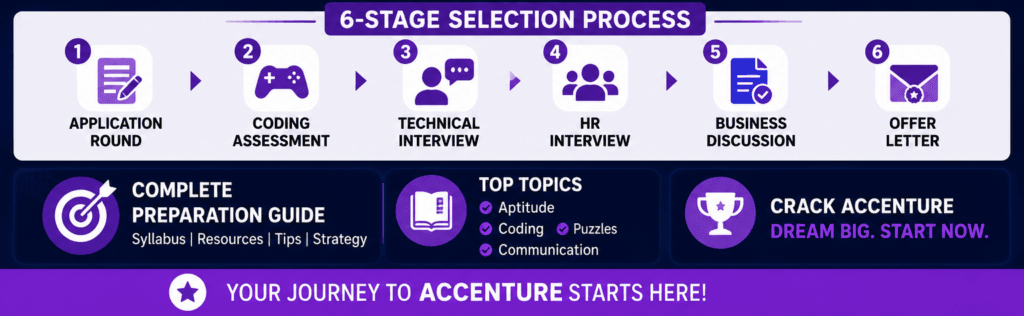
In 2026, Accenture runs a six-stage selection pipeline with two distinct salary tracks from the very beginning. All candidates go through the same first four stages. Stage 4, the coding assessment, has two performance thresholds — the standard threshold qualifies for the ASE track at Rs. 4.5 to 6.5 LPA, and the higher threshold qualifies for the Advanced ASE (11A grade) track at Rs. 6.5 to 9.0 LPA. No second registration is needed. Your performance in a single sitting determines which track you qualify for.
This guide covers every stage of the 2026 process in detail, exactly what the two salary tracks mean for your actual in-hand income, which skills determine which track you land in, why non-CS graduates have a genuine advantage at Accenture versus other IT majors, and the complete preparation strategy for each stage.
Accenture Fresher Hiring 2026 — Quick Facts at a Glance
| Detail | Information |
| Company Overview | Accenture plc — global IT services, consulting and strategy firm. 742,000+ employees globally, 250,000+ in India alone. |
| India Delivery Centres | Bengaluru, Hyderabad, Chennai, Pune, Mumbai, Gurugram, Kolkata — freshers placed across all locations |
| Fresher Role Title | Associate Software Engineer (ASE) — standard track | Advanced ASE (11A grade) — premium track |
| Standard ASE CTC | Rs. 4.5 to 6.5 LPA — varies based on performance and joining location |
| Advanced ASE CTC | Rs. 6.5 to 9.0 LPA — for candidates clearing higher coding threshold at Stage 4 |
| GenAI Skills Focus | 2026-specific: candidates with GenAI project experience gain measurable advantage at Technical Interview (Stage 5) |
| Eligible Degrees | B.E. / B.Tech / ME / M.Tech / MCA / M.Sc — ALL branches eligible including Mechanical, Civil, EEE |
| Minimum Academic % | 60% throughout — 10th, 12th, and graduation (unchanged since 2018) |
| Active Backlogs | Zero at time of interview |
| Eligible Batches | 2024, 2025, and 2026 graduating batches |
| Selection Stages | 6 stages — 4 online + Technical Interview + HR Interview |
| Online Assessment Platform | Accenture’s own proctored platform + AMCAT (for off-campus direct shortlisting) |
| Application Portal | careers.accenture.com/in-en | Also via AMCAT portal: myamcat.com |
| IT Sector Fresher Hiring Target (FY26) | IT sector projected to add 150,000+ fresher roles — Accenture named GenAI skills as explicit FY26 hiring focus |
Why Accenture Is Different From TCS, Infosys, and Wipro for Freshers
Most freshers treat Accenture as interchangeable with TCS, Infosys, or Wipro — apply to all four, join whichever sends the offer first. That approach misses the structural differences that make Accenture a genuinely distinct first-job choice:
| Factor | Accenture | TCS | Infosys | Wipro |
| Base Track CTC | Rs. 4.5 – 6.5 LPA | Rs. 3.36 LPA (Ninja) | Rs. 3.6 LPA (SE) | Rs. 3.5 LPA (Elite NTH) |
| Branch Restriction | None — ALL branches including Mech, Civil, EEE | All branches (Ninja) | CS/IT preferred for Digital | All branches (SE) | CS/IT preferred for SP | All branches (Elite) | CS/IT preferred for Turbo/Hexa |
| Promotion Timeline | 12 to 18 months to Software Engineer — fastest of the four | 24 to 36 months typical | 18 to 24 months typical | 18 to 24 months typical |
| International Client Exposure | Day 1 — Accenture’s business model is client-facing from the start | Project-dependent | Project-dependent | Project-dependent |
| Joining Bonus | Completion bonus after successful training — track-dependent | None standard | Rs. 75,000 for DSE off-campus | None for SE | None standard for Elite |
| Two-Track System | Same pipeline, two salary outcomes based on Stage 4 performance | Separate NQT for Ninja vs Digital | Separate InfyTQ Foundation vs Master | Separate Elite vs Turbo registration |
| GenAI Upskilling Post-Join | LearnVantage platform — 40+ hours of Stanford Online GenAI content from Day 1 | TCS iLearn platform | InfyTQ continued learning | Wipro TalentNext |
| Essay Writing in Assessment | No | No | No | YES — unique to Wipro |
The Non-CS Advantage at Accenture: Accenture explicitly hires from ALL engineering branches for ASE roles — Mechanical, Civil, EEE, ECE, CS, IT. The eligibility bar and selection process are identical regardless of branch. This matters because at Wipro Turbo or Infosys SP level, non-CS graduates face a harder path due to stronger coding assessment requirements. At Accenture ASE, a Civil engineer with 65% CGPA and strong communication skills competes on equal footing with a CS engineer for the standard track.
Accenture Fresher Salary 2026 — ASE vs Advanced ASE In-Hand Breakdown
Standard ASE Track — Rs. 4.5 to 6.5 LPA
| Salary Component | Monthly Amount (at Rs. 4.5 LPA CTC) |
| Basic Salary | Rs. 18,750 |
| HRA | Rs. 9,375 |
| Special / Flexible Allowance | Rs. 9,375 |
| Gross Monthly Pay | Rs. 37,500 |
| Less: PF Deduction (12% of Basic) | – Rs. 2,250 |
| Less: Professional Tax | – Rs. 200 |
| Estimated In-Hand / Month | Rs. 32,000 – 34,000 |
At Rs. 6.5 LPA (upper range of ASE track based on location and performance review), estimated in-hand rises to approximately Rs. 48,000 to Rs. 52,000 per month.
Advanced ASE Track (11A Grade) — Rs. 6.5 to 9.0 LPA
| Salary Component | Monthly Amount (at Rs. 7 LPA CTC estimate) |
| Basic Salary | Rs. 29,167 |
| HRA | Rs. 14,583 |
| Special / Flexible Allowance | Rs. 14,583 |
| Gross Monthly Pay | Rs. 58,333 |
| Less: PF Deduction | – Rs. 3,500 |
| Less: Professional Tax + TDS | – Rs. 500 (approx.) |
| Estimated In-Hand / Month | Rs. 54,000 – 58,000 |
At Rs. 9.0 LPA (upper Advanced ASE range), estimated in-hand reaches approximately Rs. 70,000 to Rs. 74,000 per month.
Important: The two-track system at Accenture is determined entirely by your Stage 4 coding performance — no separate registration, no different eligibility, no additional interview round. A fresher who scores above the standard coding threshold lands Advanced ASE automatically. This means your 60 days of coding preparation directly determines whether you earn Rs. 34,000/month or Rs. 56,000/month from the same single Accenture application.
Accenture vs TCS vs Infosys vs Wipro — Complete Fresher Salary Comparison 2026
| Company | Base Track | Base CTC | In-Hand/Month | Premium Track | Premium CTC | Premium In-Hand |
| Accenture | ASE | Rs. 4.5 LPA | Rs. 32,000 – 34,000 | Advanced ASE (11A) | Rs. 6.5 – 9 LPA | Rs. 50,000 – 74,000 |
| TCS | Ninja | Rs. 3.36 LPA | Rs. 25,500 – 26,500 | Digital / Prime | Rs. 7 – 12 LPA | Rs. 52,000 – 90,000 |
| Infosys | SE | Rs. 3.6 LPA | Rs. 27,000 – 29,000 | SP (InfyTQ Master) | Rs. 8 – 21 LPA | Rs. 62,000 – 1.65L |
| Wipro | Elite NTH | Rs. 3.5 LPA | Rs. 26,000 – 28,000 | Turbo / Hexa | Rs. 6.5 – 10 LPA | Rs. 48,000 – 80,000 |
Key takeaway: Accenture offers the best base-track salary (Rs. 4.5 LPA) among the Big 4 for freshers in 2026. However, for the highest premium track ceilings, Infosys SP L3 (Rs. 21 LPA) and TCS Prime (Rs. 12 LPA) both exceed Accenture’s Advanced ASE upper range. Apply to all four simultaneously — they are not mutually exclusive, and the preparation strategies overlap significantly.
Accenture Fresher Eligibility Criteria 2026
| Criteria | Requirement |
| Class 10th | Minimum 60% or equivalent CGPA |
| Class 12th | Minimum 60% or equivalent CGPA |
| Graduation | Minimum 60% or 6.0 CGPA — all semesters aggregate |
| Post-Graduation (if applicable) | Minimum 60% — same threshold applies |
| Eligible Degrees | B.E. / B.Tech / M.E. / M.Tech / MCA / M.Sc — ALL branches eligible |
| Active Backlogs | Zero at time of interview — previously cleared backlogs acceptable |
| Academic Gap | Maximum 2 years total across entire academic record |
| Previous Accenture Application | Candidates who appeared in Accenture process within last 3 months are not eligible to re-apply |
| Age Limit | Maximum 28 years at date of joining — confirm on official job posting |
| Eligible Batches | 2024, 2025, and 2026 graduating batches |
| Work Experience | Freshers only — full-time work experience post-graduation disqualifies from fresher track |
60% Is The Real Floor: Unlike Wipro which differentiates Turbo at 65% and Hexa at 70%, Accenture uses a single 60% cutoff for both ASE and Advanced ASE tracks at the eligibility stage. The differentiation between tracks happens at Stage 4 performance, not eligibility. This means a fresher with exactly 60% in every academic level can still land the Advanced ASE track at Rs. 9 LPA if their coding performance in Stage 4 meets the higher threshold. Your CGPA is an entry ticket — your coding performance is what determines your salary.
Accenture 2026 Selection Process — All 6 Stages Explained
The 2026 Accenture process has grown from the 3-round structure used in 2018 to a 6-stage pipeline. Stages 1 through 4 are online and typically completed in a single extended session. Stages 5 and 6 are scheduled after online results are declared:
| Stage | Name | Duration | What Is Tested | Key Notes |
| Stage 1 | Cognitive and Personality Assessment | 40 minutes | Logical reasoning, problem solving, attention to detail, behavioural traits (personality mapping) | A mock assessment is mandatory before the real test — it checks your hardware, internet, and webcam. Do not skip it. |
| Stage 2 | Verbal Ability Assessment | 25 minutes | Pronunciation, fluency, active listening, spoken English understanding, vocabulary, grammar, articulation | This is a spoken English test — you respond verbally to prompts. A working microphone is mandatory. Test in a quiet environment. |
| Stage 3 | Technical Assessment | 45 minutes | Core programming concepts, OOP, DBMS, networking basics, OS fundamentals, data structures | MCQ format — covers CS fundamentals across languages. Non-CS graduates should spend extra time on basic programming and OOP topics. |
| Stage 4 | Coding Assessment | 45 minutes | 2 coding problems — problem 1 at standard difficulty, problem 2 at higher difficulty | Single sitting, two thresholds. Standard threshold = ASE track (Rs. 4.5–6.5 LPA). Higher threshold = Advanced ASE (Rs. 6.5–9 LPA). No second chance. |
| Stage 5 | Technical Interview | 30 to 45 minutes | Programming fundamentals, data structures, your resume projects, and increasingly — GenAI project discussion in 2026 | 2026 specific: candidates with a deployed GenAI or LLM project on GitHub gain a measurable advantage. Accenture interviewers are explicitly probing for applied AI experience. |
| Stage 6 | HR Interview | 15 to 30 minutes | Communication skills, relocation willingness, understanding of service agreement, career goals, cultural fit | Be clear and direct about relocation. Accenture deploys freshers across Bengaluru, Hyderabad, Chennai, Pune, Mumbai, and Gurugram — expressing flexibility helps. |
Stages 1 through 4 are typically completed in a single online session lasting 2.5 to 3 hours. Candidates receive results before Stages 5 and 6 are scheduled, giving a clear gap to prepare for the interview rounds. The track assignment (ASE vs Advanced ASE) is determined after Stage 4 results are processed — candidates know their track before the Technical Interview.
Stage-by-Stage Preparation Guide
Stage 1 — Cognitive and Personality Assessment (40 minutes)
This stage tests logical reasoning and attention to detail alongside personality mapping. The personality component does not have right or wrong answers — Accenture uses it for cultural fit assessment, not elimination. Focus your preparation entirely on the cognitive component:
- Logical reasoning: Number series, coding and decoding, analogies, odd one out, visual pattern recognition
- Attention to detail: Spot differences between two data sets, identify inconsistencies in tables, verify information sequences
- Problem solving: Multi-step reasoning problems, data sufficiency, logical deductions
- Practice resource: IndiaBix and PrepInsta Accenture-tagged question banks — 20 to 30 problems per day for one week is sufficient for Stage 1
Stage 2 — Verbal Ability Assessment (25 minutes)
This is Accenture’s spoken English assessment — one of the most unique and most ignored stages. Candidates speak their answers into a microphone in response to prompts. It tests:
- Reading aloud a passage with correct pronunciation and appropriate pace
- Listening to an audio clip and answering comprehension questions verbally
- Repeating sentences accurately and speaking responses to general questions in fluent English
- Preparation: Record yourself speaking on any technology or current affairs topic for 2 to 3 minutes daily for 7 days before the assessment. Replay and correct pronunciation, pace, and fluency. This simple practice significantly improves Stage 2 performance.
Stage 3 — Technical Assessment (45 minutes)
MCQ-based technical knowledge test. Covers the following areas — non-CS graduates should focus specifically on the first two:
- Programming fundamentals: Variables, loops, functions, recursion, basic algorithms in C, Java, or Python
- Object-Oriented Programming: Classes, objects, inheritance, polymorphism, encapsulation, abstraction
- Data Structures: Arrays, stacks, queues, linked lists, basic trees — operations and traversals
- Database Fundamentals: SQL SELECT, WHERE, JOINs, GROUP BY, aggregate functions
- Networking and OS Basics: OSI model, TCP/IP, process management, memory management — lightweight coverage for most questions
- Practice resource: GeeksForGeeks Accenture tag, PrepInsta Technical MCQ section
Stage 4 — Coding Assessment (45 minutes) — The Track Decider
This is the most important stage. Two problems in 45 minutes. Your performance here determines whether you land ASE (Rs. 4.5–6.5 LPA) or Advanced ASE (Rs. 6.5–9 LPA):
| Problem | Typical Difficulty | Topics | Time Budget |
| Problem 1 | Easy to Medium | Arrays, Strings, basic sorting, simple maths logic, pattern printing | 15 to 20 minutes — solve this completely first |
| Problem 2 | Medium to Hard | Greedy algorithms, Binary Search, Two Pointer, basic Dynamic Programming, Hashing | 25 to 30 minutes — this determines the Advanced ASE threshold |
- Allowed languages: C, C++, Java, Python — Python recommended for speed
- Partial credit is awarded for partial test case passes — always submit even incomplete solutions
- Standard ASE threshold: Complete Problem 1 fully and make meaningful progress on Problem 2
- Advanced ASE threshold: Complete both problems with optimised solutions — brute force on Problem 2 typically does not meet the higher threshold
Stage 5 — Technical Interview (30 to 45 minutes)
The Technical Interview in 2026 has a significant new dimension that most preparation guides do not cover:
Standard Preparation Topics (expected for all candidates)
- Programming fundamentals in your chosen language — expect live coding of a simple function or algorithm
- OOP concepts — expect scenario-based questions: ‘How would you design a class for a banking system?’
- Data Structures — linked list insertion, binary tree traversal, stack implementation are commonly asked
- DBMS — write a SQL query live; explain normalisation concepts
- Your resume projects — be prepared to explain every line of your resume in technical depth; interviewers probe whatever you have listed
2026 Addition: GenAI Project Discussion
Accenture’s 2026 hiring explicitly targets GenAI skills. Candidates who bring a deployed GenAI project into the Technical Interview create a measurable advantage:
- A simple chatbot built using OpenAI API and LangChain, deployed on GitHub or Streamlit, gives you a concrete walkthrough topic
- Ability to explain what a Large Language Model (LLM) is, how prompt engineering works, and what Retrieval Augmented Generation (RAG) means signals genuine 2026-relevant knowledge
- You do not need an advanced AI background — even a basic understanding of how to call an API to a language model and display the output is enough to differentiate yourself from candidates who have never touched this area
GenAI Edge in 2026: Accenture’s post-hire LearnVantage platform delivers 40+ hours of Stanford Online GenAI content to all incoming freshers. The company is visibly building an AI-first workforce. A candidate who arrives at the Technical Interview already able to discuss GenAI practically — not theoretically — sends a clear signal of preparedness that aligns with Accenture’s own strategic direction.
Stage 6 — HR Interview (15 to 30 minutes)
- Communication fluency — speak clearly, at measured pace, with appropriate vocabulary. The Verbal Assessment in Stage 2 has already benchmarked you; the HR interview validates that benchmark in a live conversation.
- Relocation willingness — express openness to all Accenture locations. Candidates who restrict themselves to one city face fewer project options and longer wait times between interview and joining.
- Service agreement — Accenture has a training completion requirement before you are considered fully onboarded. Understand the terms and express willingness to complete the training period.
- Career goals — frame your answer in terms of technology skills you want to build and contributions you want to make, not just salary milestones. Accenture interviewers respond better to skill-oriented answers than career-advancement-first answers.
How to Apply for Accenture Fresher Roles 2026 — Step by Step
- Visit careers.accenture.com/in-en — the official India career portal. Search for ‘Associate Software Engineer’ or ‘ASE Fresher’ to find active openings.
- Alternatively, register on myamcat.com — Accenture directly sources candidates from the AMCAT database for off-campus shortlisting. Completing an AMCAT assessment with strong scores can generate an Accenture shortlist without a separate application.
- Create your Accenture profile with complete and accurate academic details. Ensure your graduation CGPA/percentage matches your official transcript exactly — document verification at onboarding is strict.
- Upload your resume in PDF format. Keep it to one page. Highlight: any programming projects (GitHub link), internships, relevant certifications, and any GenAI-related project work prominently.
- Complete the mandatory mock assessment after receiving your test invitation — this verifies your technical setup (internet, webcam, microphone) and is required before the real assessment link activates.
- Complete all four online stages (Stages 1 through 4) in your scheduled session. Stages cannot be paused or rescheduled once started.
- Wait for results and track assignment notification — typically 5 to 10 working days after the online assessment. Your email will specify ASE or Advanced ASE track and schedule Stage 5 (Technical Interview).
- Attend Technical Interview (Stage 5) and HR Interview (Stage 6) — prepare as outlined in the stage-by-stage guide above.
- Offer letter received after successful completion of all 6 stages — typically within 2 to 3 weeks of the final interview.
Accenture Preparation Plan — 4 Weeks to Offer
Week 1 — Aptitude and Verbal Foundation
- Solve 25 to 30 logical reasoning and attention-to-detail problems daily using IndiaBix Accenture-specific section
- Start recording your spoken English daily — 3-minute responses on tech topics (AI, cloud, remote work). Review and improve pronunciation, filler words, and sentence structure
- Read one technology news article daily and summarise it verbally — builds both vocabulary and the habit of articulate technical discussion that Stage 2 and Stage 6 test
Week 2 — Technical MCQ and Core Concepts
- Complete OOP revision — cover all four pillars with practical examples in Python or Java
- Practice 20 Data Structures MCQs daily — arrays, linked lists, stacks, queues, trees
- Complete SQL practice: joins, subqueries, GROUP BY, aggregate functions — all HackerRank SQL Easy questions
- Study OSI model and TCP/IP stack — 5 to 6 Accenture technical MCQs in Stage 3 consistently come from networking basics
Week 3 — Coding for Both Track Thresholds
- Days 1 to 3: LeetCode Easy problems — solve 15 to 20 problems on Arrays and Strings. Target under 15 minutes per problem.
- Days 4 to 7: LeetCode Medium problems — focus on Two Pointer, Sliding Window, Binary Search, and Greedy patterns. Solve 10 to 15 medium problems with optimised solutions.
- Daily: 1 full timed session of 2 problems in 45 minutes simulating Stage 4 conditions. Track which problem types slow you down most.
Week 4 — Interview Preparation and GenAI Edge
- Prepare for all core Technical Interview topics: OOP, DBMS, Data Structures — one mock answer per topic written out and practiced aloud
- Build a basic GenAI project: A simple Python script that calls the OpenAI API, takes a user question, and returns an answer — deploy it on GitHub. Even this minimal project gives you a concrete walkthrough for Stage 5.
- Prepare your resume walkthrough — be ready to discuss every item in technical depth. If something is on your resume and you cannot explain it clearly, remove it.
- Practice 2 to 3 full mock HR interview rounds with a friend or by recording yourself — focus on relocation answer, service agreement understanding, and career goal framing.
5 Accenture Application Mistakes Freshers Make in 2026
| Mistake | Why It Hurts | What to Do Instead |
| Skipping the mock assessment | The real assessment link does not activate until the mock is completed — candidates who skip it miss their test window entirely | Complete the mock assessment immediately when you receive the email invitation — do not delay it |
| Not testing microphone before Stage 2 | Stage 2 is a spoken English assessment — a broken or untested microphone leads to a failed stage | Test your microphone at least 24 hours before the assessment. Use a quiet, echo-free room. |
| Treating both coding problems equally in Stage 4 | Problem 1 should be solved first and completely — rushing Problem 1 to get to Problem 2 risks losing guaranteed marks | Spend first 15 to 20 minutes exclusively on Problem 1. Complete it fully. Then move to Problem 2 with remaining time. |
| Preparing only for standard ASE track | The Advanced ASE track is determined by Stage 4 performance — extra preparation for medium coding problems costs only 2 weeks but gains Rs. 22,000 more per month | Always prepare for the Advanced ASE threshold — the incremental effort for 2 additional weeks of medium-level coding practice is one of the highest ROI decisions a fresher can make |
| Ignoring GenAI in Technical Interview preparation | Accenture explicitly named GenAI skills as part of its FY26 hiring focus — candidates who cannot discuss applied AI at all miss a 2026-specific differentiation opportunity | Build any simple GenAI project — even calling the OpenAI API in Python for a chatbot — and be able to explain it clearly in Stage 5 |
Frequently Asked Questions
What is the difference between ASE and Advanced ASE at Accenture in 2026?
ASE (Associate Software Engineer) is the standard fresher track at Rs. 4.5 to 6.5 LPA. Advanced ASE — also called the 11A grade — is the premium track at Rs. 6.5 to 9.0 LPA. Both are filled from the same hiring pipeline and the same single application. All candidates go through identical Stages 1 through 4. In Stage 4 (coding), there are two performance thresholds. Candidates meeting the standard threshold qualify for ASE. Those meeting the higher threshold qualify for Advanced ASE. No separate registration is required for Advanced ASE — your coding performance automatically determines which track you land in.
Can a non-CS fresher apply for Accenture ASE in 2026?
Yes — and Accenture is among the most genuinely branch-agnostic of the Big 4. Mechanical, Civil, EEE, ECE, and any other engineering branch graduates are all eligible for both ASE and Advanced ASE tracks with the same 60% eligibility criteria and the same selection process. The only differentiator is coding performance at Stage 4 — which is preparation-dependent, not branch-dependent. Non-CS graduates who invest 3 to 4 weeks in Python and Data Structures basics can qualify for Advanced ASE regardless of their branch.
What is the Accenture online assessment pattern in 2026?
The 2026 Accenture online assessment covers four stages completed in a single session: Stage 1 is a Cognitive and Personality Assessment (40 minutes covering logical reasoning and attention to detail), Stage 2 is a Verbal Ability Assessment (25 minutes of spoken English), Stage 3 is a Technical Assessment (45 minutes of CS fundamentals MCQ), and Stage 4 is a Coding Assessment (45 minutes, 2 problems). The total online session runs approximately 2.5 to 3 hours. A mandatory mock assessment must be completed before the real test to verify your hardware and internet setup.
Does Accenture hire through AMCAT in 2026?
Yes. Accenture sources candidates directly from the AMCAT database for off-campus shortlisting, particularly for candidates from colleges that do not have formal Accenture campus tie-ups. Registering on myamcat.com and completing an AMCAT assessment with strong scores can generate an Accenture interview invitation without a separate application through careers.accenture.com. Both pathways lead to the same 6-stage selection process once shortlisted.
What is the Accenture AMCAT test pattern?
The AMCAT assessment used for Accenture shortlisting typically covers three sections: English Communication (reading comprehension, grammar, vocabulary), Quantitative Ability (arithmetic, algebra, data interpretation), and a Computer Programming section or domain-specific module depending on the role. AMCAT scores are benchmarked nationally and Accenture uses percentile cutoffs rather than raw scores for shortlisting. Aim for 75th percentile or above across all sections for a reliable Accenture shortlist.
How long does Accenture’s hiring process take from application to offer?
The typical timeline from application to offer letter is 4 to 8 weeks for off-campus candidates. After submitting your application, shortlisting typically takes 1 to 2 weeks. The online assessment session (Stages 1 to 4) is usually scheduled within 2 weeks of shortlisting. Results and track assignment come within 5 to 10 working days. Technical and HR interviews (Stages 5 and 6) are typically scheduled 1 to 2 weeks after results. Offer letters follow within 1 to 2 weeks of successful completion of all stages. Total: 4 to 8 weeks depending on batch size and recruitment cycle timing.
Is Accenture a good first job for freshers in 2026?
Yes — for specific reasons that make it genuinely stand out from other Big 4 IT companies. Accenture pays the highest base salary among the four major Indian IT employers at the standard fresher level. Promotion timelines (12 to 18 months to Software Engineer) are faster than TCS, Infosys, or Wipro. International client exposure starts from Day 1 given Accenture’s business model. The LearnVantage platform provides 40+ hours of GenAI content from Stanford Online post-joining, keeping freshers current with the most in-demand skills in 2026. The only consideration is that Accenture’s growth trajectory is less predictable than product companies for candidates targeting Senior Engineer roles within 3 to 4 years — if that is the goal, GCC roles at Microsoft or Google India may be a stronger long-term path.
Which is better — Accenture ASE or TCS Ninja for a 2026 batch fresher?
For the standard base track, Accenture ASE (Rs. 4.5 LPA, Rs. 32,000/month in-hand) is better than TCS Ninja (Rs. 3.36 LPA, Rs. 26,000/month in-hand) purely on salary. Accenture also offers faster promotion cycles and stronger international exposure from Day 1. However, the TCS NQT scorecard is valid for 2 years and accepted by 4,000+ partner companies — making it valuable beyond just TCS itself. The ideal approach for any 2026 batch fresher is to apply to both simultaneously. Prepare for TCS Digital and Accenture Advanced ASE tracks in parallel — the preparation overlaps significantly (aptitude + coding at medium difficulty). If you receive both offers, Accenture Advanced ASE (Rs. 6.5–9 LPA) is a clearly stronger starting point than even TCS Digital (Rs. 7 LPA) at the upper range.
Final Thoughts — Apply Smart, Prepare for Advanced ASE
Accenture’s 2026 fresher hiring offers one of the best standard-track salary packages among Indian IT employers, and the Advanced ASE track at Rs. 6.5 to 9 LPA is entirely within reach for freshers who prepare systematically for Stage 4. The preparation investment — 3 to 4 weeks of focused aptitude and coding practice — is the same whether you are targeting ASE or Advanced ASE. The only difference is whether you extend your coding practice to medium-level problems in Week 3.
The 2026-specific addition every fresher should take seriously: build one simple GenAI project before your Technical Interview. It does not need to be complex. A Python script that calls an AI API and displays a response, deployed on GitHub with a clear README, gives you a concrete, relevant talking point in Stage 5 that most other candidates will not have. In a cohort of hundreds of freshers applying for the same roles, that differentiation is meaningful.
Apply now at careers.accenture.com/in-en, complete the mandatory mock assessment within 24 hours of receiving your test link, and follow the 4-week preparation plan above. Apply to TCS NQT, Infosys InfyTQ Master, and Wipro Turbo simultaneously — the preparation strategies complement each other, and the final joining decision is best made with multiple offers in hand.
READ NOTE
Capgemini Hiring Process 2026 for Freshers – Eligibility, Assessment, Interview & Salary Guide
GCC Jobs in India 2026 for Freshers — Complete Guide (Salary, Top Companies & How to Get Hired)
Top 50 International Companies Hiring Remote Jobs in 2026 for India & APAC Region Read Now
One Comment