

GCC Jobs in India 2026 for Freshers — Complete Guide (Salary, Top Companies & How to Get Hired)
If you have been searching for fresher jobs in 2026, you have almost certainly seen the term GCC appear hundreds of times on Naukri, LinkedIn, and Indeed — often without any explanation of what it actually means. Most freshers scroll past these listings entirely, assuming GCC is just another consulting firm or IT services company. This is a costly mistake.
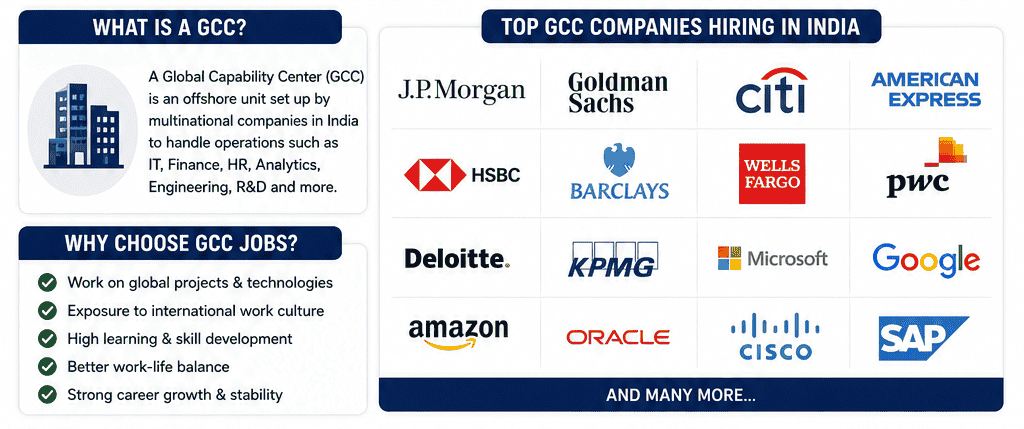
A Global Capability Centre, or GCC, is one of the most valuable and fastest-growing employers of Indian talent in 2026 — and most freshers do not understand the opportunity sitting in front of them. GCCs are not third-party outsourcing vendors like the IT services companies most freshers default to applying at. They are wholly-owned offshore units of global companies like Microsoft, Walmart, JPMorgan Chase, and Google, doing real product engineering, AI research, and strategic work — directly for the parent company, with global-standard pay.
This guide explains exactly what a GCC is, why it pays more than traditional IT services jobs, which companies are hiring freshers right now, what skills you need, and the precise strategy to get hired — because GCC hiring works very differently from the mass campus drives most freshers are used to.
MUST READ: Top 50 International Companies Hiring Remote Jobs in 2026 for India & APAC Region Read Now
Top 12 Work From Home Jobs in 2026 for Freshers — Real Salaries, Skills & Where to Apply
GCC Jobs in India — Quick Facts at a Glance (2026)
| Detail | Information |
| Total GCCs operating in India | Over 1,700 centres across major and emerging cities |
| Total professionals employed | 1.9+ million professionals currently |
| New jobs expected in 2026 | 4.25 – 4.5 lakh new jobs this year alone |
| Projected employment by 2030 | 2.5 – 2.8 million professionals (1 million net new jobs) |
| Salary premium over IT services | 12% to 20% higher for comparable tech roles |
| Average annual salary increment (2026) | 10.4% — highest among all employer categories in India |
| Fresher hiring intent | 64% of GCCs plan up to a 20% increase in fresher hiring |
| Internship to full-time conversion rate | 40% to 70% — far higher than typical IT services companies |
| Top hiring cities | Bengaluru (880+ GCCs), Hyderabad (355+), Pune and Mumbai (720+ combined), Delhi NCR (465+), Chennai |
| Live GCC job openings (June 2026) | 11,884+ on Naukri; 12,384+ fresher-specific listings on foundit.in |
What Is a GCC? (And Why It Is Different From an IT Services Company)
A Global Capability Centre is a wholly-owned offshore unit that a multinational company sets up in India to run strategic business functions for its global operations. Think of it as the company’s own office in India — not an outsourced vendor working on a contract. You would be a direct employee of Microsoft, Walmart, or JPMorgan Chase, not an employee of a vendor company providing services to them.
GCCs are also known by several other names depending on the company and industry: Centre of Excellence (CoE), Global In-house Centre (GIC), Captive Centre, Global Competency Centre, or Shared Services Centre (SSC). If you see any of these terms in a job posting, you are looking at a GCC role.

GCC vs IT Services Company — Key Differences
| Factor | GCC (e.g., Microsoft India, Walmart Global Tech) | IT Services Company (e.g., TCS, Infosys, Wipro) |
| Ownership Structure | Wholly owned by the parent multinational company | Independent Indian company providing services to multiple clients |
| Who You Work For | Directly for the global brand — same internal systems as US/UK/EU teams | Wipro/TCS/Infosys, who staff you on a client’s project |
| Type of Work | Core product engineering, R&D, strategic decision-making | Often maintenance, support, or staff augmentation for client systems |
| Salary (Comparable Role) | 12% to 20% higher on average | Baseline — lower than GCC for the same skill level |
| Career Mobility | Internal mobility to parent company HQ in some cases | Limited to internal company hierarchy and client rotations |
| Brand on Resume | Microsoft, Google, Walmart, JPMorgan Chase — globally recognised | TCS, Infosys, Wipro — recognised but viewed differently by global recruiters |
| Hiring Volume | Smaller, more selective, often via referral or campus partnership | Mass campus hiring — tens of thousands per cycle |
| Job Security Perception | High — captive units tied to long-term parent company strategy | High — but more exposed to client contract fluctuations |
Important Mindset Shift: A GCC role at Microsoft India Development Center or Walmart Global Tech India is not a ‘backup option’ compared to a product company job — it often pays better and offers more strategic work than many product-company roles. The misconception that GCCs are just ‘glorified back offices’ is outdated. In 2026, 92% of GCC leaders report their centres contribute far beyond cost savings, and 87% own end-to-end global processes for their parent company.
Why GCC Hiring Is Booming in India in 2026
Three decades ago, global companies set up India operations primarily to cut costs. That era is over. The strategic role of GCCs has fundamentally changed, and understanding this shift helps explain why hiring is accelerating so rapidly:
- GCCs now own end-to-end global processes — not just isolated tasks farmed out from headquarters
- 45% of GCC leaders say their India centres participate directly in enterprise-wide decision-making, not just execution
- The dominant hiring focus has shifted from legacy IT maintenance toward Generative AI, advanced data analytics, and cloud computing
- Demand for AI specialists within GCCs has increased by over 300% compared to 2024
- Companies are moving from volume-based hiring to precision, skills-based recruitment — which favours candidates with demonstrable project work over pedigree alone
This shift directly benefits freshers with the right skill profile. GCCs are no longer just hiring experienced professionals for cost arbitrage — they are actively building fresh talent pipelines for genuinely strategic, high-growth functions.
Top GCC Companies Hiring in India — By Sector
Here are the major global companies operating GCCs in India, organised by sector, along with what they typically hire for. These are direct employer names to search for on LinkedIn and company career pages.
Technology and Cloud
| Company | Cities | Typical Focus Areas |
| Microsoft India Development Center | Hyderabad, Bengaluru, Noida | Product development, AI research, Azure cloud solutions |
| Google India | Bengaluru, Hyderabad | Search, Android, AI/ML research, cloud engineering |
| Amazon Development Center / AWS India | Bengaluru, Hyderabad, Chennai | AWS cloud services, e-commerce engineering, machine learning, logistics tech |
| Apple India | Hyderabad, Bengaluru | Maps development, AI projects, design and engineering |
| SAP Labs India | Bengaluru (largest R&D hub outside Germany) | Enterprise ERP systems, cloud platforms, business intelligence tools |
| Intel India | Bengaluru | Semiconductor R&D, chip design, processor validation, AI and IoT |
| Cisco | Bengaluru | Enterprise networking systems, cybersecurity frameworks, cloud-native infrastructure |
BFSI (Banking, Financial Services, Insurance)
| Company | Cities | Typical Focus Areas |
| JPMorgan Chase India | Mumbai, Bengaluru | Compliance, financial analytics, fraud detection, banking technology |
| Goldman Sachs | Bengaluru, Hyderabad | Investment banking technology, risk analytics, engineering |
| HSBC | Bengaluru, Pune | Digital banking platforms, risk management, technology development |
| Standard Chartered Bank | Bengaluru, Chennai | Banking technology, retail and corporate banking systems |
| Citi | Mumbai, Pune | Financial technology, risk management, global banking operations |
| Barclays | Pune, Mumbai | Investment banking tech, risk and compliance systems |
| American Express | Pune, Gurugram | Payments technology, fraud and risk, customer experience platforms |
| BNY Mellon | Pune, Chennai | Asset management technology, custody and fund services |
Retail, E-Commerce and Consumer
| Company | Cities | Typical Focus Areas |
| Walmart Global Tech India | Bengaluru, Chennai | Supply chain technology, e-commerce platforms, retail data engineering |
| Target India | Bengaluru | Retail technology, merchandising systems, supply chain analytics |
| Renault Nissan | Chennai | Automotive engineering and design |
Healthcare and Pharma
| Company | Cities | Typical Focus Areas |
| UnitedHealth Group (Optum) | Hyderabad, Bengaluru, Noida | Healthcare technology, claims processing, data analytics |
| Wells Fargo | Hyderabad, Bengaluru | Banking technology, risk and compliance (note: Hyderabad also strong in healthcare GCCs like GE Healthcare) |
| Pfizer | Delhi NCR | Pharmaceutical R&D support, clinical data systems, healthcare analytics |
Consulting and Professional Services
| Company | Cities | Typical Focus Areas |
| Deloitte India (Global Delivery) | Hyderabad, Mumbai, Bengaluru | Audit, consulting, financial advisory, risk management |
| EY Global Delivery Services | Bengaluru, Gurugram | Assurance, tax, transaction advisory, consulting |
| Alvarez & Marsal | Gurugram | Business analysis, transformation strategy, technology consulting |
Search Tip: When job hunting, search LinkedIn and Naukri directly for these company names plus ‘India’ rather than searching generically for ‘GCC jobs’ — many of these companies do not always label their listings with the word ‘GCC,’ even though that is exactly what their India centre is.
GCC Hiring by City — Where to Focus Your Job Search
| City | Number of GCCs | Best For | Notable Employers |
| Bengaluru | 880+ (largest hub) | Software engineering, AI/ML, cloud, semiconductor design | Microsoft, Google, Amazon, Intel, SAP Labs, JPMorgan Chase |
| Hyderabad | 355+ (fastest growing) | Banking technology, healthcare, pharma, new media tech | Microsoft, Apple, Wells Fargo, GE, UnitedHealth Group |
| Pune and Mumbai | 720+ combined | Banking and financial services, manufacturing, engineering | Citi, Barclays, BNY Mellon, American Express, Standard Chartered |
| Delhi NCR | 465+ | Technology, healthcare, consulting | Samsung, Pfizer, Alvarez & Marsal |
| Chennai | 305+ | Automotive engineering, industrial design, SaaS | Walmart, Renault Nissan — lowest attrition rate among Tier-1 cities |
| Emerging Tier-2 cities (Coimbatore, Indore, GIFT City Ahmedabad, Jaipur) | Growing rapidly | Lower cost of living, growing talent pools, 15–20% lower operational costs for employers | Smaller GCC expansions and new centre setups |
Tier-2 City Opportunity: If you are not based in a metro, do not overlook this. Cities like Coimbatore, Indore, and GIFT City in Ahmedabad are seeing rapid GCC growth precisely because companies want lower operational costs without sacrificing talent quality. These hubs often have less competition per opening than Bengaluru or Hyderabad.
GCC Fresher Salary 2026 — What to Expect
| Role Level | Typical Salary Range (Annual) | Comparable IT Services Salary | Notes |
| Standard Fresher GCC Role | Rs. 6 – 10 LPA | Rs. 3.5 – 4.5 LPA (TCS/Infosys/Wipro base track) | Already 1.5x to 2x higher than standard IT services fresher packages |
| Premium GCC Cluster (AI/ML or BFSI mandate, specialised skills) | Rs. 10 – 18 LPA | Rs. 7 – 9 LPA (TCS Digital / Infosys SP track) | Requires demonstrable GenAI, data engineering, or specialised technical skill |
| Software Engineer L4 Equivalent (1-3 yrs experience, Bengaluru) | Rs. 25 – 45 LPA | Rs. 12 – 18 LPA at IT services equivalent level | Indicative — varies significantly by company and individual profile |
| Software Engineer L4 Equivalent (Hyderabad / Pune) | Rs. 20 – 38 LPA | Rs. 10 – 15 LPA at IT services equivalent level | Slightly lower than Bengaluru but still a major premium over IT services |
Why This Matters for Your Career: If you have already read our TCS vs Infosys vs Wipro Salary comparison, you know that standard IT services fresher packages sit between Rs. 3.36 and Rs. 4.5 LPA. A standard GCC fresher role at Rs. 6–10 LPA already beats this comfortably — and the premium AI/ML or BFSI-focused GCC tracks at Rs. 10–18 LPA roughly match or exceed even TCS Prime or Infosys Specialist Programmer L1 packages, while offering globally standardised work and direct brand-name employment.
Skills GCCs Want From Freshers in 2026
GCC hiring is increasingly skills-first rather than purely credential-based. According to industry survey data, GCCs prioritise specific technical foundations alongside emerging differentiator skills. Here is exactly what to build:
Must-Have Foundation Skills (Non-Negotiable)
- Strong programming fundamentals in Python or Java
- SQL to an intermediate level — joins, aggregations, and window functions specifically
- Basic understanding of REST APIs and version control using Git
- Clear written and verbal communication in English — GCCs require regular interaction with global teams across time zones
High-Value Differentiator Skills (Significant Premium)
- Any demonstrable GenAI or LLM knowledge — prompt engineering, RAG (Retrieval-Augmented Generation) architecture basics, or fine-tuning exposure immediately differentiates a fresher from the rest of the applicant pool
- Cloud fundamentals certification — AWS Cloud Practitioner or Microsoft Azure Fundamentals signal genuine seriousness to recruiters
- Domain expertise relevant to the GCC’s sector — basic finance knowledge for BFSI GCCs, basic healthcare data understanding for healthcare GCCs
- Data engineering and BI exposure — Power BI, Tableau, or basic data pipeline understanding
According to the EY GCC Pulse Survey 2025, the top niche skill priorities for GCC hiring in 2026 are AI/ML (cited by 63% of GCCs), domain expertise (66%), and data engineering and BI (54%). Freshers who can demonstrate even one of these areas through a personal project — not just a certificate — have a meaningful edge.Practical Project Idea: Build a simple RAG-based chatbot using LangChain and a free vector database like Chroma or FAISS, push the code to GitHub, and reference it directly in your resume and LinkedIn profile. This single project demonstrates GenAI exposure — one of the highest-value differentiator skills GCCs are actively screening for in 2026
How GCC Hiring Actually Works — Why It Is Different From IT Services Campus Drives
This is the single most important thing for freshers to understand. GCCs do not recruit the way TCS, Infosys, or Wipro do. There are no mass campus drives sending ten thousand offer letters in a single day. The pipelines, interview formats, and preparation strategy are fundamentally different.
| Aspect | GCC Hiring Approach |
| Primary Hiring Channels | Referrals, LinkedIn outreach, and structured campus partnerships — many roles fill before ever being publicly posted |
| Visibility of Openings | Limited — GCCs do not always advertise openly; by the time a role appears on a job board, internal candidates may already be in process |
| Best Early Signal | Company expansion announcements — when a GCC announces 500+ new seats in a city, their hiring pipeline activates within weeks, often before any job is formally posted |
| Campus Hiring Programs | Yes — many GCCs run structured campus hiring specifically for fresh graduates, often through targeted college partnerships rather than open drives |
| Internship Pathway | The single highest-conversion pathway — GCC internships (2–6 months) convert to full-time Pre-Placement Offers (PPOs) at a rate of 40–70% |
| Assessment Method | Increasingly skills-based — online coding assessments, portfolio reviews, and practical problem-solving evaluations rather than degree-based screening alone |
| Timeline for Campus-Track Hiring | Typically 3–6 weeks from application to offer |
| Timeline for Lateral/Experienced Hiring | Typically 4–8 weeks; newly establishing GCCs may move faster (2–3 weeks) when under pressure to hit headcount targets |
The Single Best Strategy: Treat any GCC internship offer as a 3-month interview, not just a resume line. Given the 40–70% internship-to-PPO conversion rate at top GCCs, landing an internship is often a far more reliable path to a full-time GCC role than applying directly for full-time positions, which face significantly higher competition and stricter experience screening.
How to Get Hired at a GCC — Step-by-Step Strategy for Freshers
- Identify your target sector first: Decide whether you want technology (Bengaluru-focused), BFSI (Mumbai/Pune-focused), or healthcare (Hyderabad-focused) — this determines which companies and cities to prioritise in your search.
- Build the non-negotiable foundation skills: Python or Java, SQL to an intermediate level, Git, and REST API basics. Do not skip this step even if you are targeting a non-technical GCC role — basic technical literacy is now expected across most GCC functions.
- Add one high-value differentiator project: A simple GenAI project (chatbot, RAG pipeline), a cloud certification (AWS Cloud Practitioner is free to study for), or a data analytics dashboard using Power BI. Document it clearly on GitHub or in your portfolio.
- Set LinkedIn alerts for target companies: Follow Microsoft India, Walmart Global Tech, JPMorgan Chase India, and your other target GCCs directly on LinkedIn. Many roles are shared first through company pages and employee referral networks before appearing on job boards.
- Watch for expansion announcements: When a GCC announces a new centre setup or a significant seat expansion in a city, their hiring pipeline activates within weeks. Track GCC-focused news sources and industry reports to catch these signals early — applying right after an expansion announcement, before the role is formally posted, significantly improves your odds.
- Apply for internships aggressively: Given the 40–70% PPO conversion rate, a 2–6 month GCC internship is one of the highest-leverage moves available to a fresher. Apply to multiple GCC internship programmes even if you already have a full-time offer elsewhere — the long-term trajectory is often stronger.
- Prepare for skills-based assessment: Practice coding assessments on platforms like HackerRank or LeetCode (easy to medium difficulty), and be ready to discuss your portfolio projects in depth — GCCs increasingly evaluate practical problem-solving over rote interview answers.
- Leverage referrals wherever possible: Since GCCs fill many roles through referrals before public posting, reach out to any contacts — college seniors, LinkedIn connections, alumni networks — who work at your target GCCs and request a referral. This is significantly more effective than cold applications for GCC roles specifically.
5 Mistakes Freshers Make When Targeting GCC Jobs
| Mistake | Why It Hurts | What to Do Instead |
| Assuming GCC means low-quality outsourcing work | Causes freshers to overlook some of the highest-paying, most strategic employers in India in 2026 | Research the specific GCC and its mandate — many run core product engineering and AI research, not back-office support |
| Only checking job boards, never company career pages directly | GCCs fill many roles through referrals and direct outreach before public posting | Visit target company India career pages weekly and set Google Alerts for ‘company name + India + hiring’ |
| Applying without any differentiator skill | Skills-based GCC hiring increasingly screens out generic resumes with no demonstrable project work | Build at least one GenAI, cloud, or data project before applying to premium GCC clusters |
| Ignoring internship listings in favour of full-time roles only | Misses the single highest-conversion pathway into a full-time GCC role (40–70% PPO rate) | Apply to GCC internships even while pursuing other full-time offers — treat it as a 3-month interview |
| Skipping Tier-2 city opportunities | Overlooks lower-competition openings in fast-growing hubs like Coimbatore, Indore, and GIFT City | Include Tier-2 GCC hubs in your search — competition per opening is often significantly lower than Bengaluru or Hyderabad |
Frequently Asked Questions
What does GCC stand for and what does it actually mean?
GCC stands for Global Capability Centre — a wholly-owned offshore unit that a multinational company sets up in India to handle strategic business functions for its global operations, such as research and development, product engineering, data analytics, finance operations, or customer experience. Unlike an IT services vendor, a GCC employee works directly for the parent company. GCCs are also referred to as Centres of Excellence (CoE), Global In-house Centres (GICs), Captive Centres, or Shared Services Centres (SSCs) — these terms are used interchangeably depending on the company and sector.
Is a GCC job better than a job at TCS, Infosys, or Wipro?
For comparable roles, GCC jobs generally pay 12% to 20% more than IT services companies and offer a 10.4% average annual increment in 2026, the highest among employer categories. GCC employees work directly for globally recognised brands like Microsoft, Walmart, or JPMorgan Chase rather than being staffed onto client projects through a vendor company. That said, IT services companies like TCS hire in far greater volume through mass campus drives, making them more accessible for freshers without a strong skill differentiator. The better choice depends on your skill profile, target sector, and whether you can access GCC hiring channels like internships and referrals.
Can a fresher with an average academic record get a GCC job?
Yes, increasingly so. GCC hiring in 2026 has shifted decisively toward skills-based assessment over credential screening. Online coding assessments, portfolio reviews, and practical problem-solving evaluations now matter more than which college you attended or your exact CGPA, provided you meet the basic eligibility threshold most companies set. A fresher from a Tier-2 college with a strong GitHub portfolio and demonstrable Python, SQL, and one differentiator skill like GenAI or cloud fundamentals has a genuinely competitive shot at GCC roles that a similar fresher relying purely on academic pedigree would not.
Which city is best for GCC jobs in India in 2026?
Bengaluru remains the largest GCC hub with over 880 centres, dominant in software engineering, AI/ML, and semiconductor design. Hyderabad is the fastest-growing Tier-1 GCC city, strong in banking technology and healthcare. Pune and Mumbai combined host over 720 GCCs, concentrated in banking and financial services. Chennai has the lowest attrition rate among Tier-1 GCC cities and leads in automotive engineering. For freshers seeking lower competition, emerging hubs like Coimbatore, Indore, and GIFT City in Ahmedabad are growing rapidly and offer 15–20% lower operational costs for employers, which often translates to faster hiring decisions.
How is a GCC internship different from a regular internship?
A GCC internship typically runs 2 to 6 months and offers significantly higher conversion to a full-time role compared to internships at other types of companies — the Pre-Placement Offer (PPO) conversion rate at top GCCs ranges from 40% to 70%, well above typical IT services or startup internship conversion rates. Because GCCs often fill full-time roles through internal pipelines and referrals before public posting, a GCC internship functions as an extended, real-world interview. Treat every task during the internship as a direct input into your final hiring decision, not just a resume credential to collect.
What is the difference between a GCC and a Centre of Excellence (CoE)?
In most cases, these terms refer to the same underlying structure. Centre of Excellence (CoE), Global In-house Centre (GIC), Captive Centre, Global Competency Centre, and Shared Services Centre (SSC) are all alternative names used by different companies for what is functionally a Global Capability Centre. The naming choice usually reflects the specific company’s internal terminology or the particular function the centre specialises in, rather than indicating a fundamentally different employment structure or career opportunity.
Do GCCs offer remote work or work-from-home options?
Most GCC roles in India are based on-site or hybrid at the company’s established campus locations in cities like Bengaluru, Hyderabad, Pune, or Chennai, given the collaborative, cross-time-zone nature of the work and the strategic, often confidential projects involved. Fully remote GCC roles are less common than at remote-first international companies, though hybrid arrangements (2–3 days in office) have become standard at many GCCs since 2023. Always confirm the specific work arrangement during your interview process, as policies vary significantly by company and role.
Final Thoughts — Should You Target GCC Jobs in 2026?
For most ambitious freshers, the answer is a clear yes — but with a different strategy than the one you would use for TCS, Infosys, or Wipro. GCCs represent one of the most significant and currently underexploited opportunities in the Indian job market: 4.25 to 4.5 lakh new jobs in 2026 alone, a genuine salary premium over traditional IT services, and direct employment with globally recognised brands, all without needing to relocate outside India.
The path is different, though. Mass campus applications that work for IT services hiring will not work the same way for GCCs. Success here comes from building the right foundational and differentiator skills, watching for expansion announcements, prioritising internships as your highest-leverage entry point, and using referrals wherever you can access them.
Start today: pick one sector — technology, BFSI, or healthcare — pick one city from this guide, and follow three target companies directly on LinkedIn. Build one differentiator project over the next 30 days. The freshers who understand this hiring system in 2026 will be the ones working directly for Microsoft, Walmart, and JPMorgan Chase from Indian soil, while their peers are still only applying to the same five IT services companies everyone else is applying to.


One Comment