
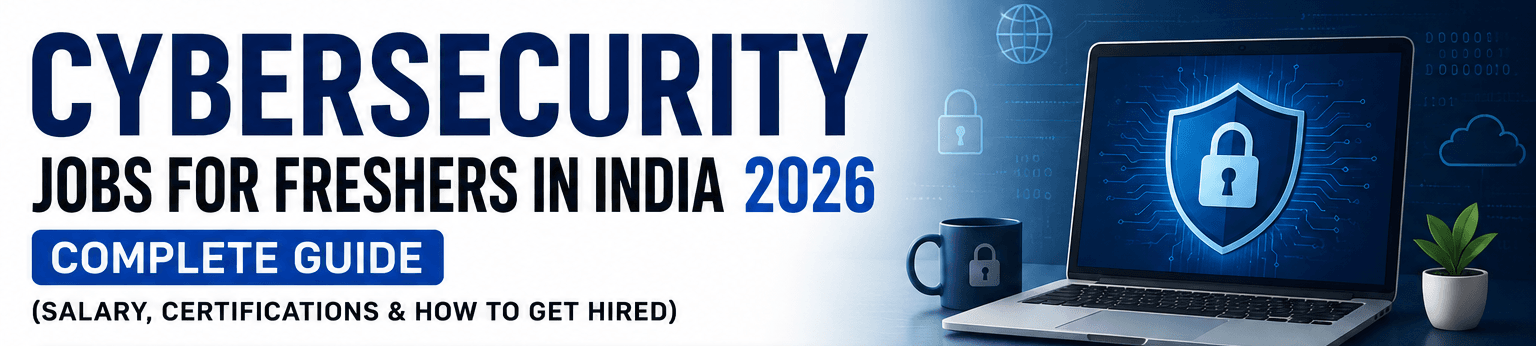
Cybersecurity Jobs for Freshers in India 2026 — Complete Guide (Salary, Certifications & How to Get Hired)
India has over one million unfilled cybersecurity positions in 2026. The country currently has only around 80,000 qualified cybersecurity experts to fill them. That gap — one million jobs, eighty thousand qualified people — is not a statistic. It is an open door for every fresh graduate willing to spend 60 to 90 days building the right skills.
Cybersecurity is not like most technology careers. You do not need five years of experience before you can start earning well. You do not need a CS degree from a premium college. You do not need to wait for a campus placement drive. Entry-level cybersecurity roles like SOC Analyst, VAPT Analyst, and GRC Associate are actively filled by freshers with the right certifications and hands-on lab experience — and they pay 30 to 50 percent more than equivalent general IT roles from day one.
This guide covers everything a fresher needs to understand about cybersecurity careers in India in 2026 — what the roles actually involve, exactly what the salary numbers look like across companies and cities, which certifications produce the highest ROI, which companies are hiring right now, and the exact step-by-step path to get your first cybersecurity job even with zero prior experience.
Cybersecurity in India — Quick Facts at a Glance (2026)
| Metric | Data (2026) |
| Unfilled cybersecurity positions in India | Over 1 million — growing every year |
| Currently qualified professionals available | Approximately 80,000 — a massive gap |
| Global unfilled positions | 3.5 million globally by 2025 — structural shortage, not temporary |
| Annual industry growth rate | 18% to 22% per year — among the fastest in all of IT |
| Companies increasing cybersecurity budgets | 93% of Indian companies — with 17% planning increases of 15% or more |
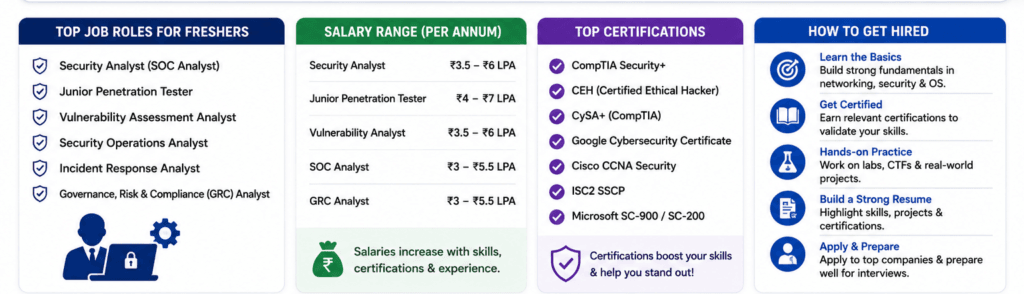
| Entry-level salary range (no certification) | Rs. 3.5 – 5 LPA |
| Entry-level salary range (with CEH or Security+) | Rs. 6 – 8 LPA — 15% to 25% premium over uncertified peers |
| Entry-level salary range (with internship + certification) | Rs. 7 – 10 LPA at the higher end of the bracket |
| Salary vs general IT fresher | 30% to 50% higher — a typical IT fresher earns Rs. 3–5 LPA vs cybersecurity fresher at Rs. 5–8 LPA |
| DPDP Act impact | India’s Digital Personal Data Protection Act has made compliance a board-room priority — GRC roles are surging |
| GCC cybersecurity jobs (2026) | GCCs alone projected to create 500,000+ positions — many in cybersecurity and platform engineering |
Key Mindset Point: In most tech careers, freshers wait for employers to lower the bar. In cybersecurity, the bar is already low — because there simply aren’t enough people. Companies are actively looking for flexible learners to fill the growing number of roles. The question is not whether they will hire freshers. It is whether you have the specific, demonstrable skills they are screening for.
Why Cybersecurity Is the Smartest Career Choice for Indian Freshers in 2026
Six factors make cybersecurity stand out from every other entry-level tech career available to Indian freshers right now:
- Structural demand that will not disappear: Unlike many IT services roles that face automation pressure, cybersecurity is made more complex — not simpler — by AI. AI-powered attacks require AI-aware defenders. The job is evolving, not shrinking.
- Premium salary from day one: Cybersecurity freshers start at Rs. 5–8 LPA versus Rs. 3.5–4.5 LPA for general IT freshers. This 30–50% salary premium applies from the very first role, not after 3 years of experience.
- No degree restriction: A dedicated cybersecurity degree is not required by any major Indian employer. B.Tech, B.Sc., BCA, Diploma in CS — all accepted. What matters is demonstrable skill through certifications and lab practice.
- Regulatory acceleration: India’s DPDP (Digital Personal Data Protection) Act, ISO 27001 mandates, and increasing RBI cybersecurity guidelines are forcing companies to build compliance and GRC teams urgently — directly creating entry-level demand in GRC Associate roles that do not require deep technical expertise.
- Direct path to international remote work: Cybersecurity is one of the strongest skills for international remote employment. Penetration testers and cloud security engineers with OSCP or AWS Security certifications are hired globally, at rates significantly above Indian domestic packages.
- Faster career growth than IT services: A fresher entering as an L1 SOC Analyst can realistically double their salary within 2 to 3 years through specialization — far faster than the typical IT services increment cycle.
Cybersecurity Roles for Freshers in India 2026 — Complete Breakdown
Cybersecurity covers dozens of specializations. Here are the roles that are both genuinely accessible to freshers and currently in high hiring demand:
1. SOC Analyst (Level 1) — Most Common Fresher Entry Point
| Detail | Information |
| What you do | Monitor networks and systems for security threats in real-time, investigate alerts, escalate confirmed incidents to senior analysts |
| Fresher salary | Rs. 4 – 7 LPA — higher at MNCs and GCCs, lower at Indian IT services companies |
| Tools you will use | SIEM tools (Splunk, IBM QRadar, Microsoft Sentinel), endpoint security tools, ticketing systems |
| 2026 shift in this role | AI now handles 40% of L1 triage — modern SOC analysts focus on threat hunting rather than just clicking through alerts |
| Who hires freshers | TCS, Infosys, IBM India, Accenture, GCCs in BFSI sector, dedicated cybersecurity firms |
| Path forward | L1 SOC → L2 SOC Analyst → Threat Intelligence Analyst → SOC Manager (Rs. 20–35 LPA in 4–5 years) |
2. VAPT Analyst (Vulnerability Assessment and Penetration Testing)
| Detail | Information |
| What you do | Test systems and applications for vulnerabilities before attackers find them, document findings, suggest remediation |
| Fresher salary | Rs. 4 – 8 LPA — higher at dedicated cybersecurity SMEs where hands-on work starts immediately |
| Tools you will use | Nessus, Burp Suite, Metasploit, Nmap, Kali Linux |
| Best learning platform | TryHackMe (free learning path) and Hack The Box — practical lab environments that employers specifically recognize |
| Who hires freshers | Sequretek, Certcube Labs, Nexavise Consulting, CloudSEK, Kratikal Tech, TAC Security — cybersecurity SMEs hire freshers faster than large IT companies for VAPT roles |
| Path forward | VAPT Analyst → Senior Penetration Tester → Red Team Lead (Rs. 25–50 LPA with OSCP certification) |
3. GRC Analyst (Governance, Risk and Compliance) — Best Entry Point for Non-Technical Freshers
| Detail | Information |
| What you do | Help organizations comply with security regulations — ISO 27001, DPDP Act, GDPR, PCI-DSS — through risk assessments, policy writing, and audit support |
| Why it is growing fast | India’s DPDP Act and increasing RBI/SEBI cybersecurity mandates are creating urgent demand for GRC professionals at every company that processes personal data |
| Fresher salary | Rs. 4 – 7 LPA — with GRC-specific certifications, Rs. 7 – 10 LPA |
| Technical depth required | Low to medium — strong written communication and attention to compliance frameworks matters more than coding ability |
| Who hires freshers | Big 4 consulting (Deloitte, EY, PwC, KPMG), BFSI companies, GCCs with compliance mandates, MNCs undergoing ISO 27001 audits |
| Path forward | GRC Analyst → Senior GRC Consultant → CISO (one of India’s highest-paid tech executives) |
GRC for Law Background: If you come from a law, commerce, or management background — not a CS or engineering degree — GRC is your most direct entry into cybersecurity. Knowledge of regulations, documentation, and audit processes is exactly what GRC roles need, and the DPDP Act specifically has created massive demand for professionals who understand both legal compliance and data security.
4. Cloud Security Engineer (Junior) — Highest Growth Track
| Detail | Information |
| What you do | Secure cloud infrastructure on AWS, Azure, or Google Cloud — manage IAM policies, monitor cloud misconfigurations, implement cloud-native security controls |
| Fresher salary | Rs. 6 – 10 LPA — cloud security roles command a premium even at fresher level |
| Prerequisite | Strong foundation in any cloud platform (AWS or Azure) — get cloud fundamentals cert first before adding security layer |
| Best certification path | AWS Cloud Practitioner → AWS Security Specialty OR Microsoft Azure Fundamentals → Azure Security Engineer |
| Who hires freshers | GCCs (Microsoft, Amazon, Google India centres), cloud-native startups, BFSI companies migrating to cloud |
| Path forward | Cloud Security Associate → Cloud Security Architect → Cloud CISO (Rs. 40–80 LPA at senior levels) |
5. Network Security Engineer (Junior)
| Detail | Information |
| What you do | Configure and monitor firewalls, VPNs, intrusion detection systems, and network access controls |
| Fresher salary | Rs. 3.5 – 6 LPA; with CCNA + security add-ons, Rs. 6 – 12 LPA within 2 years |
| Tools you will use | Cisco firewalls, Palo Alto, Wireshark, FortiGate, pfSense |
| Best certification | CCNA first → then CCNP with security specialization OR CompTIA Network+ → Security+ |
| Who hires freshers | ISPs, enterprise IT departments, government agencies, BFSI firms — highest volume of openings outside Bengaluru |
| Path forward | Network Security Engineer → Network Architect → Head of Network Security |
6. Cybersecurity Intern → Full-Time (Fastest Entry for Zero-Experience Freshers)
Multiple companies on the hiring list below offer structured cybersecurity internship programmes for 2 to 6 months that convert to full-time roles based on performance. Avenorr InfoTech, Certcube Labs, and several cybersecurity SMEs specifically welcome students and fresh graduates even before completion of their degrees. This is the fastest practical path for freshers who have zero prior experience — treat the internship as a 3-month extended technical interview and deliver consistently above expectations.

Cybersecurity Fresher Salary in India 2026 — Complete Data
By Role
| Role | Fresher Salary (0-2 yrs) | Mid-Level (3-5 yrs) | Senior (6+ yrs) |
| SOC Analyst L1/L2 | Rs. 4 – 7 LPA | Rs. 8 – 14 LPA | Rs. 15 – 25 LPA |
| VAPT / Ethical Hacker | Rs. 4 – 8 LPA | Rs. 10 – 18 LPA | Rs. 25 – 50 LPA |
| GRC Analyst | Rs. 4 – 7 LPA | Rs. 8 – 15 LPA | Rs. 18 – 35 LPA |
| Cloud Security Engineer | Rs. 6 – 10 LPA | Rs. 12 – 22 LPA | Rs. 25 – 50 LPA |
| Network Security Engineer | Rs. 3.5 – 6 LPA | Rs. 8 – 15 LPA | Rs. 18 – 30 LPA |
| Application Security Engineer | Rs. 6 – 10 LPA | Rs. 12 – 20 LPA | Rs. 25 – 45 LPA |
| Incident Response Analyst | Rs. 5 – 9 LPA | Rs. 10 – 18 LPA | Rs. 20 – 35 LPA |
| Security Architect | Not typically fresher role | Rs. 18 – 30 LPA | Rs. 35 – 70 LPA |
| CISO | Not a fresher role | Not a fresher role | Rs. 50 – 1.5 Cr+ LPA |
By City
| City | Fresher Cybersecurity Salary | Why |
| Bengaluru | Rs. 6 – 8 LPA | Highest concentration of GCCs and product companies — commands the highest starting packages |
| Mumbai | Rs. 6 – 8 LPA | Strong BFSI demand — banks and financial institutions pay premium for cybersecurity talent |
| Hyderabad | Rs. 5 – 7 LPA | Fast-growing GCC hub — Microsoft, Google, GE hiring aggressively |
| Pune | Rs. 5 – 7 LPA | BFSI and IT services — slightly lower than Mumbai but same industry mix |
| Delhi NCR / Noida | Rs. 5 – 7 LPA | Government, BFSI, large enterprise demand |
| Chennai | Rs. 4.5 – 6.5 LPA | Growing GCC presence — Walmart, Renault — slightly lower than north but improving |
| Tier-2 cities (Indore, Coimbatore, Jaipur) | Rs. 3.5 – 5.5 LPA | Lower cost of living — effective purchasing power often comparable to metro roles |
| Remote (Indian clients) | Rs. 4 – 6 LPA | Growing category — cybersecurity SMEs and startups increasingly offer remote |
| Remote (International clients) | USD 15 – 40/hour | Rs. 1.3 – 3.5 lakh/month — transformative for experienced professionals |
Certification Premium on Starting Salary
| Certification Status | Expected Starting Salary |
| No certification, no hands-on lab experience | Rs. 3.5 – 4.5 LPA — bottom of the range |
| CompTIA Security+ or ISC2 CC (entry-level) | Rs. 5 – 7 LPA — immediate premium over uncertified peers |
| CEH (Certified Ethical Hacker) | Rs. 6 – 8 LPA — widely recognised in India, especially BFSI and government |
| Google Cybersecurity Certificate (Coursera) | Rs. 5 – 7 LPA — growing recognition, accessible path for non-CS graduates |
| AWS Security Specialty or Azure Security Engineer | Rs. 7 – 10 LPA — significant premium for cloud security track |
| OSCP (Offensive Security Certified Professional) | Rs. 8 – 12+ LPA at fresher level — gold standard for penetration testing, immediate differentiation |
Negotiation Fact: Companies hire cybersecurity professionals faster than general IT roles because demand exceeds supply. A fresher with certifications and strong interview performance can negotiate Rs. 50,000 to Rs. 1,00,000 above the initial offer in most cases. Ask — the worst they can say is no, and in cybersecurity hiring, the answer is often yes.
Best Cybersecurity Certifications for Freshers in India 2026 — Ranked by ROI
MAJOR COURSES FOR COURSERA VISIT HERE FOR FULL COURSES FOR CYBER SECURITY
| Certification | Level | Cost (Approx.) | Time to Complete | Best For | Salary Impact |
| Google Cybersecurity Certificate (Coursera) | Beginner | Rs. 3,000/month (Coursera Plus) | 6 months part-time | Non-CS graduates, career switchers — lowest barrier entry | Rs. 5 – 7 LPA starting — recognized by 150+ employers globally |
| ISC2 CC (Certified in Cybersecurity) | Beginner | Free exam until ISC2 changes policy — check current pricing | 1 – 2 months self-study | First certification, especially for GRC and compliance track | Rs. 5 – 6 LPA — strong brand recognition |
| CompTIA Security+ | Entry-Level | USD 392 (approx. Rs. 33,000) exam voucher | 2 – 3 months self-study | All cybersecurity roles — most globally recognized entry cert | Rs. 5 – 7 LPA — 15–25% salary premium over uncertified peers |
| CEH (Certified Ethical Hacker) — EC-Council | Intermediate | Rs. 30,000 – 60,000 including training | 3 – 4 months with training | Penetration testing, ethical hacking — most popular in India for VAPT roles | Rs. 6 – 8 LPA — very widely recognized by Indian employers and government |
| AWS Cloud Practitioner → AWS Security Specialty | Beginner → Intermediate | Rs. 4,000 + Rs. 25,000 for Security Specialty exam | 3 – 4 months total path | Cloud security track specifically — best ROI for cloud-focused GCC roles | Rs. 7 – 10 LPA — strong premium at GCCs and cloud-native companies |
| OSCP (Offensive Security Certified Professional) | Advanced | USD 1,499 (approx. Rs. 1.25 lakh) — 90-day lab access included | 4 – 8 months serious preparation | Penetration testing at the highest level — gold standard globally | Rs. 8 – 15 LPA as a fresher — immediate senior-track eligibility |
Best First Certification for Indian Freshers in 2026: If you are starting with zero background, the Google Cybersecurity Certificate on Coursera is the most accessible. If you want maximum salary impact per rupee spent, CompTIA Security+ is the global standard. If you want the most widely recognized India-specific certification for VAPT roles, target CEH after building 3–4 months of lab practice on TryHackMe first.
Top Companies Hiring Cybersecurity Freshers in India 2026
Large IT and MNC Employers
| Company | What They Hire Freshers For | Salary Range | Where to Apply |
| TCS | Cybersecurity Analyst, SOC Analyst, Security Testing | Rs. 4 – 7 LPA | nextstep.tcs.com — look for cybersecurity roles specifically |
| Infosys | Security Analyst, GRC Analyst, Cloud Security | Rs. 4 – 7 LPA | infosys.com/careers |
| Wipro | Cybersecurity roles via WILP and Elite track | Rs. 4 – 7 LPA | wipro.com/careers |
| HCL Technologies | SOC Analyst, Security Operations, Network Security | Rs. 4 – 7 LPA | hcltech.com/careers |
| IBM India | Security Operations, QRadar SIEM, Threat Intelligence | Rs. 6 – 10 LPA | ibm.com/careers — India |
| Accenture | Security Analyst, GRC, Cloud Security | Rs. 5 – 9 LPA | accenture.com/in-en/careers |
| Deloitte India | GRC, Risk Advisory, Cyber Risk roles | Rs. 7 – 12 LPA | deloitte.com/in — notable for GRC fresher hiring |
Dedicated Cybersecurity Companies — Fastest Hands-On Learning
| Company | Specialization | Why Good for Freshers |
| Quick Heal Technologies | Antivirus and endpoint security, India’s largest pure-play cybersecurity company | Structured fresher programme, campus hiring, strong training |
| K7 Computing | Endpoint security, threat research | Chennai-based, good for Tamil Nadu freshers |
| Sequretek | Enterprise security, SOC services | Active fresher hiring for SOC analyst roles |
| CloudSEK | AI-powered threat intelligence | Startup culture, fast learning, hands-on from Day 1 |
| Kratikal Tech | VAPT, Red Team, security audits | Best for freshers targeting penetration testing career |
| Certcube Labs | VAPT, cybersecurity training, internships | Explicitly hires and trains freshers, internship-to-full-time pathway |
| TAC Security | Vulnerability management platform | Ahmedabad-based, growing team, fresher-friendly |
| Nexavise Consulting | Cybersecurity consulting, compliance | Small team, broad exposure to multiple security domains from Day 1 |
GCC Advantage in Cybersecurity: If you have read our GCC Jobs 2026 guide, you know that GCCs are projected to create 500,000+ new positions in India — many specifically in cybersecurity. Microsoft India Development Center, Google India, Amazon AWS India, and JPMorgan Chase India all run active cybersecurity teams and hire for security engineering, cloud security, and threat intelligence roles. For higher starting packages (Rs. 8–15 LPA fresher-level), target GCC cybersecurity roles specifically.
Best Free Resources to Learn Cybersecurity in India 2026
| Resource | What You Learn | Why It Matters for Hiring |
| TryHackMe (tryhackme.com) | Browser-based hacking labs — SOC, VAPT, network security, Linux basics, complete beginner-friendly paths | The most commonly referenced practical platform in Indian cybersecurity job interviews — employers specifically ask about your TryHackMe profile |
| Hack The Box (hackthebox.com) | Real-world penetration testing challenges — harder than TryHackMe, used by advanced learners | Completing HTB machines is a strong portfolio signal for VAPT roles at SMEs and consulting firms |
| Google Cybersecurity Certificate on Coursera (audit free) | 8-course program covering security fundamentals, SIEM tools, Python automation, and threat response | Directly hirable — 150+ employer partners; audit for free if cost is a barrier |
| OWASP (owasp.org) | Top 10 web application vulnerabilities — the industry standard for application security knowledge | Every application security interview tests OWASP Top 10 knowledge — non-negotiable to learn this |
| Cybrary (cybrary.it) | Free courses on CompTIA Security+, CEH, ethical hacking, and SOC operations | Good supplement to TryHackMe for certification-aligned learning |
| Professor Messer YouTube | Free CompTIA Security+ video course — extremely thorough and updated | Most popular free path for Security+ exam preparation |
| Khan Academy — Computer Science | Networking, internet fundamentals, encryption basics | Builds foundational knowledge if you have zero CS background |
| SANS Cyber Aces (sans.org/cyberaces) | Networking, operating systems, and system administration fundamentals — free | SANS certification is the gold standard for advanced security — starting with free Cyber Aces is a smart entry |
How to Get a Cybersecurity Job with Zero Experience — 90-Day Plan
This plan assumes you are starting from complete zero — no prior cybersecurity knowledge, no certifications, no portfolio. It is designed for 2 to 3 hours of daily effort:
Month 1 — Foundation (Days 1–30)
- Start TryHackMe: Create a free account and complete the Pre-Security and Introduction to Cybersecurity paths. Do not skip these even if they feel basic — they build the vocabulary every employer expects you to have.
- Learn networking fundamentals: TCP/IP, DNS, HTTP/HTTPS, VPN basics. Professor Messer’s free CompTIA Network+ videos cover exactly what you need. Do not memorise — understand how the protocols actually work.
- Set up Kali Linux: Either as a virtual machine (free) or dual boot on your existing laptop. Getting comfortable with the Linux terminal is non-negotiable for any technical cybersecurity role.
- Start your certification study: Pick one — CompTIA Security+ (global recognition) or Google Cybersecurity Certificate (more accessible if you are non-CS). Begin structured daily study for it alongside your TryHackMe labs.
Month 2 — Skill Building and Portfolio (Days 31–60)
- Complete your chosen certification exam: Book it and take it by the end of Month 2. Having a completed certification changes how recruiters respond to your application fundamentally.
- Build your home lab: Set up a small practice network using free tools — VirtualBox + Kali Linux + a vulnerable machine from VulnHub. Document what you do and how you approach each challenge.
- Practice on VAPT labs: Complete 5 to 10 TryHackMe or Hack The Box ‘easy’ rated machines. Screenshot your methodology for each one — this becomes your portfolio.
- Create a write-up blog: Post your TryHackMe or Hack The Box solutions to Medium or a free GitHub Pages site. Two to three well-written write-ups demonstrate more practical ability than a degree certificate to many cybersecurity employers.
Month 3 — Job Search and Applications (Days 61–90)
- Build your LinkedIn profile with cybersecurity focus: Headline format: ‘Junior Cybersecurity Analyst | CompTIA Security+ | TryHackMe Top X% | VAPT Learner’. Include your certification, your TryHackMe profile link, and your write-up blog link prominently.
- Apply to cybersecurity SMEs first: Certcube Labs, Sequretek, Kratikal Tech, and similar firms hire freshers faster than large IT companies. Send direct applications through their career pages, not job aggregators.
- Apply for internships simultaneously: Even one paid cybersecurity internship at Rs. 10,000 to 25,000 per month builds the ‘real experience’ line on your resume that unlocks full-time roles at higher companies.
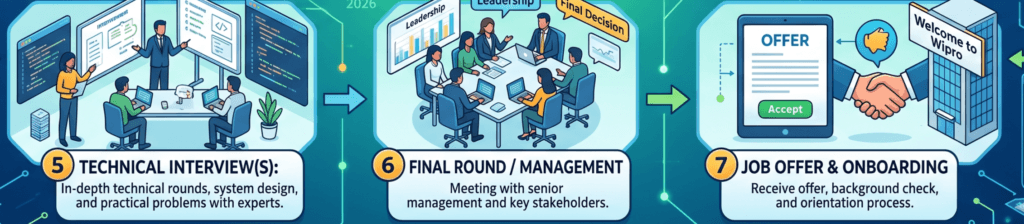
- Prepare for technical interviews: Every cybersecurity interview tests: networking fundamentals (TCP/IP, OSI model), OWASP Top 10 web vulnerabilities, basic Linux commands, and how you would respond to a specific security incident. Practise answering these aloud — not just reading them.
TryHackMe Profile as Your Portfolio: When you complete paths on TryHackMe, your public profile shows your rank percentile and completed challenges. Several Indian cybersecurity employers — including Certcube Labs and Sequretek — explicitly ask for your TryHackMe profile in their application forms. A top-25% TryHackMe ranking with a Security+ certification is a genuinely strong fresher application in this market.
5 Mistakes Freshers Make When Entering Cybersecurity in India
| Mistake | Why It Hurts | What to Do Instead |
| Studying theory without any lab practice | Cybersecurity interviews test hands-on ability — knowing the definition of a buffer overflow is not the same as having exploited one on TryHackMe | Do minimum 2 hours of TryHackMe or Hack The Box lab work for every 1 hour of theory study |
| Targeting only large IT companies (TCS, Infosys) | Large IT companies have slow, high-volume hiring processes — cybersecurity SMEs hire faster, give more hands-on experience, and build a stronger technical resume faster | Apply to cybersecurity-specific SMEs (Certcube, Sequretek, Kratikal) in parallel with large IT companies |
| Skipping networking fundamentals to jump to hacking | 80% of cybersecurity interview questions test networking basics — TCP/IP, OSI model, DNS, HTTP — before any advanced topic | Spend the full first 2 weeks on networking fundamentals before touching any security tool |
| Getting a certification without lab experience | A Security+ certificate with no practical exposure is immediately visible in any technical interview — employers test whether knowledge is applied, not just memorized | Always pair certification study with real lab work on the same topics — alternate study days and lab days |
| Applying only to full-time roles and ignoring internships | Cybersecurity SMEs hire freshers primarily through internship-to-full-time conversion — ignoring internships removes the highest-conversion pathway | Apply to every cybersecurity internship you can find on Internshala, LinkedIn, and direct company career pages — treat it as a 3-month interview |
Frequently Asked Questions
Can a non-CS fresher get a cybersecurity job in India in 2026?
Yes — and more easily than most non-CS freshers realize. No major Indian cybersecurity employer explicitly requires a CS degree. B.Tech in any stream, B.Sc., BCA, and even commerce or management graduates successfully enter cybersecurity through the GRC and compliance track, which requires regulatory and documentation skills rather than programming. For technical roles like VAPT and SOC analysis, what employers actually evaluate is certification and lab experience — both of which are accessible to anyone with basic computer literacy, a laptop, and consistent daily practice.
What is the starting salary for cybersecurity jobs for freshers in India in 2026?
Entry-level cybersecurity salary in India ranges from Rs. 3.5 LPA to Rs. 10 LPA depending on certification, role type, company size, and city. A fresher with no certification typically starts between Rs. 3.5 and Rs. 5 LPA. A fresher with CompTIA Security+ or CEH starts at Rs. 6 to Rs. 8 LPA. A fresher with AWS Security Specialty or OSCP can start at Rs. 8 to Rs. 12 LPA. Bengaluru and Mumbai consistently offer the highest starting packages. Cybersecurity freshers earn 30 to 50 percent more than equivalent general IT freshers from the very first role.
Which is the best certification for a cybersecurity fresher in India?
For the lowest barrier to entry with strong employer recognition: start with the Google Cybersecurity Certificate on Coursera (affordable, takes 6 months part-time, recognized by 150+ global employers). For maximum India-specific recognition and salary impact: CEH (Certified Ethical Hacker) is the most widely known in Indian BFSI and government hiring. For global recognition and the strongest salary premium: CompTIA Security+ is the most universally accepted entry-level cybersecurity certification worldwide. Build all three over your first year if possible — they stack well and each opens a different segment of the job market.
Is cybersecurity a good career for 2026 and beyond in India?
Yes — structurally, for reasons that will not reverse. The talent gap (1 million demand vs 80,000 supply) is widening, not closing. India’s DPDP Act, increasing RBI cybersecurity regulations, and GCC expansion are all creating structural demand that will persist through at least 2030. AI is making cybersecurity more complex, not simpler — which means demand will remain high even as AI automates other IT roles. The annual salary growth trajectory is among the steepest in Indian tech: a fresher starting at Rs. 5 LPA can realistically earn Rs. 25 to Rs. 40 LPA within 5 to 7 years through deliberate specialization and job switches at the right moments.
What is an L1 SOC Analyst and is it a good entry point?
An L1 (Level 1) Security Operations Center Analyst monitors networks and systems for security threats in real time, investigates automated alerts, and escalates confirmed incidents to L2 analysts for deeper investigation. It is the most common fresher entry point into cybersecurity in India and is actively hiring across TCS, Infosys, IBM India, GCCs, and dedicated cybersecurity firms. The work is repetitive at the L1 level — monitoring dashboards and triaging alerts — but the exposure to live threat data, SIEM tools, and real incident workflows builds the foundational understanding that makes every subsequent cybersecurity role easier to learn. The 2026 shift is that AI handles 40% of basic alert triage now, which means L1 analysts increasingly need to do actual threat hunting rather than just responding to alerts — making the role more interesting and career-building than it was even 2 years ago.
Which Indian cities have the most cybersecurity fresher jobs?
Bengaluru leads with the highest volume and the highest starting salaries, driven by GCCs and product companies. Mumbai has strong BFSI-driven demand — banks and financial institutions are among the most active cybersecurity hirers. Hyderabad is the fastest-growing cybersecurity hub driven by expanding GCCs. Pune has a strong mix of IT services companies and BFSI firms. Delhi NCR has government, defense-tech, and enterprise demand. Freshers in Tier-2 cities should not overlook emerging hubs — cybersecurity SMEs like TAC Security (Ahmedabad) and K7 Computing (Chennai) offer strong hands-on roles outside the four major metros, often with faster hiring and lower competition per opening.
How is cybersecurity hiring different from a TCS or Infosys campus placement drive?
The single most important difference is that cybersecurity hiring is skills-first rather than volume-first. Mass campus drives for TCS or Infosys test aptitude and communication and fill thousands of seats simultaneously. Cybersecurity hiring — even at the fresher level — tests specific, demonstrable technical knowledge through practical assessments, lab demonstrations, or tool-specific questions. Your TryHackMe profile, certification, and GitHub write-ups matter far more than your CGPA or college tier. Smaller cybersecurity SMEs also hire continuously throughout the year, not just during campus season — meaning you can apply in June and get hired by August rather than waiting for a single annual placement cycle.
The cybersecurity opportunity for Indian freshers in 2026 is as clear as any career data gets: one million unfilled positions, 80,000 qualified professionals, a 30 to 50 percent salary premium over general IT roles from day one, and a talent gap that is widening, not closing. The market is structurally tilted in your favor — if you take the right steps.
Those steps are not mysterious. Thirty days of TryHackMe and networking fundamentals. One certification by day sixty. A write-up portfolio and consistent applications by day ninety. The freshers who follow this path in 2026 will be the ones earning Rs. 6 to Rs. 10 LPA in their first role while their peers are still waiting for TCS NQT results at Rs. 3.36 LPA.
Pick your starting resource today — TryHackMe for free lab practice, or the Google Cybersecurity Certificate on Coursera for a structured certification path. Open either tab right now, create your account, and complete the first module before tonight. Everything else follows from that first hour.
MUST READ
- ‘GCC Jobs 2026’ → GCC Jobs in India 2026 for Freshers — Complete Guide (Salary, Top Companies & How to Get Hired)
- ‘TCS NQT’ → TCS NQT 2026: Registration Open, Eligibility, Exam Pattern, Syllabus & Complete Preparation Guide Check Now
- ‘WFH Jobs’ → Top 50 International Companies Hiring Remote Jobs in 2026 for India & APAC Region Read Now

2 Comments