

Remote hiring did not slow down after the return-to-office wave — it simply consolidated around a smaller group of companies that are genuinely committed to distributed teams. In 2026, this group is hiring more aggressively than ever, and India remains one of their top three sourcing regions alongside Eastern Europe and Latin America.
The opportunity is real and well documented. Remote-first companies like GitLab, Stripe, and Automattic post a significantly higher share of fully remote roles than the average company, and median pay for remote tech roles globally now carries a premium over equivalent hybrid or on-site positions. For a professional based in India, this premium is transformative — earning in USD or EUR while living on Indian costs changes the entire financial equation. This guide lists 50 international companies actively hiring remote employees from India and the wider APAC region in 2026 — organised by category, with the roles they typically hire for, approximate salary ranges, and where to find live openings. Whether you are a software engineer, a customer support specialist, a designer, or just starting your career, there is a realistic entry point on this list.
The State of International Remote Hiring in 2026
| Metric | 2026 Data |
| Experienced-level share of remote postings | Roughly 67% of remote roles target experienced professionals |
| Entry-level share of remote postings | Approximately 7% — smaller but real, concentrated in support and ops |
| Remote-first companies (entire org built around it) | Post about 47% of all roles as fully remote — more than double the all-listings average |
| Median salary for remote tech roles globally | USD 142,000 — a premium over hybrid and on-site equivalents |
| Time to fill a remote-first role | Roughly 14 days on average vs 28 days for hybrid roles |
| Application volume on remote postings | Around 4x the applications of equivalent on-site roles — apply within 72 hours of posting |
| Top APAC countries for remote work | Singapore (highest remote work rate globally at 23%), Australia, Japan, South Korea, and India |
| Strongest hiring categories | Software engineering, customer success, product management, data and AI, healthcare operations |
Important Reality Check: Remote-first companies like GitLab and Automattic are well known, which means competition is intense — these listings can receive hundreds of applications within days. Apply within 72 hours of a posting going live, tailor your resume specifically to the role, and do not rely on these alone. The mid-sized and lesser-known companies further down this list often have significantly better odds for Indian applicants.
Category 1: Fully Remote-First Tech Companies (Companies 1–10)
These companies were built remote-first from day one. They have transparent salary bands, established global payroll infrastructure, and explicitly welcome applicants from any country, including India.
| # | Company | Known For | Typical Roles for India/APAC | Approx. Salary Range (USD) |
| 1 | GitLab | DevOps platform, fully remote since founding | Software Engineer, DevOps, Product Manager, Support | $50,000 – $180,000+ |
| 2 | Automattic | WordPress.com, WooCommerce, Tumblr | Developer, Designer, Happiness Engineer (support), Writer | $90,000 – $200,000+ |
| 3 | Zapier | No-code automation platform, never had an office | Engineer, Customer Champion, Marketing, Product | $70,000 – $170,000 |
| 4 | Atlassian | Jira, Confluence, Trello — Team Anywhere program | Software Engineer, Product Manager, Support Engineer | $80,000 – $190,000 |
| 5 | Doist | Todoist and Twist — async-first culture | Engineer, Designer, Customer Support | $55,000 – $140,000 |
| 6 | Buffer | Social media tooling, 4-day work week pioneer | Engineer, Marketing, Customer Advocate | $60,000 – $130,000 |
| 7 | InVision | Digital product design platform | Product Designer, Engineer, Customer Success | $65,000 – $150,000 |
| 8 | Hotjar | Website heatmap and analytics tool | Engineer, Data Analyst, Customer Support | $55,000 – $135,000 |
| 9 | Toptal | Elite freelance talent network (top 3% only) | Developer, Designer, Finance Expert (contract-based) | $40 – $150/hour |
| 10 | Crossover | Remote staffing for high-performing professionals | Software Engineer, Product Manager, Operations | $60,000 – $150,000 |
GitLab Tip: GitLab publishes its entire compensation calculator and 2,000+ page remote work handbook publicly. Before applying, read their handbook at about.gitlab.com/handbook — referencing specific values from it in your application is one of the most effective ways to stand out.
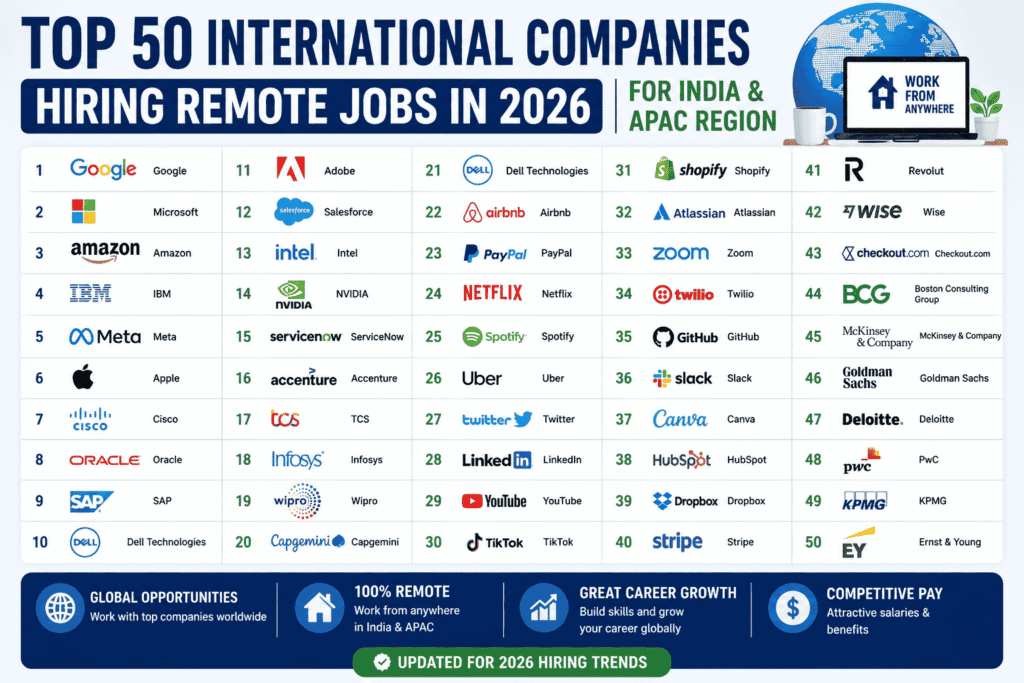
Category 2: SaaS and Product Companies Hiring Globally (Companies 11–20)
These are established SaaS and product companies that maintain significant remote and distributed teams, even if not 100% remote-first like Category 1. Roles for India and APAC are typically engineering, support, and growth-focused.
| # | Company | Known For | Typical Roles for India/APAC | Approx. Salary Range (USD) |
| 11 | Shopify | E-commerce platform, Digital by Default policy | Engineer, Support Advisor, Product Manager | $65,000 – $170,000 |
| 12 | HubSpot | CRM and inbound marketing software | Sales, Support, Marketing, Engineer | $50,000 – $140,000 |
| 13 | Canva | Design platform — large APAC presence (Sydney HQ) | Engineer, Designer, Marketing, Support | $60,000 – $160,000 |
| 14 | Notion | Productivity and workspace software | Engineer, Designer, Community Manager | $70,000 – $180,000 |
| 15 | Dropbox | Cloud storage and file collaboration | Engineer, Product Manager, Support | $75,000 – $190,000 |
| 16 | Webflow | No-code website builder | Engineer, Designer, Customer Support | $60,000 – $150,000 |
| 17 | Airtable | No-code database and collaboration tool | Engineer, Product Manager, Operations | $70,000 – $175,000 |
| 18 | Elastic | Search and data analytics (Elasticsearch) | Software Engineer, Solutions Architect, Support | $70,000 – $185,000 |
| 19 | GitHub | Code hosting platform — open-source friendly hiring | Software Engineer, Developer Advocate, Support | $80,000 – $200,000 |
| 20 | Mozilla | Firefox browser, internet health nonprofit-adjacent | Engineer, Product Manager, Policy roles | $65,000 – $160,000 |
Strategy for GitHub: Many Indian engineers land roles at GitHub by first becoming visible open-source contributors. A strong public contribution history on real GitHub repositories often carries more weight than a traditional resume for engineering roles here.
Category 3: Fintech and Payments Companies (Companies 21–28)
Fintech is one of the most aggressive remote-hiring sectors in 2026, with strong demand for backend engineers, compliance specialists, and risk analysts who can work across time zones.
| # | Company | Known For | Typical Roles for India/APAC | Approx. Salary Range (USD) |
| 21 | Stripe | Global payments infrastructure | Backend Engineer, Product Manager, Risk Analyst | $90,000 – $220,000 |
| 22 | Revolut | Digital banking and fintech super-app | Engineer, Compliance, Customer Operations | $55,000 – $150,000 |
| 23 | Coinbase | Cryptocurrency exchange platform | Engineer, Compliance Analyst, Support | $70,000 – $190,000 |
| 24 | Deel | Global payroll and HR infrastructure | Sales, Compliance, Engineer, Operations | $50,000 – $150,000 |
| 25 | Remote.com | Global employment and payroll platform | Engineer, Customer Success, HR Operations | $55,000 – $155,000 |
| 26 | Binance | Cryptocurrency exchange, globally distributed team | Engineer, Compliance, Customer Support, Marketing | $45,000 – $170,000 |
| 27 | Wise (TransferWise) | International money transfer platform | Engineer, Risk Analyst, Customer Support | $55,000 – $150,000 |
| 28 | Rippling | HR, IT, and payroll platform | Engineer, Implementation Specialist, Support | $60,000 – $165,000 |
Category 4: AI and Data Companies (Companies 29–35)
This is the fastest-growing remote hiring category in 2026. AI labs and data infrastructure companies need engineers, researchers, and increasingly, data annotation and AI training specialists — many of which are entry-accessible for Indian applicants.
| # | Company | Known For | Typical Roles for India/APAC | Approx. Salary Range (USD) |
| 29 | Hugging Face | Open-source AI and machine learning hub | ML Engineer, Researcher, Developer Advocate | $80,000 – $220,000 |
| 30 | Appen | AI training data and data annotation services | Data Annotator, AI Trainer, Quality Analyst | $10,000 – $45,000 (project-based) |
| 31 | TELUS Digital (formerly Lionbridge) | AI data services, content moderation, CX solutions | Data Annotator, Content Moderator, Customer Support | $8,000 – $40,000 |
| 32 | Scale AI | Data labeling and AI infrastructure | Data Annotator, ML Engineer, Quality Reviewer | $12,000 – $60,000 |
| 33 | Turing | Remote software developer marketplace, AI-vetted | Software Engineer, ML Engineer (contract and full-time) | $30,000 – $150,000 |
| 34 | Andela | Global tech talent network, strong India presence | Software Engineer, Engineering Manager | $35,000 – $130,000 |
| 35 | Cloudflare | Internet infrastructure and security | Engineer, Solutions Architect, Support | $70,000 – $190,000 |
Best Entry Point for Freshers: Appen, TELUS Digital, and Scale AI are the most accessible companies on this entire list for freshers with no prior experience. AI data annotation roles require careful attention to detail rather than technical degrees, and these companies are actively expanding Indian remote teams in 2026 to meet surging AI training data demand.
Category 5: Customer Support, BPO, and Operations (Companies 36–43)
This category offers the highest volume of entry-level remote openings for India. These companies regularly hire freshers and early-career professionals for voice, chat, and email-based support roles — no coding required.
| # | Company | Known For | Typical Roles for India/APAC | Approx. Salary Range (INR/Month) |
| 36 | Genpact | Global professional services and BPM, strong India operations | Data Analyst, Process Associate, Customer Support, AI Solutions | Rs. 20,000 – Rs. 60,000 |
| 37 | Concentrix | Global CX and BPO services | Customer Support (voice/chat), Technical Support, Team Lead | Rs. 18,000 – Rs. 45,000 |
| 38 | TELUS International | Digital CX, content moderation, trust and safety | Customer Support, Content Moderator, Team Lead | Rs. 20,000 – Rs. 50,000 |
| 39 | Tech Mahindra | IT services and BPO, large remote-friendly teams | Support Associate, Data Entry, IT Helpdesk | Rs. 18,000 – Rs. 42,000 |
| 40 | Working Solutions | US-based BPO with global remote contractor network | Customer Service Rep, Technical Support | $10 – $20/hour |
| 41 | Teleperformance | Global CX and customer experience outsourcing | Customer Support, Sales Support, Team Lead | Rs. 18,000 – Rs. 48,000 |
| 42 | Sutherland Global | BPO and digital transformation services | Customer Support, Back Office, Process Specialist | Rs. 18,000 – Rs. 45,000 |
| 43 | WNS Global Services | Business process management, India-strong presence | Process Associate, Data Analyst, Customer Support | Rs. 20,000 – Rs. 55,000 |
Best for Freshers: This entire category is the most realistic starting point for 2024–2026 batch graduates with zero prior experience. Genpact, Concentrix, and TELUS International all run structured fresher hiring programmes with training included — apply directly through their career portals rather than third-party job boards for the best response rates.
MUST READ: Top 12 Work From Home Jobs in 2026 for Freshers — Real Salaries, Skills & Where to Apply
Category 6: Creative, Marketing, and Content Companies (Companies 44–50)
These companies hire remote marketing, content, design, and creative professionals — strong fits for non-technical Indian professionals and freelancers transitioning to full-time remote roles.
| # | Company | Known For | Typical Roles for India/APAC | Approx. Salary Range (USD) |
| 44 | Spotify | Music streaming — distributed team model (Work From Anywhere) | Content Strategist, Data Analyst, Engineer, Marketing | $60,000 – $160,000 |
| 45 | Visual discovery platform | Content Strategist, Engineer, Trust and Safety | $65,000 – $170,000 | |
| 46 | Community and discussion platform | Engineer, Trust and Safety, Content Policy | $70,000 – $175,000 | |
| 47 | Quora | Q&A knowledge platform | Engineer, Content Operations, Trust and Safety | $55,000 – $150,000 |
| 48 | Wikimedia Foundation | Nonprofit behind Wikipedia — globally distributed team | Engineer, Program Manager, Community Liaison | $55,000 – $140,000 |
| 49 | Twilio | Cloud communications platform (APIs for SMS, voice) | Engineer, Developer Relations, Solutions Engineer | $70,000 – $190,000 |
| 50 | GoDaddy | Domain registration and web hosting, large remote teams | Engineer, Customer Care, Marketing, Designer | $50,000 – $150,000 |
How to Apply for International Remote Jobs from India — Step by Step
- Build a remote-ready resume: Highlight async communication, self-management, and any prior remote or freelance experience prominently. If you have none, mention freelance projects, open-source contributions, or self-directed learning that demonstrates independent work capability.
- Apply directly through company career pages: Roles posted on GitLab, Automattic, or Zapier’s own career pages get reviewed faster than the same listing mirrored on third-party job boards. Bookmark the career pages of your top 10 target companies and check weekly.
- Apply within 72 hours of a posting going live: Remote postings at well-known companies receive roughly 4x the applications of equivalent on-site roles. Set up Google Alerts or use a job tracker browser extension for your target companies.
- Tailor every application: Reference something specific about the company’s remote culture or product in your cover letter. Companies like GitLab and Buffer have public handbooks — quoting specific values from them signals genuine research, not a mass-sent application.
- Prepare for asynchronous interview formats: Many remote-first companies use written take-home assignments or async video responses instead of live calls for early rounds. Practice articulating your thinking clearly in writing — this is a core skill they are testing for.
- Understand the payment and tax setup before accepting: Most global companies pay Indian remote employees via Deel, Remote.com, Papaya Global, or direct international wire transfer. Clarify whether you are being hired as a full-time employee (with statutory benefits) or an independent contractor (responsible for your own taxes) before signing.
Tax and Legal Considerations for Indian Remote Employees in 2026
| Topic | What Indian Remote Workers Need to Know |
| Tax Residency | Indian tax residents are taxed on worldwide income — your foreign remote salary is taxable in India even if paid in USD to a foreign account |
| Employee vs Contractor | Full-time employee status (via an Employer of Record like Deel or Remote.com) usually means the foreign company withholds nothing — you handle advance tax yourself. Contractor status means you invoice and file as a freelancer |
| Double Taxation Treaty (DTAA) | India has DTAA agreements with the US, UK, and most countries on this list — foreign tax paid (if any) can often be credited against Indian tax liability; consult a CA for your specific case |
| Foreign Bank Account | If paid directly to a foreign bank account, this must be disclosed in your Indian income tax return under Schedule FA (Foreign Assets) |
| Recommended Payment Method | Deel, Remote.com, Wise, or Payoneer — all support direct INR transfer to Indian banks and are used by the majority of companies on this list |
| GST for Contractors | If working as an independent contractor with annual income over Rs. 20 lakh, GST registration may apply — foreign client income is generally treated as export of services (0% GST) |
| Recommended Action | Hire a Chartered Accountant familiar with foreign remote income — the cost (Rs. 5,000–20,000 annually) is minor compared to the complexity of getting this wrong |
6 Mistakes Indian Applicants Make When Applying to Global Remote Companies
| Mistake | Why It Hurts | What to Do Instead |
| Applying only through LinkedIn Easy Apply | Highest competition pool — recruiters at popular companies receive hundreds of Easy Apply submissions per role | Apply directly via the company career page; reference the specific posting in a personalised note if you also connect on LinkedIn |
| Generic resume with no remote-readiness signals | Remote-first companies specifically screen for self-management and async communication ability | Add a ‘Remote Work Readiness’ section — mention timezone overlap availability, home office setup, and any prior remote/freelance work |
| Ignoring the time zone overlap requirement | Many roles require 3–4 hours of overlap with a specific time zone (often US or EU) — missing this disqualifies otherwise strong candidates | Check the job posting’s timezone requirement before applying; be upfront about your availability in your application |
| Not clarifying employee vs contractor status before accepting | Contractor roles mean you handle 100% of your own tax filing and have no statutory benefits — a significant difference from employee status | Always ask directly: ‘Will I be hired as a full-time employee through an EOR, or as an independent contractor?’ before signing any offer |
| Underpricing yourself based on Indian market rates | Global companies often pay close to international market rates for the role level, not Indian domestic rates — leaving money on the table | Research the role’s published salary band (many companies like GitLab and Automattic disclose this) before negotiating |
| Applying to only the most famous companies | GitLab, Zapier, and Automattic get massive application volume — the odds are genuinely difficult even for strong candidates | Spend equal effort on Category 5 and 6 companies on this list — Genpact, Concentrix, TELUS International, and similar firms have dramatically better odds and still offer genuine remote international work |
Frequently Asked Questions — International Remote Jobs for India and APAC 2026
Which international companies most actively hire remote employees from India in 2026?
GitLab, Automattic, Genpact, TELUS International, Concentrix, Toptal, and Turing are among the most consistently active in hiring Indian remote talent. GitLab and Automattic hire across all functions with transparent global salary bands, while Genpact, TELUS International, and Concentrix specifically maintain large India-based remote and hybrid operations teams. Toptal and Turing are vetted talent marketplaces that connect Indian developers directly with international clients.
Can a fresher from India get a remote job at an international company?
Yes, though the odds are concentrated in specific categories. Customer support and operations roles at Genpact, Concentrix, TELUS International, and Teleperformance regularly hire freshers with structured training programmes. AI data annotation roles at Appen, TELUS Digital, and Scale AI also require no prior professional experience — only attention to detail and reliable internet access. Engineering and product roles at companies like GitLab and Stripe are significantly more competitive and typically favour candidates with some project portfolio or prior experience, even if from freelance or open-source work.
How do international companies pay Indian remote employees?
Most companies on this list use global employment platforms like Deel, Remote.com, Papaya Global, or Rippling to handle international payroll, tax compliance, and benefits administration. These platforms allow the company to legally employ you as a full-time worker in India, or you may be engaged as an independent contractor and paid via Wise, Payoneer, or direct bank wire. Always clarify which arrangement applies before accepting an offer, as it significantly affects your tax filing obligations.
Is remote international salary actually better than working at an Indian company?
In most cases, yes, often substantially. A senior software engineer at a leading Indian product company might earn Rs. 30–60 lakh annually, while the same professional working remotely for a US company can often earn $80,000 to $150,000 or more — a meaningful increase in absolute terms even after accounting for Indian tax obligations on foreign income. The differential is less dramatic at entry level, where BPO and support roles at companies like Genpact or Concentrix pay competitively with, but not dramatically above, equivalent Indian domestic roles.
Do I need a US or European work visa to work remotely for an international company from India?
No. If you are working remotely from India for a foreign company without relocating, you do not need a work visa for that country — you remain physically in India and are typically employed through an Employer of Record arrangement or as an independent contractor. Visas are only required if the role involves physical relocation to the company’s country of operation, which is a different category of opportunity from the remote-from-India roles covered in this guide.
What time zone do most of these companies expect Indian employees to work in?
This varies significantly by company and role. Fully async companies like GitLab, Automattic, and Doist generally do not require fixed-hour overlap and instead expect documented, asynchronous communication. Customer support roles at Concentrix, TELUS International, and similar BPO companies often require specific shift timing to match US, UK, or Australian business hours, which may mean evening or night shifts from India. Always check the specific time zone requirement listed on the individual job posting before applying, as it varies even within the same company across different roles.
Which APAC countries does this guide’s advice apply to beyond India?
This guide is written primarily for Indian applicants, but the same companies and strategies apply broadly across the APAC region. Singapore currently has the highest remote work rate globally at 23 percent, while Australia, Japan, South Korea, and India round out the top APAC markets for remote work due to mature digital infrastructure and large skilled talent pools. Applicants from these countries can use the same company list and application strategy, adjusting only for local tax and currency considerations specific to their country.
Final Thoughts — Your Next Step Into International Remote Work
The 50 companies in this guide represent a genuine cross-section of the international remote hiring market in 2026 — from fully remote-first tech pioneers like GitLab and Automattic, to AI infrastructure companies riding the current boom, to large-scale BPO operations that hire thousands of Indian professionals every year with structured training for freshers.
The biggest mistake job seekers make is treating this list as a lottery ticket — applying only to the most famous five names and giving up after rejection. The companies in Category 5 and Category 6 of this guide receive a fraction of the application volume that GitLab or Stripe receive, while still offering genuine international remote work, fair pay, and real career growth. Start there if you are early in your career, and work your way toward the more competitive remote-first tech companies as your portfolio and experience grow.
Pick three companies from this list today. Visit their career pages directly. Set a weekly reminder to check for new openings. Consistency in checking and applying beats waiting for the perfect single opportunity to appear.