
Every year, lakhs of Indian students apply for internships and only a small fraction hear back. The gap usually isn’t talent — it’s strategy. This guide walks you through exactly how internship hiring works in India in 2026, which platforms and schemes actually convert into offers, and the step-by-step process to go from zero experience to a signed offer letter.
Why an Internship Matters More Than Ever in 2026
Campus placement teams and private recruiters increasingly filter resumes on one signal: prior real-world exposure. A strong internship — even a short remote one — tells an employer you can operate outside a classroom. It also gives you something most fresh graduates don’t have: a reference, a portfolio piece, and a clearer sense of what you actually want to do next.
- Builds a track record before your first full-time job
- Often converts directly into a pre-placement offer (PPO)
- Helps you test a field before committing years to it
- Adds recruiter-visible keywords and projects to your resume and LinkedIn
Step 1: Get Application-Ready Before You Apply
Recruiters and AI-based screening tools reject incomplete or generic profiles first. Fix these basics before sending a single application.
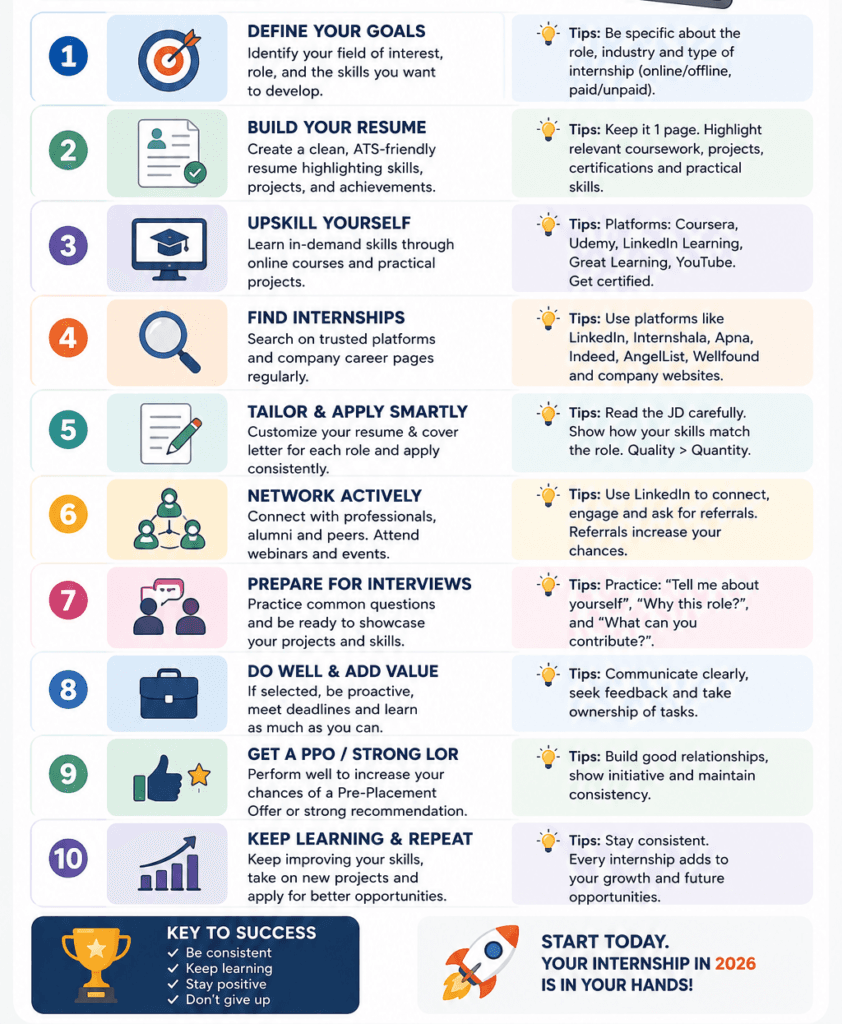
- Build a one-page resume with a clear objective line, education, skills, and any projects — even college assignments or personal projects count.
- Create or update your LinkedIn profile with a professional photo, a headline stating what you’re looking for, and 2–3 lines under ‘About’.
- List concrete skills, not just soft skills — MS Excel, Canva, basic Python, content writing, data entry, social media management, whatever applies to your target field.
- Keep a scanned Aadhaar card, passport-size photo, and latest marksheet ready as PDFs — most government and corporate portals ask for these during registration.
Step 2: Use the Right Platforms — Not Just One
No single platform covers the whole market. The students who land strong internships in 2026 typically run three or four channels in parallel and check them weekly rather than relying on one portal alone.
| Platform | Best For | Cost |
| Internshala | First-time seekers, all streams, remote & paid roles | Free |
| PM Internship Scheme (pminternship.mca.gov.in) | Government-backed 6–9 month paid internships at 500+ top companies | Free |
| Direct outreach to hiring managers and alumni | Free | |
| Unstop | Case competitions and hackathons that convert to internships | Free |
| Wellfound (AngelList India) | Startup internships, especially in tech and product | Free |
| College Placement Cell / TPO | Verified, on-campus company drives | Free |
The PM Internship Scheme (PMIS) — Step by Step
PMIS is a Government of India initiative run by the Ministry of Corporate Affairs, placing candidates in paid internships with India’s top 500 companies by CSR spending, across sectors like BFSI, FMCG, IT, and manufacturing. It runs on a rolling basis rather than one fixed annual deadline, so new listings open through the year.
- Visit the official portal at pminternship.mca.gov.in — never use a third-party site.
- Click ‘Register Now’ or ‘Youth Registration’ and enter your Aadhaar-linked mobile number.
- Verify the OTP sent to your mobile and set a password.
- Complete e-KYC through Aadhaar OTP or DigiLocker — this unlocks full listing details and the Apply button.
- Fill your profile completely: education, location preference, sector interest, and every skill you have, even basic ones. Complete profiles are shortlisted far more often.
- Browse listings using sector and location filters, then apply to multiple roles that fit.
- Track status on your dashboard — Submitted, Under Review, Shortlisted, or Selected — and respond to any offer within the given deadline.
| Good to know • Open to graduates, diploma holders, and 12th-pass candidates aged roughly 21–24 who are not currently in full-time education. • Selected interns generally receive a monthly stipend plus a one-time joining grant, credited directly to their bank account. • There is no application fee at any stage — anyone asking for payment is not part of the official scheme. • A drop-out or termination during the internship affects your eligibility for future rounds, so commit only to roles you can complete. |
Step 3: Don’t Just Apply — Reach Out Directly
Submitting an application and waiting is the slowest route. A short, personalised email or LinkedIn message to the actual hiring manager or team lead consistently outperforms cold applications, because it lands in front of a person instead of an applicant tracking system.
- Find the hiring manager or team lead on LinkedIn — search the company name plus the department you’re targeting.
- Send a 3–4 line message: who you are, one relevant skill or project, and what you’re asking for (a call, feedback on fit, or a formal application).
- Attach or link your resume and one work sample if you have one — even a college project, blog post, or spreadsheet model.
- Follow up once after 5–7 working days if you don’t hear back — a polite nudge, not repeated messages.
Step 4: Target the Hidden Market
A large share of internships, especially at smaller companies and startups, are never posted publicly — they’re filled through referrals and direct outreach before a listing goes live.
- Ask your college seniors and alumni network directly whether their team is hiring interns.
- Reach out to founders of small startups in your city — they often need help and can’t afford a formal hiring process.
- Offer a short trial project (unpaid or paid) to a business you admire, framed as ‘I’d like to help with X for two weeks and show you what I can do.’
Step 5: Prepare for the Interview or Screening Call
- Research the company’s product, recent news, and social media presence before the call.
- Prepare two or three questions about the role — this signals genuine interest.
- Be ready to explain any project on your resume in under a minute: what you did, what tools you used, what the result was.
- For government scheme or PSU internships, keep your documents (Aadhaar, marksheets, bonafide certificate) ready in case of a verification step.
A Practical 30-Day Action Plan
| Week | Focus |
| Week 1 | Finish resume and LinkedIn profile; register on Internshala and PMIS portal |
| Week 2 | Apply to 15–20 relevant listings across platforms; send 10 direct LinkedIn messages |
| Week 3 | Follow up on all pending applications; attempt one Unstop competition or case challenge |
| Week 4 | Prepare for interviews received; reach out to 5 alumni or seniors for referrals |
Common Mistakes to Avoid
- Applying to 50+ listings with the same generic resume instead of tailoring the top three lines to each role
- Waiting for the ‘perfect’ internship instead of starting with a smaller one to build experience
- Ignoring remote and part-time listings — these have no year restriction and are easier to combine with academics
- Paying anyone for internship ‘registration’ or ‘guaranteed placement’ — legitimate platforms and government schemes never charge a fee
Final Word
There is no single shortcut to landing an internship in India in 2026 — but there is a reliable process: a complete profile, applications across multiple platforms, direct outreach to real people, and consistent follow-up. Students who treat this as a structured month-long project, rather than a single afternoon of applying, are the ones who convert offers.
READ NOTE
Capgemini Hiring Process 2026 for Freshers – Eligibility, Assessment, Interview & Salary Guide
GCC Jobs in India 2026 for Freshers — Complete Guide (Salary, Top Companies & How to Get Hired)
Top 50 International Companies Hiring Remote Jobs in 2026 for India & APAC Region Read Now
Top 10 IT Companies Hiring Freshers in India 2026 — Salary, Process, Eligibility & Complete Guide
How to Write a Cover Letter for IT Jobs in India 2026 — With Templates
Salary After MBA in India 2026 — Top Companies, Roles & How Much You Really Earn