
Campus placement season 2026 is starting right now — most colleges begin drives between August and November, and the students who get placed are already 60 to 90 days into structured preparation. If you are reading this in July 2026, you are at the last possible point where a complete, systematic preparation plan can still get you through the process with confidence.
India’s employability rate reached 56.35 percent in 2026 according to the India Skills Report, while B.E. and B.Tech employability specifically reached 70.15 percent — which means skills, not marks, determine placement outcomes. Over 3 million engineering graduates compete for placement opportunities every year, and only 30 to 40 percent get placed through campus drives. The remainder need off-campus strategies. This guide covers both.
What separates students who get placed from those who do not is almost never intelligence or college ranking. It is consistency of preparation, understanding of the placement process, and targeted practice for the specific companies they are applying to. This guide gives you exactly that — a 90-day plan, topic-wise preparation roadmaps, company-specific strategies, and the practical checklist that placement toppers actually follow.
Campus Placement in India 2026 — What You Need to Know First
| Metric | 2026 Data |
| India’s graduate employability rate | 56.35% overall — 70.15% for B.E./B.Tech specifically |
| Engineering graduates competing for IT placements annually | Over 3 million |
| Placed through campus drives | 30 to 40% — the rest go off-campus |
| Employers planning to hire freshers (H2 2025 report) | 70% of employers intend to hire freshers — demand is strong |
| Campus placement season in most colleges | August to March — peak activity August to November |
| Pre-Placement Offer (PPO) season | June to August — for students who completed internships |
| Companies that hire in bulk (service-based) | TCS (40,000+), Infosys (20,000+), Cognizant (24,000+), Wipro (10,000+), HCL, Accenture — mass hiring, aptitude is primary filter |
| Companies that hire selectively (product-based) | Amazon, Microsoft, Google, Adobe, Flipkart, Zoho — small fresher batches, DSA is primary filter |
| Average service company package | Rs. 3.36 LPA to Rs. 4.5 LPA at base track |
| Average product company package for freshers | Rs. 10 LPA to Rs. 25 LPA — significantly higher but much more competitive |
| When to start preparing (ideal) | 3rd year (5th semester) — July of penultimate year |
| Minimum viable preparation window | 90 days — starting August gets you to November in time for peak drives |
The Most Important Thing to Understand About 2026 Placements: Service companies (TCS, Infosys, Wipro, Cognizant, HCL) primarily filter on aptitude in the first round. A strong coder who fails the aptitude test does not get to show their coding skills. Product companies (Amazon, Microsoft, Google) primarily filter on DSA and coding ability. You must know which type of company you are targeting before you decide how to divide your preparation time.
Two Types of Companies — Two Different Preparation Strategies
| Factor | Service-Based Companies (TCS, Infosys, Wipro, Accenture, Cognizant, HCL) | Product-Based / Dream Companies (Amazon, Microsoft, Google, Adobe, Zoho) |
| Primary filter | Aptitude test — eliminates 60 to 70% of candidates before any coding is seen | DSA and coding — 1 to 3 hard problems in timed online assessment |
| Package at fresher level | Rs. 3.36 LPA to Rs. 7.5 LPA (standard to premium tracks) | Rs. 10 LPA to Rs. 25 LPA depending on role and company |
| Hiring volume | 10,000 to 40,000 freshers per company annually | 50 to 500 freshers per year — extremely selective |
| DSA depth required | Easy to Medium — arrays, strings, basic sorting, two pointer for premium tracks | Medium to Hard — graphs, DP, advanced algorithms required |
| Core CS subjects tested | OOP, DBMS, OS basics — standard technical interview | Deep CS fundamentals + system design basics for experienced tracks |
| Resume role | Less critical — many service companies do not shortlist by resume at all | Critical — resume is screened before coding round; projects and GitHub matter |
| Interview rounds | 2 to 3 rounds — online test + technical + HR | 4 to 6 rounds — coding rounds + multiple technical interviews + HR/Bar Raiser |
| Preparation time needed | 4 to 8 weeks focused preparation is achievable | 3 to 6 months of intensive DSA and system design preparation |
| Realistic for Tier-3 college students | High — multiple companies visit or accept off-campus applications | Possible but requires near-perfect DSA preparation regardless of college tier |
Practical Strategy for Most Students: Target 2 to 3 service companies as your primary goal — these give you a job and financial stability. Simultaneously prepare for 1 dream company as a stretch goal. The service company preparation (aptitude + basic coding) takes 6 to 8 weeks. The dream company preparation (advanced DSA) requires an additional 4 to 8 weeks on top. Run both in parallel, prioritizing service company preparation since those drives happen first.
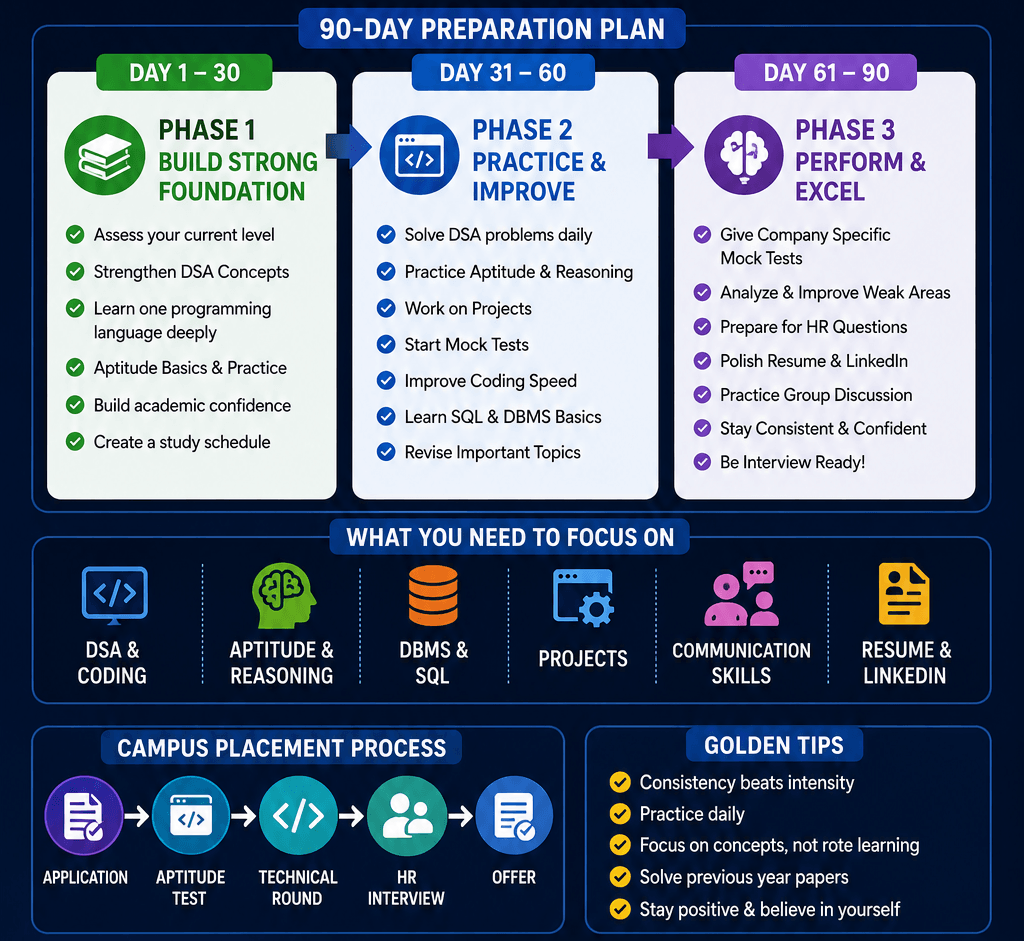
The 90-Day Campus Placement Preparation Plan — Month by Month
This plan assumes you are starting from July 2026 with placement season beginning in August to September. Adjust the start date based on your college’s actual drive schedule — work backward 90 days from your first expected drive date.
Month 1 (Days 1-30) — Foundation: Aptitude + Resume + Basic Coding
| Area | Daily Target | Resources | Goal by Day 30 |
| Quantitative Aptitude | 30 to 40 questions daily — timed | IndiaBix.com (free), R.S. Aggarwal book | 70%+ accuracy on all core topics in timed conditions |
| Logical Reasoning | 20 to 25 questions daily | IndiaBix Logical Reasoning section, PrepInsta | Seating arrangements, blood relations, syllogisms solved confidently |
| Verbal Ability | 1 comprehension passage + 10 vocabulary questions daily | IndiaBix English section, newspaper reading | Para jumbles and error identification solved accurately |
| Basic Coding (Easy DSA) | 3 to 5 LeetCode Easy problems daily | LeetCode free tier — Arrays, Strings, Basic Math | 50 Easy problems solved. Arrays and Strings sections complete. |
| Resume | One-time task — complete in first week | Use our Fresher Resume Format 2026 guide at wisdomland.in | ATS-compliant, single-column, one-page resume done |
| One-time setup in Week 1 | Use our LinkedIn Profile Tips 2026 guide at wisdomland.in | Profile 100% complete with Open to Work enabled |
Month 1 is the hardest month psychologically — you are building habits, not seeing results yet. The key insight from successful placed students is this: 60 to 90 minutes of consistent daily practice beats a 10-hour weekend study binge, especially for aptitude. Aptitude accuracy improves through distributed practice over weeks, not cramming in days.
Month 2 (Days 31-60) — Depth: DSA + Core Subjects + Mock Tests
| Area | Daily Target | Resources | Goal by Day 60 |
| DSA (Medium Level) | 5 to 7 LeetCode Medium problems daily — pattern-focused | LeetCode (Two Pointer, Binary Search, Sliding Window, Greedy, Hashing) | 100 medium problems solved across key patterns |
| Core CS Subjects | 1 hour daily — OOP, DBMS, OS, Computer Networks | GeeksForGeeks topic-wise articles, Last Minute Notes series | Can answer 80% of standard technical interview questions on these subjects |
| Aptitude — Advanced | 20 questions daily on weak topics from Month 1 | Mixed company mock tests on PrepInsta | 90%+ accuracy on all aptitude topics. Average speed under 60 seconds per question. |
| Company-Specific Mock Tests | 1 full company mock test per week | PrepInsta, IndiaBix company-specific sections | Completed mock tests for TCS, Wipro, Cognizant, Accenture formats |
| Projects | Finalize GitHub projects — add READMEs, deploy at least one | GitHub, Vercel/Netlify for deployment (both free) | 2 to 3 strong projects on GitHub with working links |
| SQL | 30 minutes daily — HackerRank SQL track | HackerRank SQL Easy and Medium | All Easy and 60% of Medium SQL problems solved |
Month 3 (Days 61-90) — Final Sprint: Mock Interviews + Company Research + Applications
| Area | Daily Target | Resources | Goal by Day 90 |
| Mock Interviews | 1 full mock interview per week — technical + HR | Pramp.com (free peer interviews), practice with friends, record yourself | 10 to 15 complete mock interviews done before first actual drive |
| Advanced DSA (for dream companies) | 3 to 5 hard LeetCode problems per week | LeetCode Hard — DP, Graphs, Advanced String algorithms | 30 Hard problems solved. Can explain time complexity of every solution. |
| HR Question Bank | 30 minutes daily — prepare and rehearse answers | Most common 25 HR questions — write and practice answers out loud | All 25 common HR questions answered confidently and naturally |
| Company Research | 1 company researched per day | Company website, Glassdoor, LinkedIn, previous year placement papers on GFG | Top 10 target companies researched — know their products, culture, hiring process |
| Application Submission | 10 to 15 applications per week on campus + off-campus portals | Campus Superset, careers.tcs.com, infytq.infosys.com, careers.wipro.com etc. | Applied to minimum 20 companies across campus and off-campus channels |
| Daily Revision | 30 minutes — revisit wrong answers and weak topics from previous weeks | Error log maintained from Month 1 — review weekly | Zero repeat mistakes on previously practiced topics |
Aptitude Preparation — The Round Most Students Underestimate
Most students lose the first round because they do not take aptitude seriously enough. It is easy to dismiss aptitude as basic maths — but in a timed exam where every wrong second costs you, the gap between 65% accuracy and 85% accuracy is the gap between placed and not placed. The first round of TCS NQT, Wipro NLTH, Cognizant AMCAT, and Infosys InfyTQ assessment all include significant aptitude components.
Topic-Wise Aptitude Preparation Guide
| Category | High-Frequency Topics | Questions Per Day | Shortcut Technique |
| Percentages and Profit/Loss | Successive percentage changes, profit percentage, discount calculations, marked price | 8 to 10 | Multiplier method — (1+r/100) format eliminates long calculation steps |
| Time, Speed, Distance | Relative speed, average speed, boats and streams, trains crossing | 5 to 7 | Distance = Speed x Time is always the base — draw the scenario before solving |
| Time and Work | Pipes and cisterns, combined work rates, work done in parts | 5 to 7 | Unit work method — express each worker’s rate as 1/n fraction first |
| Number Systems | Divisibility rules, HCF/LCM, remainders, prime factorization | 5 to 7 | Learn divisibility rules for 2 through 13 — saves 30 to 60 seconds per problem |
| Probability and Permutation/Combination | Dice problems, card problems, selections and arrangements | 4 to 6 | Favourable outcomes / total outcomes — always list total sample space first |
| Data Interpretation | Bar graphs, pie charts, line graphs, tables — 4 to 5 questions per set | 1 DI set per day (4 to 5 questions) | Read the question first, then the graph — never read the entire graph upfront |
| Logical Reasoning — Seating Arrangements | Circular and linear arrangements, complex multi-constraint problems | 3 to 4 per day | Draw the arrangement on paper first — visual setup saves 2 to 3 minutes |
| Logical Reasoning — Blood Relations | Family tree problems, coded blood relation problems | 3 to 4 per day | Always draw the family tree — never solve blood relations in your head |
| Verbal Ability — Reading Comprehension | Inference questions, tone questions, main idea questions | 1 passage per day (3 to 4 questions) | Read questions before the passage — you know what to look for as you read |
| Verbal Ability — Para Jumbles | 4 to 6 sentence rearrangements to form logical paragraphs | 3 to 5 per day | Find the sentence that cannot be first (usually starts with ‘but’, ‘however’, ‘it’) — eliminate options from there |
Weekly Mock Test Strategy: Every Sunday, take one full-length company mock test under real exam conditions — no breaks, no hints, timer running. After the test, track three numbers: accuracy percentage, average time per question, and the list of weak topics where you got questions wrong. Revisit those specific weak topics within 48 hours. Students who follow this weekly mock-and-review cycle consistently outperform students who only practice topic-wise without the pressure of timed full-length tests.
DSA (Data Structures and Algorithms) Preparation — Roadmap for Placements
For service companies, DSA preparation needs to get you to a point where you can solve Easy to Medium problems within 15 to 30 minutes each. For product companies and dream companies, you need consistent performance on Medium to Hard problems. Here is the exact sequence:
DSA Topic-Wise Preparation Sequence
| Topic | Priority | Problems to Solve | Companies That Test This |
| Arrays | Must-Do — Week 1 | 20 to 25 Easy + 15 Medium problems on LeetCode | TCS, Infosys, Wipro, HCL, Accenture, Cognizant, Amazon |
| Strings | Must-Do — Week 1 | 15 Easy + 10 Medium problems — pattern matching, anagram, palindrome | TCS, Infosys, Wipro, Cognizant, Capgemini |
| Linked Lists | High Priority — Week 2 | 10 Easy + 8 Medium — reversal, cycle detection, merge | Infosys SP, HCL Polaris, Amazon, Microsoft |
| Stacks and Queues | High Priority — Week 2 | 8 to 10 problems — balanced parentheses, next greater element | TCS Digital, Wipro Turbo, Accenture Advanced ASE |
| Binary Search | High Priority — Week 3 | 10 Medium problems — binary search on answer pattern | All companies — especially Wipro Turbo and Cognizant GenC Next |
| Two Pointer Technique | High Priority — Week 3 | 10 Medium problems — pair sum, container with most water | TCS Digital, Infosys SP, HCL Momentum, Cognizant GenC Next |
| Sliding Window | High Priority — Week 3 | 8 Medium problems — maximum sum subarray, longest unique substring | TCS Digital, HCL Polaris, Amazon |
| Greedy Algorithms | Medium Priority — Week 4 | 8 to 10 Medium problems — activity selection, fractional knapsack | TCS Digital, HCL Polaris, Capgemini WARRIOR |
| Trees and Binary Trees | Medium Priority — Week 4 to 5 | 15 problems — traversals, BST operations, height, LCA | Infosys SP, HCL Polaris, Amazon, Microsoft |
| Graphs (BFS and DFS) | Lower for service / Critical for product | 10 to 15 problems — connected components, shortest path | Amazon, Microsoft, Google — less for TCS/Infosys |
| Dynamic Programming | For product companies and top service premium tracks | 20 to 30 problems — 0/1 Knapsack, LCS, Coin Change, Edit Distance | Amazon, Microsoft, HCL Polaris, Infosys SP L3 |
| Hashing and HashMap | High Priority — Week 2 to 3 | 10 to 12 problems — frequency counting, two sum, group anagrams | All companies — one of the most frequently tested patterns |
Language Choice for Coding Rounds: Python is recommended for service company coding rounds — shorter syntax means faster implementation in timed assessments. Java is recommended for product company interviews where you need to demonstrate OOP depth and the interviewer may probe your code structure. C++ is recommended for competitive programmers who are very comfortable with STL. Pick one language and stay with it throughout your preparation — switching languages mid-preparation is one of the most common avoidable mistakes.DSA (Data Structures and Algorithms) Preparation — Roadmap for Placements
For service companies, DSA preparation needs to get you to a point where you can solve Easy to Medium problems within 15 to 30 minutes each. For product companies and dream companies, you need consistent performance on Medium to Hard problems. Here is the exact sequence:
DSA Topic-Wise Preparation Sequence
| Topic | Priority | Problems to Solve | Companies That Test This |
| Arrays | Must-Do — Week 1 | 20 to 25 Easy + 15 Medium problems on LeetCode | TCS, Infosys, Wipro, HCL, Accenture, Cognizant, Amazon |
| Strings | Must-Do — Week 1 | 15 Easy + 10 Medium problems — pattern matching, anagram, palindrome | TCS, Infosys, Wipro, Cognizant, Capgemini |
| Linked Lists | High Priority — Week 2 | 10 Easy + 8 Medium — reversal, cycle detection, merge | Infosys SP, HCL Polaris, Amazon, Microsoft |
| Stacks and Queues | High Priority — Week 2 | 8 to 10 problems — balanced parentheses, next greater element | TCS Digital, Wipro Turbo, Accenture Advanced ASE |
| Binary Search | High Priority — Week 3 | 10 Medium problems — binary search on answer pattern | All companies — especially Wipro Turbo and Cognizant GenC Next |
| Two Pointer Technique | High Priority — Week 3 | 10 Medium problems — pair sum, container with most water | TCS Digital, Infosys SP, HCL Momentum, Cognizant GenC Next |
| Sliding Window | High Priority — Week 3 | 8 Medium problems — maximum sum subarray, longest unique substring | TCS Digital, HCL Polaris, Amazon |
| Greedy Algorithms | Medium Priority — Week 4 | 8 to 10 Medium problems — activity selection, fractional knapsack | TCS Digital, HCL Polaris, Capgemini WARRIOR |
| Trees and Binary Trees | Medium Priority — Week 4 to 5 | 15 problems — traversals, BST operations, height, LCA | Infosys SP, HCL Polaris, Amazon, Microsoft |
| Graphs (BFS and DFS) | Lower for service / Critical for product | 10 to 15 problems — connected components, shortest path | Amazon, Microsoft, Google — less for TCS/Infosys |
| Dynamic Programming | For product companies and top service premium tracks | 20 to 30 problems — 0/1 Knapsack, LCS, Coin Change, Edit Distance | Amazon, Microsoft, HCL Polaris, Infosys SP L3 |
| Hashing and HashMap | High Priority — Week 2 to 3 | 10 to 12 problems — frequency counting, two sum, group anagrams | All companies — one of the most frequently tested patterns |
Language Choice for Coding Rounds: Python is recommended for service company coding rounds — shorter syntax means faster implementation in timed assessments. Java is recommended for product company interviews where you need to demonstrate OOP depth and the interviewer may probe your code structure. C++ is recommended for competitive programmers who are very comfortable with STL. Pick one language and stay with it throughout your preparation — switching languages mid-preparation is one of the most common avoidable mistakes.
Core CS Subject Preparation — What to Study and How Deep to Go
Technical interviews at service companies consistently test four core subjects: OOP, DBMS, Operating Systems, and Computer Networks. Product company interviews go deeper into OS and System Design. Here is exactly what to cover in each:
| Subject | Must-Know Topics | Depth Required | Best Free Resource |
| Object-Oriented Programming (OOP) | 4 pillars (Encapsulation, Inheritance, Polymorphism, Abstraction), classes and objects, interfaces vs abstract classes, constructor types, method overloading vs overriding, access modifiers | Deep — this is tested at every service company technical interview. Expect live coding scenarios like ‘Design a class for a banking system’ | GeeksForGeeks OOP section, Java or Python OOP tutorials on YouTube |
| Database Management Systems (DBMS) | SQL (SELECT, JOINs, GROUP BY, HAVING, subqueries, aggregate functions), normalization (1NF to 3NF and BCNF), ACID properties, transactions, indexes, ER diagrams | Medium-Deep — SQL queries are asked live in most service company interviews. Write SQL on paper during preparation, not just read | HackerRank SQL track (free), GeeksForGeeks DBMS last-minute notes |
| Operating Systems (OS) | Process management (scheduling algorithms: FCFS, SJF, Round Robin, Priority), deadlock (conditions, prevention, detection), memory management (paging, segmentation, virtual memory), file systems | Medium — service companies ask conceptual questions. Product companies may ask deeper implementation questions on scheduling and memory | GeeksForGeeks OS Last Minute Notes, Abdul Bari YouTube playlist |
| Computer Networks (CN) | OSI model (all 7 layers with protocols), TCP/IP model, TCP vs UDP, HTTP vs HTTPS, DNS resolution, IP addressing (IPv4, subnetting basics), routing protocols overview | Medium — mostly concept-based questions in service company interviews. Know the OSI model layers by heart — this comes up in 80% of CN questions | GeeksForGeeks CN Last Minute Notes, Kurose & Ross textbook for deeper understanding |
| System Design (for product companies) | Load balancers, caching (Redis, CDN), databases (SQL vs NoSQL trade-offs), microservices vs monolith, rate limiting, consistent hashing | Light — just awareness level for fresher product company roles. Mid-level product company interviews go much deeper. | System Design Primer on GitHub (free), Gaurav Sen YouTube channel |
Resume and LinkedIn — The Foundation That Determines Whether You Get Shortlisted
No matter how well you prepare for aptitude and coding, a weak resume means you never get to demonstrate those skills. Two things need to be in perfect shape before your first placement drive:
| Preparation Area | Key Actions | Where to Find the Full Guide |
| Resume Format 2026 | Single-column ATS-compliant format, no photo no DOB, Professional Headline replacing generic objective, projects with quantified outcomes and GitHub links, certifications listed with issuing platform and year | Full guide: wisdomland.in/fresher-resume-format-2026-india-guide |
| LinkedIn Profile | Complete profile with optimized headline, About section (1,500+ characters), Skills section with 15+ relevant skills and LinkedIn assessments completed, Featured section with GitHub pin, Open to Work enabled with 5+ job titles | Full guide: wisdomland.in/linkedin-profile-tips-freshers-2026-india |
| GitHub Portfolio | 2 to 3 pinned repositories with clear READMEs, deployed links, and consistent commit history — the verifiable proof of skills that both ATS and human recruiters check | Mentioned in Resume guide — build alongside project preparation |
| Projects | 2 strong projects with: clear problem statement, specific tech stack, quantified outcome (users, speed improvement, scale), GitHub link — be ready to explain architecture decisions in interviews | See Project Preparation section in this guide |
How to Crack the Technical Interview — What Interviewers Actually Evaluate
The technical interview is not a test of whether you know the correct answer. It is a test of how you think through problems, how you communicate your reasoning, and whether you can apply your knowledge to scenarios you have not seen before. Knowing this changes how you should prepare:
What Technical Interviewers Evaluate
- Problem-solving process: Can you break down a problem, identify edge cases, and move toward a solution methodically — even when you do not know the exact answer immediately?
- Communication: Do you explain your thinking clearly as you solve? Interviewers would rather see a correct thought process with a slightly wrong answer than a silent candidate who writes the perfect solution without any explanation.
- Knowledge depth vs breadth: Can you go beyond surface-level answers? When asked about inheritance, can you explain when to use it vs composition? When asked about normalization, can you identify a real table that violates 2NF and explain why?
- Project ownership: Do you genuinely understand every aspect of your projects — the architecture decisions, the challenges you faced, what you would do differently? Interviewers probe projects extensively because candidates often list things they barely touched.
- Honesty: Saying ‘I do not know this, but here is what I do know that might be related’ is significantly better than confidently giving a wrong answer. Interviewers detect bluffing reliably and it ends interviews faster than admitted ignorance.
The Technical Interview Preparation Checklist
- Prepare your 2-minute self-introduction — practice saying it aloud until it sounds natural, not rehearsed. It sets the tone for the entire interview.
- For each project on your resume: prepare answers to ‘Walk me through this project’, ‘What was the most challenging part?’, ‘What would you improve if you had more time?’, ‘How does this scale if 10 times more users come?’
- Practice coding on paper or a whiteboard — not just on an IDE. Many technical interviews still require you to write code by hand or on a shared screen without autocomplete.
- Practice explaining your code as you write it — this is the most commonly neglected preparation activity. The ability to narrate your thought process while coding is what separates good technical communicators from those who code well but interview poorly.
- Revise the most common technical interview questions for your target companies — GeeksForGeeks and PrepInsta have company-wise technical question archives that are remarkably accurate predictors of what appears in actual interviews.
How to Crack the HR Interview — The Most Underestimated Round
Candidates who fail the HR round after clearing technical rounds consistently report the same reasons: they gave generic answers that could have come from any candidate, they spoke about salary too early, or their relocation answer was ambiguous. The HR interview is structured, predictable, and entirely preparable — yet most students treat it as the round they can wing.
The 25 Most Common HR Interview Questions — With Answer Framework
| Question | Answer Framework — What Works and What Does Not |
| Tell me about yourself | 60 to 90 seconds: Name + Degree + College + 2 strongest skills + 1 significant project or achievement + what you are looking for. NOT your entire life history. End with something that invites a follow-up question about your work. |
| Why do you want to join [Company]? | Research the company before the interview. Name one specific thing — a technology they work on, a product you use, a growth initiative you read about. Generic answers like ‘it is a great company’ fail this question every time. |
| What are your strengths? | Name 2 specific strengths with a brief example each. ‘Problem-solving’ is too generic. ‘I am good at breaking complex coding problems into manageable sub-problems — when I built my project, I decomposed the database design into three stages’ is specific and credible. |
| What are your weaknesses? | Name a real weakness that is not critical to the role, and immediately follow it with what you are actively doing to address it. ‘I used to procrastinate on documentation, so I now write README files immediately after completing each project feature.’ |
| Why should we hire you? | Three clear, specific differentiators — skills, attitude, something you have built — that align with what this specific company is hiring for. This is your 60-second sales pitch. |
| Where do you see yourself in 5 years? | Show ambition that aligns with the company’s growth trajectory. ‘I want to become a senior developer who has worked on full-stack products and possibly led a small team’ is better than ‘I want to be a manager’ (too ambitious for a fresher) or ‘I am not sure’ (signals no direction). |
| Are you willing to relocate? | Always say yes if you genuinely are. If you have genuine constraints, mention them honestly and suggest your flexibility within those constraints. Ambiguous answers (‘I will try’) create doubt that results in the next candidate being preferred. |
| What is your expected salary? | For freshers, say ‘I am open to the standard fresher package for this role — I am focused on the learning opportunity and am confident the compensation will be fair.’ Never quote a number lower than the market standard — it anchors the negotiation against you. |
| Do you have any questions for us? | Always have 2 to 3 genuine questions prepared. ‘What does a typical first month look like for a fresher at this company?’, ‘What technologies does this team currently use?’, ‘What growth opportunities exist for someone in this role?’ Never say ‘No, I think you have covered everything’ — it signals a lack of curiosity. |
Use the STAR method (Situation, Task, Action, Result) for any behavioural question that starts with ‘Tell me about a time when…’ — describe the Situation, your Task, the Action you took, and the measurable Result. This structure gives completeness to answers that otherwise tend to be vague.
Company-Specific Placement Strategy — What to Prepare For Each
| Company | Primary Filter | Key Preparation Focus | Deep-Dive Guide |
| TCS | NQT score — aptitude + coding (Ninja threshold vs Digital threshold) | Aptitude accuracy at 80%+, 2 Easy coding problems solved in 60 min, improve for Digital with 2 Medium problems | wisdomland.in/tcs-nqt-2026 |
| Infosys | InfyTQ certification level — Foundation vs Master | Free InfyTQ platform — Master certification requires Medium DSA: Two Pointer, Binary Search, Greedy, basic DP | wisdomland.in/infosys-infytq-2026-complete-guide |
| Wipro | NLTH aptitude + essay writing + coding | Aptitude + UNIQUE essay writing (400 words, 20 min) — Wipro is the only Big 6 company testing this in 2026. Practice writing one 400-word essay daily. | wisdomland.in/wipro-fresher-hiring-2026-elite-turbo-wilp-guide |
| Accenture | Online assessment + spoken English (Versant) | Stage 2 is a spoken English test unique to Accenture — test your microphone, practice speaking clearly. GenAI project gives Advanced ASE advantage. | wisdomland.in/accenture-fresher-hiring-2026-ase-guide |
| Cognizant | AMCAT — Communication + Aptitude + Technical + Coding | All sections are mandatory — missing one section disqualifies regardless of other scores. GenC Next requires 70% CGPA — check eligibility before registering. | wisdomland.in/cognizant-genc-2026-complete-guide |
| HCL | AMP online assessment — single application, track assigned by performance | Target Momentum or Polaris from Day 1 of preparation — HCL AMP assigns track by performance. GenAI project experience helps Polaris assignment. | wisdomland.in/hcl-fresher-hiring-2026-amp-techbee-guide |
| Amazon | DSA coding round — Medium-Hard LeetCode level | 100+ Medium and 30+ Hard problems solved before applying. Amazon Leadership Principles must be studied for HR/Bar Raiser round — 14 principles, 2 examples each. | Apply at amazon.jobs — India SDE roles |
| Capgemini | NINJA/WARRIOR coding threshold | WARRIOR track (Rs. 7 LPA) requires Medium-level DSA performance. No essay writing unlike Wipro. Spoken English tested in HR. | Apply at careers.capgemini.com |
Off-Campus Placement Strategy — If Your College Drive Is Limited
Only 30 to 40 percent of engineering freshers get placed through campus drives. The remaining 60 to 70 percent need off-campus strategies — and in 2026, off-campus hiring has never been more accessible. Here is the complete off-campus application approach:
- Apply through official company career portals directly: nextstep.tcs.com, infytq.infosys.com, careers.wipro.com, careers.accenture.com/in-en, careers.cognizant.com, careers.hcltech.com — all accept off-campus applications year-round with the same eligibility criteria as campus hiring.
- Use Naukri.com with filters set to ‘Fresher’ and the specific company names — companies post off-campus drives on Naukri regularly and these listings receive less competition than the company’s own portal in some cases.
- Apply through LinkedIn — set up job alerts for ‘Fresher Software Engineer’ in your target cities. Apply within 24 hours of a posting going live — early applications have higher shortlisting rates at most companies.
- Use the Superset platform — many colleges that do not have direct TCS or Infosys campus ties can access drives through Superset, which aggregates campus drives across hundreds of colleges and companies.
- Attend Naukri Campus events and company-organized mega drives — TCS, Wipro, and Accenture regularly conduct pan-India assessment days where off-campus candidates appear alongside campus candidates.
- Build your referral network — connect with seniors from your college who are already working at your target companies on LinkedIn. A referral from an employee increases shortlisting probability significantly at most companies. Your message: ‘Hi [Name], I am a 2026 B.Tech CSE graduate from [College]. I noticed you work at [Company] and I am actively applying to [role]. Would you be open to referring me if you think I am a fit?’
- Track your applications systematically — maintain a Google Sheet with: Company, Role, Date Applied, Application Portal, Status. Most freshers lose track of where they applied and miss follow-up windows that could have resulted in interviews.
10 Campus Placement Mistakes That Cost Students Offers in 2026
| Mistake | Why It Costs You | Fix |
| Starting preparation less than 30 days before the drive | Aptitude accuracy cannot be built in days — it compounds over weeks. DSA pattern recognition requires consistent practice, not cramming. | Start 90 days before your first expected drive date — this guide gives you the exact plan |
| Skipping aptitude in favour of only coding | Service companies filter 60 to 70% of candidates in the aptitude round — a strong coder who fails aptitude never reaches the coding round | Spend equal time on aptitude and coding for the first 4 weeks |
| Preparing DSA randomly without a pattern-based approach | Solving 500 random LeetCode problems does not build pattern recognition. Solving 50 pattern-focused problems builds the muscle needed for timed exams. | Follow the topic-wise sequence in this guide — solve by pattern, not by random browsing |
| Not taking full mock tests under timed conditions | Placement tests have strict time limits — speed and accuracy under pressure cannot be developed through untimed practice | Take one full timed mock test every Sunday starting from Month 1 |
| Listing projects on resume that you cannot explain | Interviewers probe every line of your resume — a project you barely touched becomes your weakest point when probed in a technical interview | List only projects you built yourself and can explain in detail — architecture, challenges, decisions, and what you would improve |
| Not researching the company before the HR interview | Giving generic answers to ‘Why do you want to join us?’ immediately signals that you applied to them without thinking — which is often true but should not be visible | Spend 30 minutes on the company’s website and LinkedIn page before every HR interview |
| Giving ambiguous relocation answers | Companies like TCS, Wipro, HCL, and Accenture deploy freshers across multiple cities — ambiguous answers create doubt that the next candidate does not have | Say clearly: ‘Yes, I am open to relocation across [cities you are genuinely open to]’ |
| Not practising speaking aloud | The difference between interview preparation that stays in your head and interview preparation that sounds natural in the room is practice aloud — not reading silently | Record yourself answering 5 HR questions and 1 technical explanation daily — review and improve |
| Applying only through campus and missing off-campus | Campus drives are limited to your college’s company tie-ups — missing off-campus applications means missing 60 to 70% of available opportunities | Apply to every company through their official portal AND through campus simultaneously |
| Ignoring your online presence | Recruiters check LinkedIn and GitHub before and after interviews — a sparse LinkedIn and missing GitHub URL signals a candidate who is not genuinely engaged with their field | Complete your LinkedIn and GitHub before submitting any applications — both should be strong before your first drive |
Frequently Asked Questions — Campus Placement 2026
When should I start preparing for campus placements in 2026?
Ideally in your 5th semester — July of your penultimate year gives you 12 to 15 months, which is enough time for thorough aptitude, coding, and interview preparation. If you are reading this as a final-year student, the minimum viable preparation window is 90 days before your first expected drive. Starting in July gives you enough time for August to November drives, which is when most colleges run their primary placement cycles. If you have less than 30 days, focus exclusively on: aptitude for 3 weeks, resume completion, and target the service companies with the most accessible aptitude thresholds (TCS, Cognizant, Accenture) rather than attempting advanced DSA that cannot be built in days.
What is the difference between campus placement and off-campus placement?
Campus placement happens when companies visit your college directly and conduct drives exclusively for your college’s eligible students — you apply through your college’s Training and Placement cell, typically via the Superset platform. Off-campus placement happens when you apply directly through the company’s career portal or job boards without your college being a formal partner — you compete with students from all colleges. Most major IT companies (TCS, Infosys, Wipro, HCL, Accenture, Cognizant) accept off-campus applications year-round with the same eligibility criteria as campus hiring. If your college does not have ties with your target companies, off-campus applications are your primary channel.
How many LeetCode problems do I need to solve for placements?
For service companies (TCS Ninja, Wipro Elite NTH, Cognizant GenC, Accenture ASE) — solving 50 Easy problems across Arrays, Strings, and basic Sorting is sufficient preparation for the coding round. For premium service company tracks (TCS Digital, Wipro Turbo, HCL Momentum, Cognizant GenC Next) — 100 Medium problems across key patterns (Two Pointer, Binary Search, Sliding Window, Greedy, Hashing) is the realistic target. For product companies and dream companies (Amazon, Microsoft, Google) — 150+ Medium problems and 30+ Hard problems in Dynamic Programming, Graphs, and Advanced Algorithms. The quality of problems solved with full understanding of the pattern matters more than the raw count.
Is a CGPA below 7.0 a barrier to campus placements?
It depends entirely on the company. TCS, Infosys SE, Wipro Elite NTH, Accenture, and Cognizant GenC all accept 60% CGPA (6.0 CGPA) — the majority of major IT employers. HCL’s metro centres require 70%, but HCL New Vistas accepts 65%. Cognizant GenC Next requires 70% with no rounding off. For product companies like Amazon and Microsoft, there is typically no stated CGPA minimum — your coding ability, projects, and GitHub portfolio are the primary filters. A student with 6.2 CGPA and three strong GitHub projects regularly gets shortlisted at Accenture and Cognizant over a student with 7.8 CGPA and no practical work to show.
What should I say in the HR interview if I do not have any work experience?
Most freshers do not have formal work experience — HR interviewers at TCS, Infosys, and Wipro know this and design their questions accordingly. For behavioural questions, draw examples from college projects (‘Tell me about a time you solved a difficult problem’ — describe the most complex bug you debugged in your major project), team experiences (‘Tell me about a time you worked in a team’ — describe a group project where you navigated disagreement), and academic achievements. Prepare one strong story per competency area: problem-solving, teamwork, initiative, and handling setbacks. Format each story using STAR method — the structure ensures completeness and prevents rambling.
Can I prepare for both service companies and product companies simultaneously?
Yes — and you should. The optimal approach is to prepare for service companies first (since those drives come earlier, in August and September) while building toward product company requirements simultaneously. Weeks 1 to 4: aptitude + Easy DSA + resume — this handles service company first rounds. Weeks 5 to 8: Medium DSA + core subjects — this handles service company premium tracks AND product company first rounds. Weeks 9 to 12: Hard DSA + system design awareness + mock interviews — this is primarily for product company preparation. By running both tracks in parallel with service company preparation taking priority in early weeks, you maximise your chances of multiple offers.
Final Thoughts — Placement Is a Process, Not a Single Exam
Campus placement is the sum of 90 days of consistent preparation, a strong resume, an optimized LinkedIn profile, and the ability to perform under pressure in a timed assessment. No single component determines the outcome on its own — the students who consistently get placed are those who work on all components simultaneously and systematically, not those who are the most talented coders in their batch.
Start your 90-day plan today. Fix your resume this week using our Fresher Resume Format 2026 guide. Complete your LinkedIn profile. Register for TCS NQT and Infosys InfyTQ immediately — both are free and have no downside to early registration. Start solving 30 aptitude questions daily. The compounding effect of 90 days of consistent, structured preparation is the single most reliable predictor of placement success — more reliable than college rank, CGPA, or previous competitive programming experience.
Placement season 2026 has already started for some colleges and is starting for the rest. Every day of preparation you begin today adds to your advantage over the students who begin next month. The placement offers go to the prepared, not the brilliant.
READ NOTE
Capgemini Hiring Process 2026 for Freshers – Eligibility, Assessment, Interview & Salary Guide
GCC Jobs in India 2026 for Freshers — Complete Guide (Salary, Top Companies & How to Get Hired)
Top 50 International Companies Hiring Remote Jobs in 2026 for India & APAC Region Read Now
Top 10 IT Companies Hiring Freshers in India 2026 — Salary, Process, Eligibility & Complete Guide