

Ask ten people whether a government job or a private job is better for a fresher, and you’ll get ten confident, contradictory answers. The honest truth is that neither is universally better — the right choice depends on your risk tolerance, your timeline, and what you actually want your twenties to look like. This guide skips the generic ‘govt is safe, private is exciting’ framing and instead walks through the real numbers, the genuine trade-offs, and a practical decision framework for 2026.
The Real Salary Comparison: What Freshers Actually Earn
Government pay is standardised and transparent, rising through fixed pay levels and annual increments. Private sector pay is variable, negotiable, and tied heavily to your specific role, company, and individual performance — which means private salaries have a much wider spread than government ones.
The 8th Pay Commission, formally constituted in late 2025, is expected to revise government salaries retrospectively from January 2026, with experts projecting a fitment factor between 2.6 and 2.86 that could raise minimum basic pay from ₹18,000 to somewhere between ₹46,000 and ₹51,000 — though full implementation isn’t expected until FY 2026–27. Until that rolls out, a fresher at Level 1 typically earns a basic pay of around ₹18,000, which works out to roughly ₹32,000–₹35,000 gross per month once Dearness Allowance and HRA are added.
| Path | Fresher Starting Pay (Year 1) | Notes |
| Government (Level 1, pre-8th Pay Commission rollout) | ~₹32,000–₹35,000/month gross | Basic pay + DA (~60%) + HRA |
| Government (post-8th Pay Commission, expected FY26–27) | Likely ₹46,000–₹51,000+ basic | Full effect phased in over FY 2026–27 |
| IAS / top civil services | ~₹56,100/month base (~₹6.7 LPA) | Effective package 30–50% higher with HRA, DA, LTC, medical cover |
| PSU engineering roles (ONGC, GAIL, BHEL, Coal India) | ₹12 LPA+ | ‘Hybrid’ path: private-like pay, government-like security |
| Private — IT service companies (TCS, Infosys, etc.) | ₹3.5–₹4.5 LPA | Lower starting pay, faster growth trajectory |
| Private — product-based/tech companies | ₹6–₹12 LPA | Wide range depending on college tier and role |
| Private — banking (entry-level) | ₹2.2–₹3.6 LPA | Among the lower-paying private fresher tracks |
| Private — high-demand fields (data science, AI) | ₹7–₹15 LPA | Narrow, competitive segment; requires specialised skills |
All private-sector figures are CTC and vary significantly by company tier, city, and role. Government figures are basic pay/gross before allowances unless noted.
Why the Year-1 Comparison Is Misleading
On paper, a private-sector IT fresher earning ₹6–8 LPA looks well ahead of a government employee’s ₹32,000–₹35,000 monthly gross. But that comparison misses several things that materially change the real value of a government package.
- House Rent Allowance (HRA), Dearness Allowance (DA), and Leave Travel Concession (LTC) can add 30–50% above base salary in many government roles.
- Government employees typically get subsidised or free medical coverage for their entire family — a benefit private employees usually have to buy separately or absorb as an out-of-pocket cost.
- Pension and provident fund structures under the National Pension System (NPS) provide a retirement safety net that most private-sector jobs simply don’t offer.
- Private salaries, by contrast, often include performance bonuses and variable pay that aren’t guaranteed — a strong year can mean a big bonus, but a weak one can mean none at all.
Over a 5-year horizon, a government employee starting at Level 1 with 3% annual increments and a possible promotion to Level 2 or 3 might see cumulative earnings of roughly ₹22–25 lakh. A private-sector IT fresher starting at ₹5 LPA with consistent 15% annual hikes can outpace that fairly quickly — but only if those hikes actually materialise, which depends entirely on performance, company health, and market conditions.
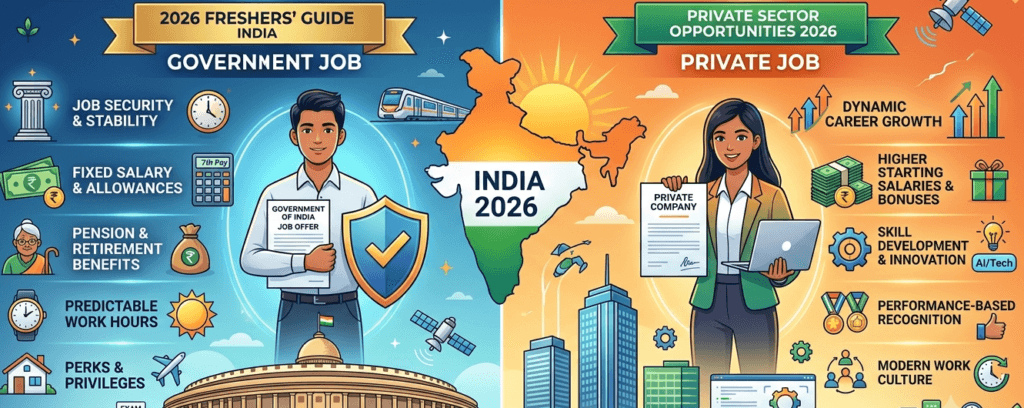
Beyond Salary: What Each Path Actually Feels Like Day to Day
Job Security
This is where the gap is starkest. Government employees are rarely terminated — job security is close to absolute once you clear probation. The private sector, by contrast, is directly exposed to market conditions, company performance, and increasingly to automation: 2026 has brought a sharp wave of tech layoffs in India, driven partly by AI eliminating routine coding, basic data processing, and entry-level customer support roles. The private sector adapts and creates new roles faster than government — but it also displaces people faster.
Work-Life Balance and Hours
Government roles generally offer fixed timings, predictable hours, and significantly more public holidays — often cited as 15–20% more time off than comparable private roles. Private sector work, especially in consulting, IT services, and startups, more often involves overtime, target-based pressure, and variable hours, though a large and growing share of private roles now offer hybrid or fully remote arrangements, which government jobs — almost entirely in-office and location-bound — don’t provide.
Career Growth and Skill Development
Private sector growth is faster and less predictable — high performers can see their compensation multiply within a few years, especially in high-demand fields, while average performers may plateau. Government growth is slower but far more structured and predictable, following defined pay levels and promotion cycles rather than individual negotiation.
Location and Flexibility
Government postings can require relocation to wherever you’re assigned, with limited say in the matter, especially early in your career. Private roles generally offer more choice over location, and remote or hybrid arrangements have become common enough that many freshers can now choose where they live independent of where their employer is based.
The Middle Path: Hybrid Options Worth Knowing About
A growing category of roles in 2026 blends the security of government work with private-sector-level pay, and it’s worth knowing about before you commit fully to either extreme.
| Hybrid paths to consider • PSU roles (ONGC, GAIL, BHEL, Coal India, and similar) — starting salaries of ₹12 LPA or higher for engineers, combined with government-equivalent job security. • Government-approved private roles listed on the NCS (National Career Service) portal — private-sector jobs vetted by the government, reducing the risk of fraudulent or unstable listings. • Contractual roles with NITI Aayog and central ministries — hiring ‘Young Professionals’ on contract at market-linked salaries for public-service work. |
A Practical Decision Framework
Rather than asking ‘which is better,’ ask yourself these questions:
- How much uncertainty can I genuinely tolerate in my income and job stability for the next 5–10 years?
- Do I have the discipline and time to prepare seriously for a competitive government exam (12–18 months is a realistic focused-preparation window), or would that time be better spent building private-sector skills right now?
- Do I value predictable hours and strong retirement benefits more than higher earning potential and faster skill growth?
- Am I open to relocating wherever a government posting sends me, or is location flexibility important to my life plans?
- Could a hybrid option — a PSU role, an NCS-listed private job, or a contractual government role — actually give me both, instead of forcing a binary choice?
A Sensible Hybrid Strategy If You’re Still Unsure
If you genuinely can’t decide, the most practical approach for many freshers is a hybrid plan: start earning in a private role while preparing for government exams in parallel, rather than putting your entire career on hold for an uncertain outcome. Set yourself a realistic limit — commonly around 12–18 months of focused government exam preparation — and if your scores and progress aren’t improving within that window, it’s usually smarter to commit fully to the private path with the skills you’ve built, rather than extending the uncertainty indefinitely.
| Quick summary: who tends to prefer which path • Government job — if you prioritise long-term security, predictable hours, strong retirement benefits, and can commit real time to competitive exam preparation. • Private job — if you want faster growth, higher earning potential (especially in high-demand fields), flexibility over location and work style, and can tolerate more income uncertainty. • Hybrid path (PSU, NCS-listed roles, contractual government work) — if you want a meaningful share of both worlds and are willing to research these less-obvious options. |
Final Word
There’s no universally correct answer to government versus private for freshers in 2026 — only the answer that’s correct for your own risk tolerance, timeline, and what kind of career you actually want to build. The private sector offers speed, flexibility, and higher ceiling earnings, but with real exposure to market and automation risk. Government work offers security, structure, and long-term stability, but slower growth and less personal control over your posting and hours. Whichever you choose, make the decision with the real numbers in front of you — not just the version of the argument your family or friends happen to believe.
READ NOTE
Capgemini Hiring Process 2026 for Freshers – Eligibility, Assessment, Interview & Salary Guide
GCC Jobs in India 2026 for Freshers — Complete Guide (Salary, Top Companies & How to Get Hired)
Top 50 International Companies Hiring Remote Jobs in 2026 for India & APAC Region Read Now
Top 10 IT Companies Hiring Freshers in India 2026 — Salary, Process, Eligibility & Complete Guide
How to Write a Cover Letter for IT Jobs in India 2026 — With Templates
Salary After MBA in India 2026 — Top Companies, Roles & How Much You Really Earn