
RBI Repo Rate 2026: Impact on Home Loan EMI and FD Rates
RBI Repo Rate 2026: Latest Update
The Reserve Bank of India (RBI) increased the policy repo rate by 25 basis points, from 5.25% to 5.50%, on 7 October 2026. This marked a key shift in the RBI Repo Rate 2026 trajectory, being the first rate hike since February 2023. The RBI also changed its monetary policy stance from neutral to calibrated tightening amid rising inflation concerns and global economic uncertainty. Read the latest policy coverage from Reuters.
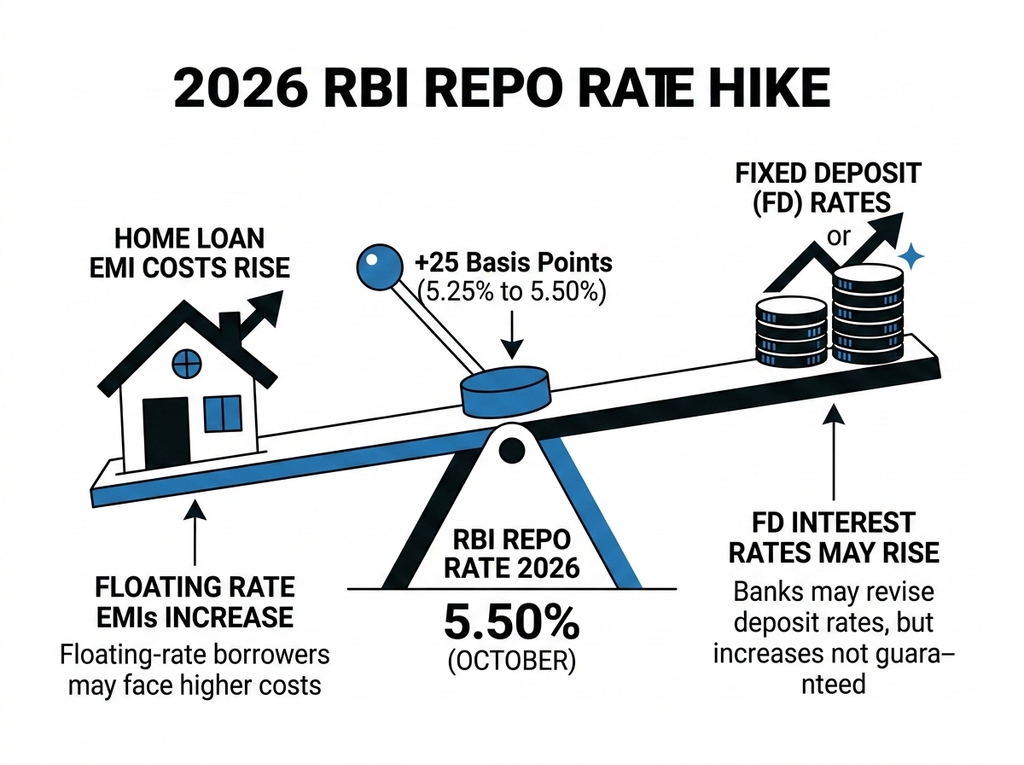
This decision matters to people paying home loan EMIs, planning to borrow money or investing in fixed deposits (FDs). A higher repo rate can increase borrowing costs, while banks may respond by revising their lending and deposit interest rates.
However, a repo rate hike does not automatically mean every bank will immediately increase every loan or FD rate. The actual impact depends on the bank, loan benchmark, loan agreement, deposit tenure and the timing of any rate revision.
RBI Repo Rate 2026: Key Highlights
| Particulars | Latest Update |
| Policy repo rate | 5.50% |
| Previous repo rate | 5.25% |
| Latest change | Increase of 0.25 percentage points |
| Date of rate change | 7 October 2026 |
| Monetary policy stance | Calibrated tightening |
| Home loan impact | Floating-rate borrowers may face higher interest costs |
| FD impact | Banks may revise deposit rates, but increases are not guaranteed |
| Main authority | Reserve Bank of India (RBI) |
Source: RBI monetary policy announcement and reporting by Reuters. Check the RBI official website for the primary policy record and subsequent updates.
What Is the Repo Rate?
The repo rate is the interest rate at which the RBI lends money to eligible banks against securities under its monetary policy framework.
The RBI uses this rate as one of its main tools to influence borrowing costs, credit growth and inflation in the economy.
When inflationary pressures rise, the RBI may increase the repo rate to make borrowing more expensive and moderate demand. When economic conditions support lower rates, it may reduce the rate to encourage borrowing and spending.
How Does the Repo Rate Work?
The process is relatively simple:
- The RBI changes its policy repo rate.
- Banks assess their funding costs, liquidity and lending benchmarks.
- Banks may revise eligible loan interest rates.
- Borrowers may see changes in their EMI, loan tenure or total interest payable.
- Banks may also revise FD interest rates depending on their funding requirements and market conditions.
These changes do not necessarily happen at the same time across all banks.
Why Did the RBI Increase the Repo Rate in October 2026?
The October 2026 increase came amid concerns about rising inflation, higher oil prices and global economic uncertainty.
The RBI must balance two important goals: keeping inflation under control and supporting sustainable economic growth.
A higher policy rate can help moderate demand and inflationary pressures, but it can also make loans more expensive for households and businesses.
For borrowers, the main concern is whether banks pass the increase on to their loans. For savers, the question is whether banks respond by offering better interest rates on new fixed deposits.
You can follow official updates through the RBI website and its monetary policy publications.
How Will the RBI Repo Rate Hike Affect Home Loan EMI?
Home loans are one of the most important areas affected by changes in interest rates.
If your home loan has a floating interest rate linked to an external benchmark, such as the repo rate, a rate increase may raise your borrowing cost when your lender resets the loan rate.
However, the effect depends on your bank’s benchmark, spread, reset schedule and loan terms.
1. Existing Home Loan Borrowers
If you already have a floating-rate home loan, your lender may increase your interest rate following the repo rate hike.
Depending on your loan agreement, the bank may:
- Increase your monthly EMI.
- Keep your EMI unchanged but extend your repayment tenure.
- Apply another adjustment permitted by your loan terms.
If your loan has a fixed interest rate for the relevant period, the immediate effect may be different. Check your loan agreement to understand when and how your rate can change.
2. People Planning to Take a New Home Loan
A higher repo rate can make new home loans more expensive if banks raise their lending rates.
Before choosing a lender, compare the effective interest rate, processing fees, reset terms, benchmark and total repayment cost—not just the advertised starting rate.
3. Home Loan EMI Example After a 25 Basis Point Increase
Consider a borrower with a ₹50 lakh home loan and a remaining repayment period of 20 years.
The following is an illustrative calculation, not a prediction of any particular bank’s rate. It assumes that the interest rate increases from 8.50% to 8.75%, with the outstanding principal and repayment period unchanged.
| Particulars | Before Increase | After Increase |
| Loan amount | ₹50,00,000 | ₹50,00,000 |
| Assumed annual interest rate | 8.50% | 8.75% |
| Repayment period | 20 years | 20 years |
| Approximate monthly EMI | ₹43,391 | ₹44,178 |
| Approximate monthly increase | — | ₹787 |
Under these assumptions, the monthly EMI increases by approximately ₹787.
Actual figures may differ slightly because of rounding and the lender’s calculation method. The example also assumes that the rate change applies immediately and the repayment period stays the same.
How to Calculate Your Home Loan EMI
You can calculate EMI using standard home loan EMI calculations with the formula:
EMI = P × r × (1 + r)ⁿ ÷ [(1 + r)ⁿ − 1]
Where:
- P = Outstanding loan principal.
- r = Monthly interest rate, calculated by dividing the annual rate by 12.
- n = Remaining number of monthly instalments.
For example, if your annual interest rate is 8.75%, your monthly rate is approximately 0.7292%.
To estimate your own EMI, use your outstanding loan amount, current interest rate and remaining tenure. For a more accurate result, use your lender’s EMI calculator.
What Should Existing Home Loan Borrowers Do?
If your interest rate increases, consider these steps:
- Check your revised rate: Review your loan statement or contact your bank.
- Ask about the reset date: Your loan may not change immediately after the RBI announcement.
- Compare EMI and tenure options: Decide whether a higher EMI or a longer tenure suits your budget.
- Review your spread: Ask your lender whether your loan’s spread or benchmark has changed.
- Compare balance-transfer offers: Consider switching lenders only after accounting for processing fees, legal charges and other costs.
- Make prepayments carefully: If you have surplus funds, check whether a part-payment could reduce your interest burden without affecting your emergency savings.
How Will the RBI Repo Rate 2026 Affect FD Interest Rates?
Fixed deposit investors may benefit if banks raise deposit rates after a repo rate hike. Banks sometimes offer higher rates to attract deposits and meet their funding requirements.
However, FD interest rates do not automatically increase whenever the RBI raises the repo rate.
A bank may increase rates for selected tenures, leave existing rates unchanged or adjust rates at a later date. The decision depends on its liquidity position, funding needs, competition and expectations about future interest rates.
Will FD Rates Increase After the October 2026 Repo Rate Hike?
Banks may review their FD rates following the latest increase, but the extent and timing of any revision will differ between institutions.
Before booking a deposit, check the bank’s official rate card for your chosen tenure and deposit amount.
| FD Situation | What It Means for You |
| You already have a fixed-rate FD | Your contracted rate generally remains unchanged until maturity, subject to the deposit’s terms. |
| You are opening a new FD | You receive the rate applicable when the deposit is booked. |
| Your FD is nearing maturity | Compare the latest rates before renewing. |
| You want to lock in a long tenure | Consider whether a fixed return or flexibility is more important to you. |
| You are a senior citizen | Check whether the bank offers an additional senior-citizen rate and the applicable conditions. |
Example: How a Higher FD Rate Can Affect Returns
Suppose you invest ₹5 lakh in a one-year FD.
| Annual FD Rate | Approximate Interest for One Year |
| 6.50% | ₹32,500 |
| 6.75% | ₹33,750 |
| 7.00% | ₹35,000 |
These examples use simple annual interest for easy comparison. Actual FD maturity amounts depend on whether interest is paid periodically or compounded, the compounding frequency, the tenure and the bank’s terms. Tax may also apply.
A difference of 0.25 percentage points would mean approximately ₹1,250 more in one year on ₹5 lakh under this simple-interest illustration.
Should You Wait for Higher FD Rates?
There is no guarantee that banks will increase FD rates further. Waiting may help if rates rise, but it could also mean missing a currently attractive offer.
You can consider the following options:
- Compare rates across several banks and deposit tenures.
- Divide a large investment into multiple deposits with different maturity dates.
- Keep emergency funds accessible rather than locking all savings into long-term deposits.
- Check premature-withdrawal penalties and the tax treatment of interest.
- Review deposit insurance rules before placing a large amount with one bank.
For eligible bank deposits, the Deposit Insurance and Credit Guarantee Corporation (DICGC) generally provides insurance of up to ₹5 lakh per depositor per bank, including principal and interest, subject to its rules. Read the official DICGC information. Fixed deposits can also play a vital role alongside PPF and NPS when structuring long-term retirement planning.
Home Loan vs FD: Who Benefits From the Repo Rate Hike?
The effect differs depending on whether you are borrowing or saving.
| Financial Situation | Possible Impact |
| Existing floating-rate home loan | Borrowing costs may increase when the lender resets the rate. |
| New home loan applicant | May face higher lending rates if the bank revises its offers. |
| Person planning an FD | May find better rates if banks revise selected deposit tenures. |
| Existing fixed-rate FD investor | Usually keeps the contracted rate until maturity, subject to the FD terms. |
| Senior citizen relying on FD income | Could benefit from improved rates on new or renewed deposits if available. |
| Business seeking a loan | May face higher financing costs if the lender passes on the increase. |
The key takeaway is that borrowers may feel the pressure of higher rates, while savers may benefit only if their bank offers more attractive deposit rates.
Will Personal Loan and Car Loan Interest Rates Also Increase?
They may, but the effect depends on the type of loan and the lender’s pricing policy.
Some loans have floating rates, while others have fixed rates for the agreed period. Personal loans and car loans may also be priced using factors beyond the repo rate, including the borrower’s credit profile, income, repayment history and the lender’s cost of funds.
If you are planning to take a personal loan or car loan, compare the annual percentage cost where available, processing fees, repayment schedule and prepayment conditions.
Do not assume that every loan rate will rise by exactly 0.25 percentage points just because the RBI increased the repo rate by that amount.
What Should Borrowers and Investors Do Now?
The right approach depends on your financial goals.
If You Have a Home Loan
- Check whether your loan is fixed or floating.
- Confirm the benchmark and the next reset date.
- Calculate the impact of a possible rate increase on your EMI.
- Maintain enough cash for essential expenses and loan payments.
- Compare refinancing options only after calculating the total switching cost.
If You Are Planning to Invest in FDs
- Compare official FD rate cards from banks.
- Check rates for the exact tenure you need.
- Consider splitting deposits across different maturity dates.
- Understand premature-withdrawal rules.
- Check tax implications and deposit insurance coverage, or explore broader FD investment strategies.
If You Are Planning to Buy a House
- Calculate affordability using a realistic interest rate.
- Leave room in your budget for possible future rate changes.
- Compare the total loan cost, not only the initial EMI.
- Ask lenders how rate changes affect EMI and tenure.
- Avoid taking on a loan that leaves too little money for emergencies.
Where to Check Official RBI and Bank Updates
Use reliable sources when checking the latest rates and loan terms.
| Resource | What You Can Find | Link |
| Reserve Bank of India | Monetary policy announcements and official information | RBI official website |
| RBI monetary policy publications | Policy statements and related documents | RBI publications |
| State Bank of India | Home loan information and FD rates | SBI official website |
| HDFC Bank | Home loan products and deposit information | HDFC Bank official website |
| ICICI Bank | Loan and FD product details | ICICI Bank official website |
| DICGC | Deposit insurance rules and coverage | DICGC official website |
Rates and product conditions may change. Always check the latest information directly with the bank before making a financial decision.
Frequently Asked Questions (FAQs)
1. What is the RBI repo rate in October 2026?
The RBI increased the policy repo rate to 5.50% on 7 October 2026, up from 5.25%, an increase of 25 basis points.
2. Will home loan EMI increase after the RBI repo rate hike?
Your EMI may increase if your lender raises the interest rate on your floating-rate loan. The actual impact depends on your loan benchmark, reset schedule, outstanding principal and repayment tenure.
3. Will FD interest rates increase after the repo rate hike?
Banks may increase FD rates, but there is no guarantee. They may revise rates for selected tenures or keep existing rates unchanged.
4. Do home loans offer tax benefits under the RBI Repo Rate 2026 regime?
Yes, eligible borrowers can claim interest deductions up to ₹2 lakh under Section 24(b) and principal repayments under Section 80C under the old tax regime. Read our detailed guide on home loan tax benefits for complete eligibility details.
5. Is a fixed-rate home loan affected by the repo rate hike?
A fixed-rate loan may not be affected immediately during its fixed-rate period. However, the loan agreement determines whether and when the interest rate can change.
6. Can I reduce my home loan interest burden after a rate increase?
You can review your lender’s rate, compare balance-transfer offers, consider part-prepayment if affordable and ask whether changing the EMI or tenure would suit your finances. Calculate all fees before switching lenders.
7. Does a 0.25% repo rate increase mean my home loan rate will also rise by 0.25%?
Not necessarily. The lender’s benchmark, spread, loan terms and pricing decisions determine the actual change. Some borrowers may experience a different adjustment or no immediate change.
8. Where can I check the latest RBI repo rate?
Visit the official RBI website and check its latest monetary policy announcements. For your personal loan or FD rate, consult your bank’s official website or branch.
Final Takeaway
The October 2026 repo rate increase to 5.50% is important for both borrowers and savers. People with eligible floating-rate home loans may face higher borrowing costs, while FD investors could benefit if banks offer better rates on new deposits.
Understanding the overall trajectory of the RBI Repo Rate 2026 helps borrowers and savers make informed choices. Still, the impact will vary from one bank and product to another. Before making a decision, check the latest official rates, calculate your EMI or expected FD return, and compare the terms carefully.
Disclaimer: This article is for general information and educational purposes only. Interest rates, loan terms and deposit returns can change. Confirm all figures with the RBI and your bank before making financial decisions. For additional guidance, explore our loans and credit guides.
Author & Reviewer Information
Written by: Srinivas Joshi, Senior Personal Finance Analyst & Banking Writer