
Best Health Insurance for Parents Over 60 in India: Costs, Coverage and Exclusions
Written By: Srinivas Joshi, Senior Financial & Insurance Analyst
Reviewed By: Medical & Health Insurance Advisory Panel
Introduction
Finding the best health insurance for parents over 60 in India can be challenging. At this age, medical expenses may increase, regular health check-ups become more important, and conditions such as diabetes, high blood pressure and heart disease may affect insurance eligibility and premiums.
A suitable health insurance policy can help your parents manage eligible hospitalisation expenses without using all their savings. However, not every policy offers the same benefits. Some plans have co-payment requirements, disease-specific waiting periods, room-rent restrictions or limits on particular treatments.
The right policy is not necessarily the cheapest one. It is the policy that offers suitable coverage for your parents’ medical needs, at a premium you can afford over the long term.
In this guide, we compare senior citizen health insurance options, explain the costs and exclusions to check, and share practical tips for choosing a policy in 2026.
Best Health Insurance for Parents Over 60 in India: Quick Comparison
The following insurers offer products worth comparing for older adults. Product names, features, eligibility and terms can change, so check the latest policy wording before buying.
| Insurance Company | Plan to Explore | What to Check Carefully | Official Website |
| Star Health | Senior Citizens Red Carpet | Co-payment, room-rent limits, disease waiting periods and eligible treatments | Star Health |
| Care Health Insurance | Care Supreme Senior | Pre-existing disease waiting period, recharge benefits, coverage limits and exclusions | Care Health Insurance |
| HDFC ERGO | Optima Secure / Optima Secure+ | Eligibility at entry, applicable co-payment, room-rent conditions and add-on terms | HDFC ERGO |
| Niva Bupa | Senior-eligible health plans | Entry age, waiting periods, restoration benefits and hospital network | Niva Bupa |
| Aditya Birla Health Insurance | Senior-eligible health plans | Chronic disease provisions, waiting periods, co-payment and wellness conditions | Aditya Birla Health Insurance |
Important: This is a shortlist for comparison, not a ranking or guarantee that every plan will accept every applicant. Insurers may apply medical underwriting, request tests or offer different terms based on age and medical history.
1. Star Health Senior Citizens Red Carpet
Star Health offers a dedicated product called Senior Citizens Red Carpet. It is designed for older adults who want health insurance for eligible medical expenses.
What to compare:
- Available sum-insured options.
- Co-payment requirements.
- Room-rent and ICU limits.
- Waiting periods for pre-existing diseases and specified treatments.
- The list of covered hospitalisation expenses and exclusions.
Official product information and policy documents are available through the Star Health website.
Who should consider it? Parents who prefer to compare a policy specifically marketed for senior citizens, especially when they need to review age-related eligibility and coverage restrictions carefully.
Do not decide based on the product name alone. Check the current brochure and Customer Information Sheet (CIS) to understand the actual benefits.
2. Care Supreme Senior
Care Health Insurance offers Care Supreme Senior for older adults. Its official product page describes features such as hospitalisation benefits, annual health check-ups, cumulative bonuses and automatic recharge, subject to policy terms.
The insurer states that pre-existing conditions are covered after a four-year waiting period for this product. Confirm the current wording and applicable terms directly with the insurer before purchase.
What to compare:
- The waiting period for existing illnesses.
- Whether co-payment applies and under what circumstances.
- Automatic recharge conditions.
- Room-rent and treatment limits.
- Premium at your parents’ exact ages.
Read the details on the official Care Supreme Senior page.
Who should consider it? Families comparing senior-specific policies with restoration or recharge benefits. Remember that a recharge benefit is subject to conditions and does not necessarily mean every hospital bill will be paid in full.
3. HDFC ERGO Health Insurance for Senior Citizens
HDFC ERGO lists health insurance options for senior citizens, including Optima Secure and Optima Secure+.
When comparing these plans, focus on the coverage available at your parent’s age, the premium quoted for the chosen sum insured and the conditions attached to additional coverage benefits.
What to compare:
- Entry-age eligibility under the current product version.
- Applicable co-payment and deductible provisions.
- Room-rent restrictions, if any.
- Pre-existing disease and specified-treatment waiting periods.
- The conditions attached to restoration and additional-cover benefits.
Visit the HDFC ERGO senior citizen health insurance page.
Who should consider it? Families looking at broader health insurance products rather than limiting their search to policies marketed exclusively for senior citizens.
4. Niva Bupa Health Insurance
Niva Bupa offers multiple health insurance products. Eligibility for older applicants and the terms available depend on the specific plan.
Before selecting a product, ask for a quotation based on your parent’s age, city, medical history and required sum insured.
Check:
- Whether the plan accepts applicants at the required age.
- Waiting periods for pre-existing diseases.
- Whether co-payment or deductibles apply.
- How restoration benefits work.
- Which nearby hospitals are included in the cashless network.
Visit the official Niva Bupa website to review current products and policy documents.
Who should consider it? Families who want to compare multiple plan designs and verify whether the available benefits match their parents’ existing medical needs.
5. Aditya Birla Health Insurance
Aditya Birla Health Insurance also offers health insurance products that may be relevant to older adults, subject to product-specific eligibility.
When evaluating a policy, check whether the insurer offers terms suitable for your parent’s chronic conditions and whether any additional benefit requires an add-on or fulfilment of specific conditions.
Review:
- Entry-age requirements.
- Coverage for disclosed pre-existing conditions.
- Waiting periods and exclusions.
- Co-payment, deductibles and sub-limits.
- Hospital network and claims procedures.
Visit the official Aditya Birla Capital Health Insurance website.
Who should consider it? Families looking for another option to compare against senior-specific policies, particularly when their parents need coverage for ongoing medical conditions.
How Much Does Health Insurance for Parents Over 60 Cost?
The premium depends on several factors. There is no single price that applies to every senior citizen.
The main factors include:
- Age: A policy for a 70-year-old may cost more than a comparable policy for a 60-year-old.
- Medical history: Diabetes, hypertension, heart disease and other conditions may affect underwriting and the final premium.
- Sum insured: Higher coverage generally costs more.
- City and hospital costs: Location and the insurer’s pricing structure can affect the quotation.
- Co-payment and deductible: A plan with greater cost-sharing may have a lower premium, but you may pay more during a claim.
- Policy benefits: Restoration, add-ons and other benefits may affect the cost.
- Individual versus floater cover: The premium and shared coverage structure may differ.
Health Insurance Premium Comparison: What to Budget For
Instead of relying on a generic online price, obtain current quotations for the exact age, location, medical history and sum insured.
| Comparison Item | Quote A | Quote B | Quote C |
| Insurer and plan | Enter details | Enter details | Enter details |
| Parent’s age | Same age | Same age | Same age |
| Sum insured | Same amount | Same amount | Same amount |
| Annual premium | Check quote | Check quote | Check quote |
| Pre-existing disease waiting period | Check policy | Check policy | Check policy |
| Co-payment | Check policy | Check policy | Check policy |
| Room-rent limit | Check policy | Check policy | Check policy |
| Nearby hospitals covered | Check network | Check network | Check network |
| Important exclusions | Check wording | Check wording | Check wording |
For a fair comparison, request quotations using the same sum insured and broadly similar coverage requirements. A lower premium does not automatically mean better value.
Is ₹5 Lakh or ₹10 Lakh Health Insurance Enough for Parents?
It depends on your parents’ health, city, hospital preferences, existing insurance and available savings.
A ₹5 lakh policy may help with eligible hospital bills, but a major procedure or a longer hospital stay can exceed that amount. A ₹10 lakh policy provides a higher base limit, although exclusions, co-payments and sub-limits still affect the amount payable.
Consider these options:
- Compare ₹5 lakh and ₹10 lakh base coverage.
- Check whether a higher sum insured is available at an affordable premium.
- Explore a suitable super top-up policy if you understand its deductible and claim conditions.
- Review whether existing employer or individual cover can be retained.
- Keep emergency savings for expenses that insurance does not cover.
There is no universally correct sum insured for every family.
What Does Senior Citizen Health Insurance Cover?
Coverage varies by policy. Common benefits may include the following, subject to the policy’s conditions.
| Benefit | What It May Cover |
| In-patient hospitalisation | Eligible medical expenses when the insured person is admitted to hospital |
| Day-care treatment | Listed procedures that do not require a 24-hour hospital stay |
| Pre- and post-hospitalisation | Eligible medical expenses incurred within the specified periods before or after hospitalisation |
| Ambulance charges | Covered ambulance expenses within policy limits |
| Organ donor expenses | Eligible expenses related to organ donation, subject to policy terms |
| AYUSH treatment | Eligible treatment under covered systems of medicine, according to the policy |
| Home treatment or domiciliary hospitalisation | Only where the policy includes it and its conditions are satisfied |
| Annual health check-ups | Available in some plans, subject to specified conditions |
| Restoration or recharge | Additional cover after qualifying use of the sum insured, subject to the benefit’s rules |
Never assume that a benefit is unlimited just because it appears in an advertisement. Check the Customer Information Sheet and full policy wording.
Pre-Existing Disease Cover: What Parents Must Know
Pre-existing disease cover is one of the most important factors when buying medical insurance for parents over 60.
A pre-existing disease may include a condition diagnosed, treated or advised for treatment before the policy begins, according to the applicable definition.
Examples may include:
- Diabetes.
- High blood pressure.
- Heart disease.
- Asthma.
- Thyroid disorders.
- Other ongoing or previously diagnosed illnesses.
An insurer may accept an application after assessing the medical details, but coverage for an existing condition may begin only after the applicable waiting period. Terms can differ by policy and by condition.
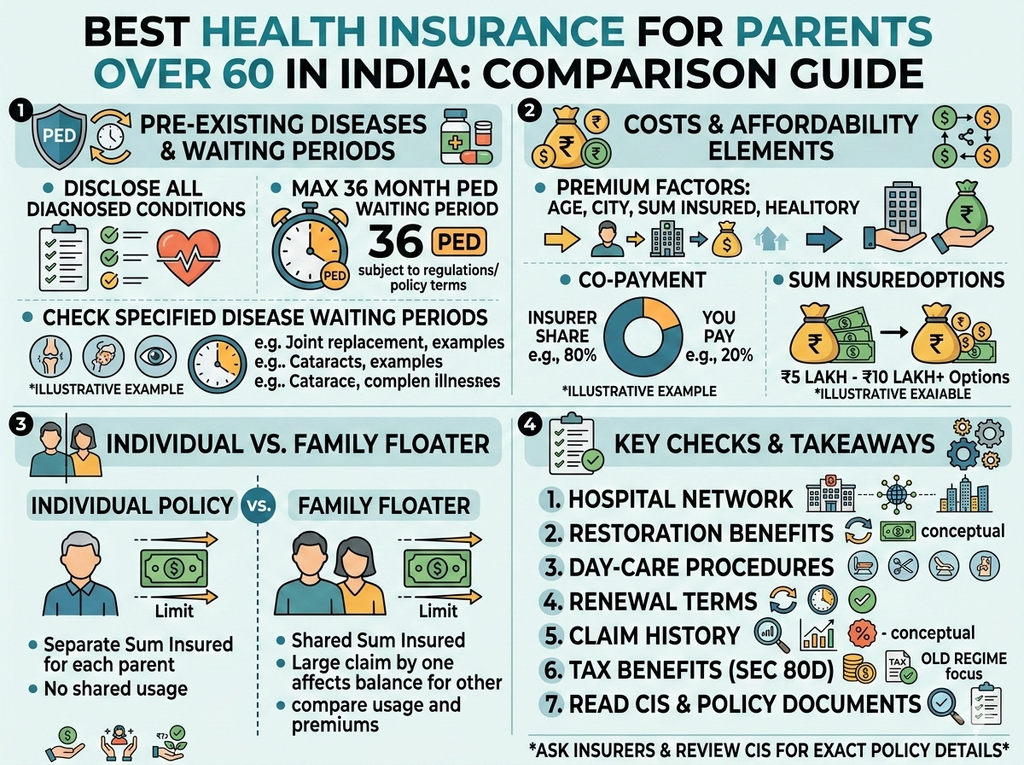
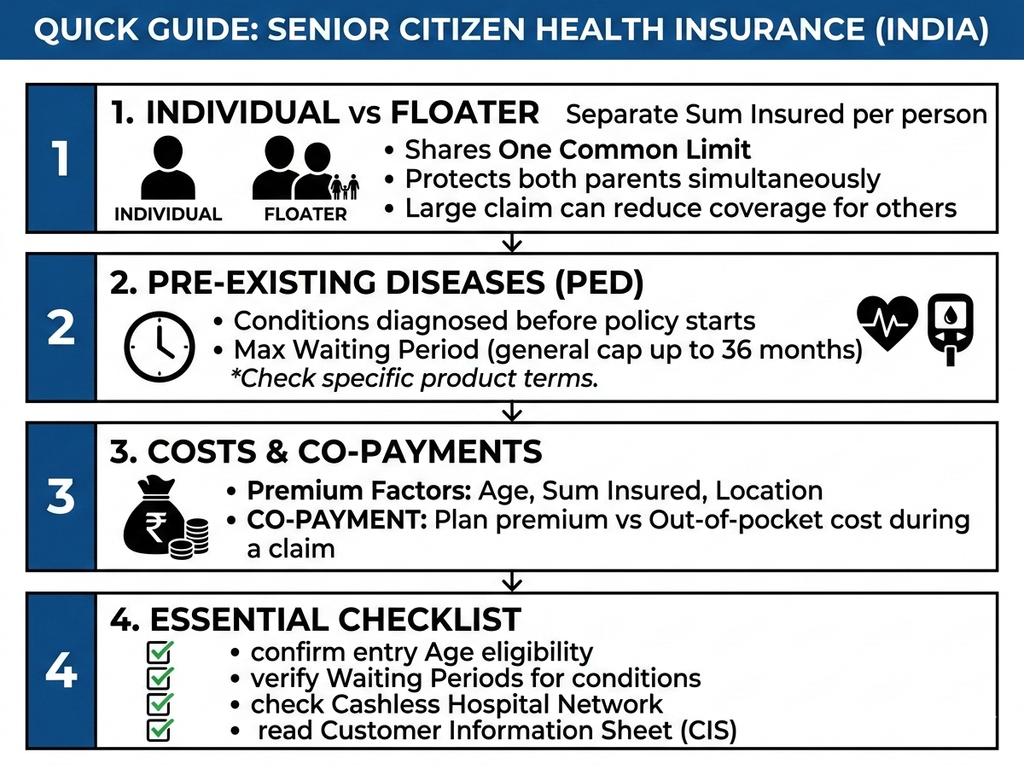
Under the applicable IRDAI health insurance framework, the maximum waiting period for pre-existing diseases and specified diseases or procedures is generally capped at 36 months. Always verify the current regulatory requirements and the actual waiting period in the policy being offered.
Read the IRDAI health insurance regulations FAQ for further information.
How to Get Better Coverage for Existing Conditions
- Disclose all diagnosed conditions, medicines, previous surgeries and relevant medical advice.
- Submit medical records and test results when requested.
- Ask the insurer to confirm any special terms or exclusions in writing.
- Compare waiting periods for the conditions that matter most to your parents.
- Do not cancel an existing policy until a replacement has been accepted and the implications are clear.
Important: Never hide a medical condition to obtain a lower premium. Inaccurate or incomplete disclosure can lead to claim disputes and other consequences under the policy.
Important Exclusions in Senior Citizen Health Insurance
Health insurance does not cover every medical expense. The exact exclusions depend on the policy wording.
| Exclusion or Restriction | What It Means |
| Initial waiting period | Illness-related claims may not be covered during the initial waiting period, subject to policy terms and exceptions such as eligible accident claims. |
| Pre-existing disease waiting period | A disclosed existing condition may not be covered until its applicable waiting period ends. |
| Specified disease waiting period | Certain illnesses or procedures may have a separate waiting period. |
| Co-payment | You must pay the specified percentage of an admissible claim. |
| Deductible | You pay eligible expenses up to the deductible before the policy begins paying, as specified in the contract. |
| Room-rent or treatment sub-limits | The insurer’s payment may be restricted to a stated amount for particular expenses. |
| Non-medical expenses | Certain administrative or personal expenses may not be payable unless the policy covers them. |
| Cosmetic treatment | Cosmetic procedures are commonly excluded unless an applicable exception or covered medical indication applies. |
| Non-disclosure or misrepresentation | Failure to provide accurate information can create serious problems with claims or policy validity. |
The precise treatment of every expense depends on the policy. Review the exclusions section before paying the premium.
What Is Co-Payment in Senior Citizen Health Insurance?
Co-payment means that you must pay a specified portion of an admissible claim, while the insurer pays the covered balance according to the policy.
For example, suppose the admissible claim amount is ₹2 lakh and the policy has a 20% co-payment.
| Particulars | Amount |
| Admissible claim | ₹2,00,000 |
| Policyholder’s 20% co-payment | ₹40,000 |
| Insurer’s share before other applicable limits | ₹1,60,000 |
This is an illustration. The final amount may differ if exclusions, deductibles, sub-limits or other policy conditions apply.
A plan with a co-payment may have a lower premium, but it can also mean a larger out-of-pocket expense during hospitalisation. Compare the potential claim cost with the premium saving before choosing it.
Individual Policy vs Family Floater for Parents Over 60
An individual policy gives each insured parent a separate sum insured. A family floater generally shares one sum insured among the covered members.
| Feature | Individual Policy | Family Floater |
| Sum insured | Separate limit for each insured person | Shared limit for covered members |
| Use of coverage | One parent’s claim generally does not consume the other parent’s separate sum insured | A large claim by one parent can reduce the balance available to the other |
| Premium | Depends on each insured person’s details and the plan | Depends on the members covered and the product’s pricing |
| Flexibility | Easier to choose different coverage levels for each parent | One common coverage arrangement |
| Main consideration | Separate limits may offer greater protection when both parents need treatment | A shared limit may be insufficient if both parents have significant claims |
For older parents, compare both structures rather than assuming a floater will always be cheaper or better.
How to Choose the Best Health Insurance for Parents Over 60
Follow these steps before buying a policy.
Step 1: List Their Medical Needs
Write down existing illnesses, medicines, previous surgeries, regular tests and preferred hospitals. This helps you compare the features that matter most.
Step 2: Check Eligibility
Some policies have age limits or specific underwriting requirements. Confirm that the insurer will accept each parent at their current age.
Step 3: Compare the Waiting Periods
Check waiting periods for pre-existing diseases and specified treatments. A shorter waiting period may be valuable if the relevant condition is likely to require treatment, but read all associated terms.
Step 4: Review Co-Payment and Sub-Limits
Understand how much your parents might need to pay from their own savings during a claim. Look beyond the annual premium.
Step 5: Check the Hospital Network
Verify whether nearby hospitals and the hospitals your parents prefer are in the insurer’s current cashless network. Network status can change.
Step 6: Compare the Final Premium
Obtain a personalised quote after giving accurate information. Include applicable taxes and any add-on costs shown in the quotation.
Step 7: Read the Customer Information Sheet
The CIS summarises the main benefits, exclusions, limits and waiting periods. Read it along with the full policy wording.
The IRDAI health department provides useful guidance for policyholders.
Can You Buy Health Insurance for Parents Above 70 or 75?
Some health insurance products accept applicants above 70 or 75, but availability depends on the product, insurer and underwriting assessment.
Do not assume that every senior citizen policy has the same entry-age limit. Ask the insurer for written confirmation of:
- The maximum entry age.
- Whether medical tests are required.
- Whether the insurer can apply special terms.
- Waiting periods and disease exclusions.
- The renewal conditions after the policy is issued.
If a new policy is difficult to obtain, review any existing coverage and ask insurers or a qualified insurance adviser about suitable alternatives. Do not discontinue an existing policy before understanding the risks.
Tax Benefits on Health Insurance for Senior Citizen Parents
Under Section 80D of the Income-tax Act, eligible health insurance premiums for parents who qualify as senior citizens may receive a deduction of up to ₹50,000 under the applicable conditions when using the old tax regime.
Preventive health check-up expenses can also count within the prescribed limits. The exact deduction depends on the taxpayer’s circumstances and the tax rules applicable for the relevant financial year.
Important: Deductions under Section 80D generally are not available under the new tax regime. Verify the applicable law and your eligibility before claiming a deduction.
For official tax information, visit the Income Tax Department website.
What to Do If a Health Insurance Claim Is Rejected
If a claim is rejected or reduced, follow the insurer’s grievance process.
- Ask for the written reason for the decision.
- Review the relevant policy clause and the documents submitted.
- Provide missing medical records or other information if appropriate.
- Raise a formal complaint with the insurer’s grievance redressal officer.
- If the issue remains unresolved, follow the escalation process described by IRDAI, including the Insurance Ombudsman route where applicable.
Keep the policy document, claim number, hospital bills, discharge summary, medical records and correspondence together.
Visit the IRDAI official website for current grievance redressal information.
Frequently Asked Questions
1. Which is the best health insurance for parents over 60 in India?
There is no single best plan for everyone. Compare products from Star Health, Care Health Insurance, HDFC ERGO, Niva Bupa and Aditya Birla Health Insurance based on your parents’ medical history, premium, waiting periods, co-payment and hospital network.
2. How much health insurance should I buy for my parents?
Compare available ₹5 lakh and ₹10 lakh options as a starting point, then assess local hospital costs, existing coverage, medical needs and your budget. A higher sum insured can provide a larger limit, but exclusions and co-payments still matter.
3. Can senior citizens with diabetes buy health insurance?
Some insurers may accept applicants with diabetes after assessing their medical history. The policy may have waiting periods, exclusions or special terms. Disclose the condition fully and obtain written confirmation of coverage.
4. Does senior citizen health insurance cover pre-existing diseases from day one?
Not necessarily. Coverage depends on the policy’s terms, waiting period and any special conditions accepted by the insurer. Check the exact policy wording before buying.
5. Is a family floater better than separate policies for parents?
It depends on your parents’ health and the available sum insured. Separate policies provide individual limits, while a floater shares the limit. Compare premiums and the possibility of both parents needing treatment in the same policy year.
6. Can I buy health insurance for a 75-year-old parent?
Some products may accept applicants at this age, but eligibility and underwriting vary. Confirm the current entry-age requirements directly with the insurer.
7. Why is health insurance expensive for senior citizens?
Premiums can reflect age-related risk, medical history, coverage amount, location, policy benefits and the insurer’s pricing. Compare the final quoted premium alongside the out-of-pocket costs that may arise during a claim.
8. What is the maximum waiting period for pre-existing diseases?
Under the applicable IRDAI health insurance framework, the maximum waiting period is generally 36 months. Check the current regulations and the waiting period stated in your chosen policy.
9. Can I claim tax benefits for insurance premiums paid for my parents?
Eligible premiums may qualify for a deduction under Section 80D when the applicable tax-regime and other requirements are met. Check current Income Tax Department guidance before claiming.
10. What should I check before paying the first premium?
Confirm the insured person’s details, disclosed medical history, sum insured, waiting periods, co-payment, room-rent limits, exclusions, cashless hospital network and renewal terms. Keep a copy of the policy and Customer Information Sheet.
Final Verdict
The best health insurance for parents over 60 in India is the policy that fits their health requirements and remains affordable over time. Compare senior-specific products with other eligible health plans, and focus on actual coverage rather than marketing claims.
Before making a decision, obtain personalised quotations, check the hospital network, read the Customer Information Sheet and disclose all existing illnesses. A careful comparison today can help your family understand both the protection available and the expenses you may still need to pay.
Disclaimer: This article is for general educational purposes and is not personalised insurance, medical or tax advice. Product availability, premiums, eligibility, waiting periods and policy conditions can change. Confirm all details with the insurer and review the current policy wording before purchasing.
Editorial Note: We regularly review and update this guide whenever insurers revise their policy wording, premiums, or eligibility conditions to ensure all information remains accurate and up to date.