
Education Loan Without Collateral for Abroad Studies 2026: Eligibility, Banks and Documents
Studying abroad can open doors to better education, international work opportunities and career growth. But tuition fees, accommodation, travel and living expenses can make the dream expensive. What if your family does not own property or cannot pledge assets to a bank?
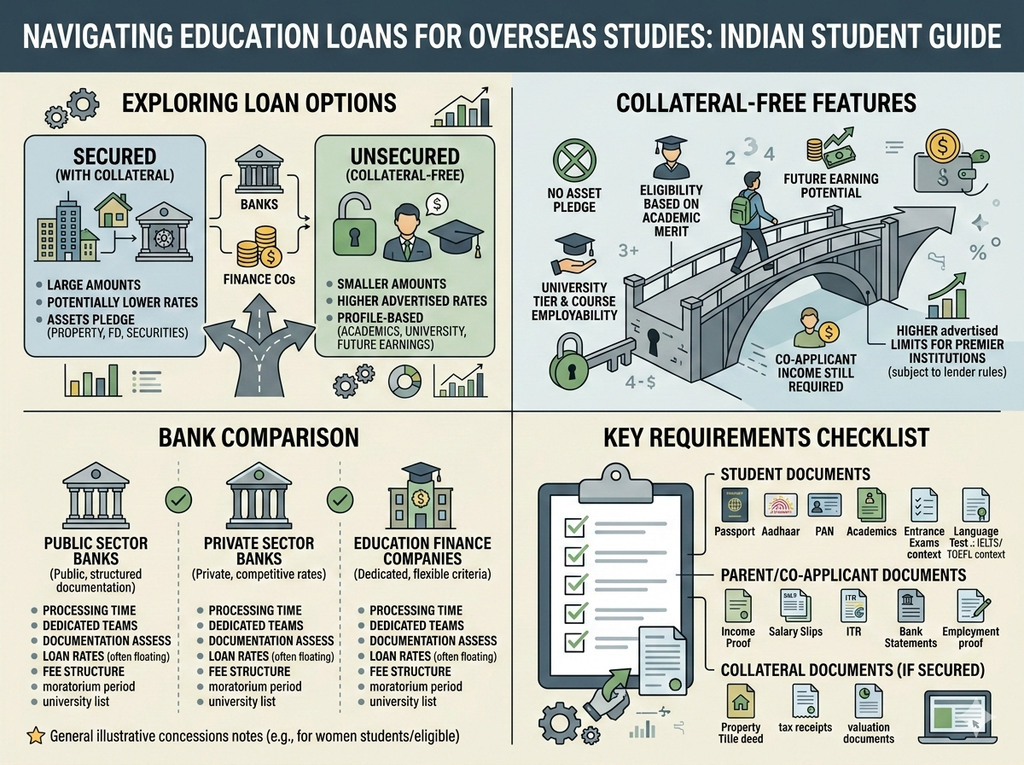
An education loan without collateral for abroad studies 2026 may help eligible Indian students finance their overseas education without pledging a house, land or other security. However, approval depends on the lender, university, course, academic record and the financial profile of the student and co-applicant.
In this guide, you will learn how unsecured study abroad loans work, which lenders offer collateral-free options, what documents are needed, how eligibility is assessed, and what to check before accepting a loan offer.
Education Loan Without Collateral for Abroad Studies 2026: Quick Overview
An education loan without collateral is a loan that does not require you to pledge property or another asset as security. It is also called an unsecured study abroad loan.
Some Indian banks and specialist education finance companies offer collateral-free loans to eligible students admitted to selected foreign universities. The loan amount and conditions vary considerably.
| Feature | What students should know |
| Collateral | Not required for eligible unsecured loan products |
| Co-applicant | A parent or other eligible co-borrower may be required |
| Loan amount | Depends on the lender, course, university and applicant profile |
| Eligible expenses | May include tuition, accommodation, travel and other approved costs |
| Interest rate | Depends on lender policy, course, university and credit assessment |
| Repayment | May start after the course or after a defined grace period |
| Approval | Subject to document verification and lender assessment |
Important: “Without collateral” does not mean “without a co-applicant,” “without income checks” or “guaranteed approval.” Always read the written loan offer and sanction letter.
What Is an Unsecured Study Abroad Loan?
An unsecured study abroad loan is an education loan for which the lender does not require the borrower to pledge property, a fixed deposit or another asset as collateral.
For example, imagine that a student receives admission to a master’s programme in Germany. The family can support part of the expenses but does not own property that can be pledged to a bank. The student may explore an unsecured education loan if the university, programme and co-applicant meet a lender’s criteria.
The lender still evaluates the repayment risk. It may consider the student’s academic history, chosen course, university reputation, expected employability, the co-applicant’s income and credit history.
Secured vs. unsecured education loans
| Comparison | Unsecured education loan | Secured education loan |
| Property pledge | Usually not required | Usually required |
| Approval | Based on eligibility and credit assessment | Based on eligibility, credit assessment and collateral |
| Loan amount | Depends on the lender and applicant profile | May allow higher funding where adequate collateral is accepted |
| Interest rate | May be higher than a comparable secured offer | May be lower, depending on the offer |
| Documentation | Academic, identity and financial documents | Includes additional collateral documents |
| Risk to family assets | No pledged property under the unsecured product | Pledged assets may be at risk if repayment obligations are not met |
Neither option is automatically better. Compare the actual interest rate, fees, repayment conditions and total cost before deciding.
Which Banks Offer Education Loans Without Collateral for Abroad Studies?
Several lenders publish collateral-free education loan options. The conditions are different, so students should compare them rather than assume that every applicant qualifies for the maximum advertised amount.
1. SBI Global Ed-Vantage
State Bank of India offers the Global Ed-Vantage scheme for eligible students pursuing full-time regular courses at foreign colleges and universities.
SBI’s official scheme page states that the product can finance overseas education, with loan amounts above ₹7.50 lakh and up to ₹3 crore. It also advertises collateral-free loans up to ₹50 lakh for students attending selected premier institutions. The collateral-free facility is not a general guarantee for all universities or applicants. Other eligibility and security conditions apply. Check the official SBI Global Ed-Vantage scheme.
Before applying, ask SBI to confirm:
- Whether your university is eligible for the collateral-free facility.
- The maximum amount available for your course.
- Whether a co-applicant or guarantor is required.
- The interest rate and processing fee applicable to your application.
- The repayment holiday and total repayment period.
SBI lists a processing fee of 0.50% of the loan amount, subject to a minimum of ₹10,000 and a maximum of ₹50,000, plus applicable GST, on its current scheme page. Confirm the amount payable before applying.
2. ICICI Bank education loan
ICICI Bank offers education loans for overseas study, including collateral-free options for eligible students.
Its official website says that collateral-free loans may be available up to ₹3 crore, depending on the course, institution and eligibility. This is a product-specific maximum, not an amount every student can automatically receive. Read ICICI Bank’s information on overseas education loans.
ICICI Bank’s published education loan rate page lists starting rates for overseas study of:
| Loan type | Published starting rate |
| Secured overseas education loan | 9.00% p.a. |
| Unsecured overseas education loan | 10.25% p.a. |
These are indicative starting rates, not guaranteed offers. The bank states that rates vary according to the course, institution, loan security, applicant profile and co-applicant credit history. Check the official ICICI Bank interest rate page for the current offer.
ICICI Bank may be worth comparing if you have secured admission to a recognised foreign university and meet its underwriting criteria. Ask whether your course and institution qualify for the collateral-free option.
3. HDFC Credila foreign education loan
HDFC Credila, whose foreign education loan product is presented on HDFC Bank’s website, also offers overseas education financing.
Its published product information states that unsecured loans may be available up to ₹75 lakh, subject to eligibility and approval. The applicable interest rate is floating and linked to Credila’s benchmark lending rate plus a spread based on the risk profile of the application. Review the official foreign education loan details.
The lender may consider the student’s academic background, course prospects, co-borrower’s financial strength, credit history and other underwriting factors.
Before applying, confirm:
- Whether your chosen university and programme qualify.
- The approved amount available without collateral.
- The rate and benchmark used for your loan.
- The moratorium and repayment terms.
- Processing fees and other applicable charges.
Do not rely only on the maximum amount shown on a product page. Request a written quotation for your individual case.
Compare lenders before making a decision
| Factor | SBI Global Ed-Vantage | ICICI Bank | HDFC Credila |
| Overseas education | Yes | Yes | Yes |
| Collateral-free option | Up to ₹50 lakh for selected premier institutions, subject to conditions | Advertised up to ₹3 crore, subject to eligibility | Advertised unsecured loans up to ₹75 lakh, subject to eligibility |
| Interest rate | Check current scheme rate | Overseas unsecured rates listed from 10.25% p.a. | Floating rate linked to benchmark plus spread |
| Co-applicant and financial assessment | Conditions apply | Conditions apply | Conditions apply |
| Best next step | Check institution eligibility | Request a written offer | Request a written offer |
Loan amounts and rates are based on the lenders’ published information available for this article. Product terms can change. The figures are not a ranking or a guarantee of approval.
Education Loan Without Collateral: Eligibility Criteria
Banks do not approve unsecured education loans solely because a student has received a university offer. They assess whether the student and co-applicant meet the lender’s requirements.
The exact eligibility criteria differ by lender.
1. Indian citizenship
Many Indian lenders require the student and relevant co-applicant to meet citizenship and residency conditions. Check the specific product rules before applying.
2. Confirmed admission or eligible university offer
You generally need an offer or admission letter from an eligible overseas university. Some lenders allow an initial or pre-admission assessment, but final disbursement depends on their conditions and the required documentation.
3. Academic record
Your previous marks, academic progression, entrance examination results and course selection may influence the lender’s assessment.
A strong academic record can support an application, but it does not guarantee loan approval.
4. Course and university eligibility
Some lenders offer higher collateral-free amounts for selected universities or courses. A programme at one institution may qualify for a different loan amount from the same programme at another institution.
For additional financial aid opportunities, you can explore study abroad scholarships and fully funded scholarships for 2027.
Ask the lender to confirm eligibility for your exact university, campus and course.
5. Co-applicant income
A co-applicant may be a parent, guardian or another eligible family member, depending on the lender’s policy.
The lender may ask for salary slips, income tax returns, bank statements or business income records to assess repayment capacity.
6. Credit history
The credit history of the co-applicant can affect the lender’s decision. Existing loans, repayment delays, outstanding obligations and credit score may be considered.
If you or your co-applicant have outstanding debts, ask the lender how those obligations affect your eligibility before applying.
7. Course cost and requested amount
The lender may compare the amount requested with the tuition fees, living expenses and other eligible costs. Scholarships, personal funds and other financial support may also affect the amount required.
How Much Education Loan Can You Get Without Property?
There is no single amount available to every student. The amount depends on the lender’s product, the institution, course, country, academic record and financial assessment.
For example:
- SBI advertises collateral-free funding up to ₹50 lakh for selected premier institutions under Global Ed-Vantage.
- ICICI Bank advertises collateral-free education loans up to ₹3 crore for eligible applicants and programmes.
- HDFC Credila advertises unsecured foreign education loans up to ₹75 lakh, subject to eligibility.
These are different products with different conditions. The highest advertised amount does not necessarily represent the best or most affordable loan.
Calculate your actual funding requirement
Before applying, prepare a budget covering:
- Tuition fees for each year of study.
- Accommodation and food.
- Health insurance.
- Visa and application expenses.
- Air tickets and local travel.
- Books, equipment and other academic costs.
- An emergency reserve, funded from an appropriate source.
Then subtract scholarships, family contributions, savings and other confirmed funding.
Example: If the total eligible study cost is ₹35 lakh and your family and scholarship can cover ₹10 lakh, you may need to arrange funding for the remaining ₹25 lakh. The lender will still decide how much it can approve.
Avoid borrowing more than necessary simply because a lender advertises a high maximum loan amount.
Documents Required for an Education Loan Without Collateral
Preparing your documents early can make the application process smoother. The exact checklist varies by lender and applicant profile.
Student documents
- PAN card, where required.
- Passport and other accepted identity proof.
- Address proof.
- Passport-size photographs.
- Class 10 and Class 12 marksheets.
- Graduation marksheets or certificates, if applicable.
- Entrance examination results, where applicable.
- Admission or offer letter from the foreign university.
- Course fee structure and estimated expenses.
- Scholarship or assistantship letter, if available.
- CV or statement of academic history, if requested.
Co-applicant documents
- PAN card and accepted identity proof.
- Address proof.
- Recent salary slips, if salaried.
- Form 16 and income tax returns, where applicable.
- Bank statements.
- Business registration or income documents, if self-employed.
- Details of existing loans and financial obligations.
Overseas study documents
Depending on the lender and stage of application, you may also need:
- University fee invoices.
- Course details and duration.
- Proof of scholarship or other funding.
- Visa-related documents.
- Country-specific insurance or financial documents.
- Any additional forms requested by the lender.
For example, ICICI Bank’s overseas education loan guidance lists academic records, the admission letter, identity and residence proof, and co-applicant income documents among the requirements. The bank may request additional documents based on the application. Check its official document guidance.
Tip: Keep your name, date of birth and other details consistent across your passport, academic certificates and application forms. If you find a mismatch, ask the relevant authority or lender how to correct it before submitting the final application.
Interest Rates, Processing Fees and Hidden Costs
An unsecured education loan may have a higher interest rate than a comparable secured loan. However, this is not a universal rule, and your actual offer depends on the lender and product.
When comparing offers, check more than the advertised rate.
| Cost or condition | What to check |
| Interest rate | Is it fixed or floating? What benchmark or spread applies? |
| Processing fee | Is it a percentage or a fixed charge? |
| Taxes | Does GST apply to fees? |
| Interest during study | Does interest accrue during the course and moratorium? |
| Repayment tenure | How many years are available for repayment? |
| Part-payment | Can you make extra payments? Are charges applicable? |
| Late-payment charges | What happens if an instalment is missed? |
| Insurance | Is any insurance required or optional? What does it cost? |
| Disbursement | Is the money paid to the university, the student or another recipient? |
Ask each lender for a Key Facts Statement or other applicable written disclosure, a repayment schedule and a clear list of fees. Compare the effective cost before accepting an offer.
What Is the Moratorium Period on an Overseas Education Loan?
A moratorium is a defined period during which regular repayment of the loan principal may be deferred. For education loans, it often covers the course period plus a specified grace period.
However, a moratorium does not automatically mean that interest stops accumulating.
Depending on your loan agreement, interest may accrue while you study and during the grace period. The lender may require interest payments during this time, or it may add accrued interest to the outstanding loan when regular repayment begins.
Before signing, ask the lender:
- When does interest start?
- Is interest payable during the course?
- When must regular EMI payments begin?
- How is unpaid interest handled?
- What happens if your course is extended or you graduate late?
Understanding these details can help you avoid surprises after completing your studies.
How to Apply for an Unsecured Study Abroad Loan
Follow these steps to compare and apply for an education loan without collateral.
Step 1: Shortlist universities and courses
Identify your target universities, course duration, tuition fees and likely living expenses. Check that your intended programme meets the lender’s eligibility conditions.
Step 2: Calculate your funding gap
Prepare a complete budget. Deduct scholarships, savings and confirmed family contributions to estimate how much you need to borrow.
Step 3: Compare lenders
Approach suitable lenders, including SBI, ICICI Bank and HDFC Credila. Ask each lender about collateral-free eligibility for your exact university and course.
Step 4: Prepare your documents
Collect academic certificates, admission documents, identity proof, passport and co-applicant financial records. Ask the lender for its latest document checklist.
Step 5: Submit the application
Apply through the lender’s official website or authorised branch. Provide accurate information and disclose existing financial obligations when requested.
Step 6: Review the sanction letter
Check the sanctioned amount, interest rate, processing fee, repayment tenure, moratorium and disbursement conditions. Do not rely only on verbal promises.
Step 7: Complete the disbursement requirements
Provide any outstanding university invoices, enrolment documents or other required evidence. The lender will release funds according to its agreement and disbursement process.
Can You Get an Education Loan Without Collateral With Low Family Income?
Possibly, but it depends on the lender’s criteria and the family’s overall financial position.
Some lenders focus on the university, course, employability and co-applicant profile. Others may place greater weight on income, credit history and the requested loan amount.
If family income is limited, consider these steps:
- Apply for scholarships and university financial aid.
- Compare several lenders instead of relying on one offer.
- Ask whether a smaller loan amount would meet the funding gap.
- Check whether the university offers instalment payment plans.
- Review whether you qualify for any relevant government support.
- Avoid borrowing based on expected future earnings alone.
Does PM-Vidyalaxmi cover study abroad?
PM-Vidyalaxmi is a government education-loan initiative focused on eligible higher educational institutions identified under the scheme. Do not assume that an overseas university or an unsecured foreign education loan automatically qualifies.
Check the current eligible-institution list and scheme conditions on the official PM-Vidyalaxmi portal before relying on any subsidy or benefit.
Common Mistakes to Avoid
Students should avoid these mistakes when applying for a collateral-free overseas education loan:
- Assuming every university qualifies: Lenders may have separate lists or assessment criteria.
- Believing the advertised maximum is guaranteed: The final amount depends on individual eligibility.
- Ignoring the co-applicant’s credit history: Financial obligations can influence approval.
- Comparing only interest rates: Processing fees and interest during the moratorium also matter.
- Ignoring exchange-rate risk: Tuition and living costs may change when the rupee moves against the destination country’s currency.
- Borrowing too much: A larger loan means greater repayment obligations.
- Ignoring repayment after graduation: Consider realistic earnings and possible delays in finding a job.
- Paying unverified agents: Apply through official lender channels and verify all fees.
- Signing without reading the terms: Check the sanction letter and repayment schedule carefully.
Frequently Asked Questions
1. Can I get an education loan without collateral for abroad studies in 2026?
Yes. Some lenders offer unsecured education loans to eligible students. Approval depends on the course, university, co-applicant and lender’s underwriting requirements.
2. Which bank gives an education loan without property?
SBI offers collateral-free funding under Global Ed-Vantage for selected premier institutions. ICICI Bank and HDFC Credila also advertise unsecured overseas education loan options. Check the specific conditions before applying.
3. Can I get an unsecured study abroad loan without a co-applicant?
This depends on the lender and loan product. Many Indian education loan products require a co-applicant or co-borrower, even when collateral is not required. Confirm the requirement directly with the lender.
4. Is an education loan without collateral more expensive?
It may have a higher interest rate than a comparable secured loan, but this is not guaranteed. Compare the actual interest rate, fees and repayment terms offered to you.
5. What is the maximum unsecured education loan amount in India?
There is no universal maximum. SBI advertises collateral-free funding up to ₹50 lakh for selected premier institutions, ICICI Bank advertises eligible collateral-free loans up to ₹3 crore, and HDFC Credila advertises unsecured loans up to ₹75 lakh. Each product has its own conditions.
6. Is IELTS required to get an education loan?
IELTS is an admission or language requirement set by universities and immigration authorities in relevant cases, rather than a universal requirement for every education loan. Your lender may ask for admission documents and other evidence. Follow the requirements for your course and destination.
7. Can I apply before receiving my final admission letter?
Some lenders offer preliminary assessments or pre-admission processes. Final sanction or disbursement may require confirmed admission and other documents. Ask the lender what can be done at each stage.
8. Can the loan cover living expenses abroad?
Some lenders permit funding for approved expenses such as accommodation, food, travel and other education-related costs. The amount and eligible expense categories depend on the loan agreement.
9. Do I need to start paying EMIs while studying?
Not always. Some loans provide a moratorium, but interest may still accumulate during that period. Check the repayment terms before accepting the loan.
10. How long does education loan approval take?
Processing time varies with the lender, document completeness, university verification and co-applicant assessment. Apply early and ask the lender for its current expected timeline.
Final Words
An education loan without collateral for abroad studies 2026 can make international education more accessible for students who do not have property to pledge. However, collateral-free loans still require careful eligibility checks, financial assessment and a realistic repayment plan.
Start by calculating your funding requirement, checking whether your university qualifies and comparing written offers from SBI, ICICI Bank and HDFC Credila. Review interest rates, fees, moratorium terms and repayment obligations before choosing a lender.
The best loan is not necessarily the one with the highest advertised amount. It is the one that covers your genuine education costs and offers terms that you and your co-applicant can manage.
Disclaimer: This article is for general educational purposes and is not financial advice. Loan products, interest rates, fees and eligibility conditions may change. Verify all details with the official lender before applying.