
Education Loan Interest Rates in India 2026: SBI, ICICI, EMI and Fees
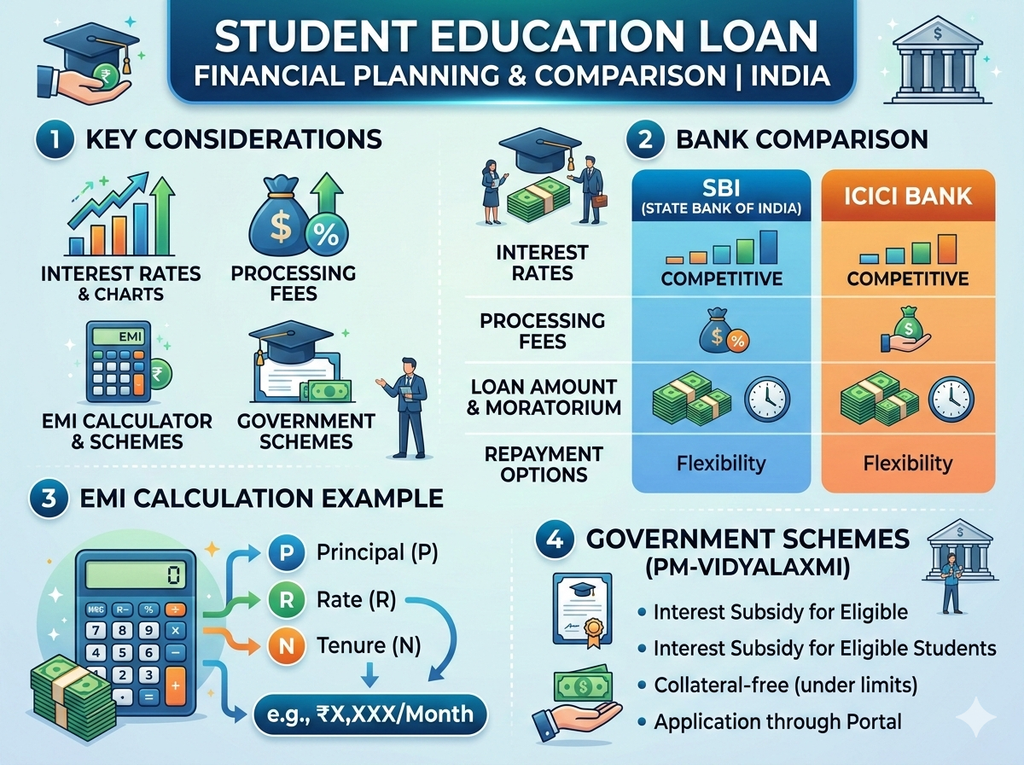
Planning to study in India or abroad but worried about college fees? An education loan can help you pay for tuition fees, accommodation, books, travel and other approved education expenses. However, choosing the right loan is important because even a small difference in interest rates can increase your total repayment.
In this guide, we explain education loan interest rates in India 2026, compare SBI and ICICI Bank, explain processing fees, show EMI examples and discuss government interest subsidy schemes. The goal is to help students and parents understand their options before applying.
Important: Interest rates and bank charges can change. The figures below are based on official bank information available in October 2026. Always check the lender’s latest offer before making a decision.
Education Loan Interest Rates in India 2026: Quick Overview
Education loan rates depend on the bank, course, college, loan amount, collateral, co-applicant profile and whether you are studying in India or abroad.
Here is a quick overview of selected bank rates:
| Bank or loan scheme | Published interest rate |
| SBI Student Loan Scheme up to ₹7.50 lakh without collateral | 9.90% p.a. |
| SBI Student Loan Scheme above ₹7.50 lakh with collateral | 9.40% p.a. |
| SBI Scholar Loan Scheme for selected institutions | 6.90%–7.65% p.a. |
| SBI PM-Vidyalaxmi scheme | 6.90%–8.40% p.a., depending on category |
| ICICI Bank secured loan for selected domestic institutes | Starting at 8.50% p.a. |
| ICICI Bank unsecured loan for selected domestic institutes | Starting at 9.25% p.a. |
| ICICI Bank secured loan for study abroad | Starting at 9.00% p.a. |
| ICICI Bank unsecured loan for study abroad | Starting at 10.25% p.a. |
Sources: SBI official education loan rates and ICICI Bank official education loan rates.
These are not guaranteed offers for every applicant. SBI’s rates are linked to an external benchmark and may change. ICICI Bank also states that rates depend on the loan category and eligibility.
SBI Education Loan Interest Rates in 2026
The State Bank of India offers different education loan schemes for students pursuing higher education in India and overseas.
According to SBI’s published rate schedule effective from 9 June 2026, the main Student Loan Scheme rates include:
- Up to ₹7.50 lakh without collateral: 9.90% per annum.
- Above ₹7.50 lakh with collateral: 9.40% per annum.
- Selected premier institutions: Special rates may apply under the Scholar Loan Scheme.
- Eligible girl students: A 0.50% interest concession is available under certain SBI schemes, subject to their conditions.
SBI also lists a special concessional rate of 6.75% per annum for eligible students admitted to specified premier institutions. The offer has scheme-specific validity dates and conditions.
Who should consider an SBI education loan?
SBI may be worth comparing if you:
- Have admission to a recognised college or eligible premier institution.
- Need a loan for domestic or overseas education.
- Can provide collateral if required by the scheme.
- Want to check whether a government-linked scheme or interest concession applies.
Before applying, check the exact scheme, applicable rate, collateral requirements, repayment terms and processing charges on the official SBI education loan page.
ICICI Bank Education Loan Interest Rates in 2026
ICICI Bank offers education loans for students studying in India and abroad. The applicable rate depends on the course, institution, loan security and applicant’s profile.
Its published starting rates include:
| Loan category | Starting interest rate |
| Domestic engineering and management, selected institutes, secured | 8.50% p.a. |
| Domestic engineering and management, selected institutes, unsecured | 9.25% p.a. |
| Other domestic institutes, secured | 9.00% p.a. |
| Other domestic institutes, unsecured | 9.75% p.a. |
| Medical courses in India, secured | 8.75% p.a. |
| Medical courses in India, unsecured | 9.50% p.a. |
| Overseas education, secured | 9.00% p.a. |
| Overseas education, unsecured | 10.25% p.a. |
Source: ICICI Bank education loan interest rates and charges.
ICICI Bank also lists a processing fee of up to 2% of the loan amount plus GST, with other charges potentially applicable.
When should you compare ICICI Bank?
Consider getting a quotation if you are planning an MBA, engineering, medical or overseas course. Compare the written offer with other lenders instead of choosing a loan only because the advertised starting rate looks attractive.
SBI vs ICICI Bank: Which Education Loan Is Better?
There is no single bank that is best for every student. The right choice depends on your course, college, loan amount and eligibility.
| Comparison point | SBI | ICICI Bank |
| Domestic education | Multiple student and scholar schemes | Different rates by course and institute |
| Overseas education | Global Ed-Vantage and other eligible schemes | Secured and unsecured loan options |
| Collateral | Depends on scheme and amount | Depends on loan product and eligibility |
| Special rates | Available for eligible categories and institutions | Starting rates vary by course and institute |
| Processing charges | Confirm the latest scheme-specific schedule | Published processing fee can be up to 2% plus GST |
| Best next step | Request a written loan quotation | Request a written loan quotation |
My suggestion: Get written quotations from at least two or three lenders. Compare the actual interest rate offered to you, processing fees, moratorium terms, repayment period and total estimated repayment.
What Is an Education Loan Processing Fee?
A processing fee is a charge that a lender may collect to process your loan application. It is separate from the interest you pay on the borrowed amount.
For example, if a lender charges a 1% processing fee on a ₹10 lakh loan, the fee would be ₹10,000 before any applicable taxes or other charges.
ICICI Bank publishes a processing fee of up to 2% of the loan amount plus GST. Fees vary by lender and scheme, so do not assume that every bank charges the same amount.
Before signing the loan agreement, ask for a written list of:
- Processing fees and GST.
- Documentation, legal and valuation charges, if applicable.
- Insurance costs, if applicable.
- Late-payment or other penalty charges.
- Conditions for part-payment and early closure.
A loan with a slightly higher interest rate may sometimes cost less overall if its fees and repayment conditions are more favourable. Compare the full cost, not just the advertised rate.
Education Loan EMI Calculator: How Much Will You Pay?
Your EMI, or Equated Monthly Instalment, is the amount you repay every month after regular EMI repayment begins.
Your EMI depends on the loan amount, interest rate and repayment tenure. The examples below assume a standard monthly-repayment calculation and do not include fees or interest that may accrue during a study-period moratorium.
| Loan amount | Interest rate | Repayment tenure | Approximate monthly EMI |
| ₹5 lakh | 9% | 5 years | ₹10,380 |
| ₹10 lakh | 9% | 10 years | ₹12,668 |
| ₹15 lakh | 10% | 10 years | ₹19,823 |
| ₹20 lakh | 10% | 15 years | ₹21,492 |
These are illustrative calculations, not bank quotations. The actual EMI may differ depending on the lender’s calculation method, rate changes and loan terms.
How to calculate your EMI
Use this formula:
EMI = P × r × (1 + r)ⁿ ÷ [(1 + r)ⁿ − 1]
Where:
- P is the loan principal.
- r is the monthly interest rate, expressed as a decimal.
- n is the total number of monthly instalments.
You can also use a bank’s official EMI calculator or a trusted online calculator. Enter the loan amount, annual interest rate and tenure to estimate your monthly repayment.
Remember: A longer tenure can reduce your monthly EMI, but it may increase the total interest paid over the life of the loan.
Can You Get an Education Loan Without Collateral?
Yes. Some lenders offer education loans without collateral, depending on the amount, institution, course and applicant’s eligibility.
Collateral is an asset, such as property or a fixed deposit, pledged as security for a loan. A secured loan may receive a different interest rate from an unsecured loan.
However, a loan without collateral is not automatically approved. Banks may still assess:
- Your admission letter and institution.
- The total cost of the course.
- Academic records.
- Your co-applicant’s income and credit history.
- The amount requested and expected repayment ability.
- The lender’s eligibility rules.
Students should ask the bank whether a co-applicant or guarantor is required under the specific scheme. Do not rely only on an advertisement that says “no collateral.”
PM-Vidyalaxmi Scheme: Can Students Get Interest Support?
The Government of India’s PM-Vidyalaxmi scheme provides a route for eligible students admitted to specified Quality Higher Educational Institutions to apply for education loans. Eligible students may also receive interest support based on family income and scheme rules.
According to government information:
- Eligible students admitted to specified institutions can access collateral-free and guarantor-free education loans under the scheme’s conditions.
- Students with annual family income up to ₹8 lakh may qualify for a 3% interest subvention on eligible loans up to ₹10 lakh.
- Under the separate PM-USP Central Sector Interest Subsidy Scheme, eligible students from families with annual income up to ₹4.5 lakh pursuing approved technical or professional courses may qualify for full interest subvention during the moratorium period on eligible loans up to ₹10 lakh.
These benefits are subject to institution, course, income, application and scheme conditions. Not every education loan automatically qualifies.
Check the official PM-Vidyalaxmi portal and its frequently asked questions before applying. The portal also publishes information about eligible institutions and interest-support processes.
Important: An interest subsidy is different from a loan waiver. Students must understand which interest is covered, for what period and what repayment obligations remain.
What Documents Are Needed for an Education Loan?
The exact list varies by lender, but students are commonly asked for the following documents:
- Identity proof and address proof.
- PAN and other KYC documents, as required.
- Academic marksheets and certificates.
- Entrance examination results, if applicable.
- Admission letter or proof of admission.
- Course fee structure and estimated education expenses.
- Bank statements and income documents for the co-applicant, where required.
- Collateral and property documents, if applicable.
- Passport, visa or other overseas-study documents, if required.
Keep clear copies of your documents and check the bank’s current checklist before submitting the application. Incomplete documents can delay processing.
How to Get a Lower Education Loan Interest Rate
You cannot control every factor used by a bank, but you can take practical steps to improve your options.
1. Compare several lenders
Check public-sector banks, private banks and eligible government-linked schemes. Ask each lender for the rate applicable to your exact course and institution.
2. Check your institution’s eligibility
Some banks offer special rates for selected colleges and universities. Confirm whether your institution is included in the scheme before comparing rates.
3. Ask about concessions
Ask whether you qualify for a concession based on the scheme, gender, institution or other eligibility conditions. Get the concession confirmed in writing.
4. Understand secured and unsecured loans
A secured loan requires eligible collateral. An unsecured loan does not require collateral under the applicable product, but it may carry a different rate or eligibility criteria.
5. Compare total repayment
Do not choose only by the lowest EMI. Compare processing fees, interest during the study period, repayment tenure, rate-reset terms and total interest payable.
6. Understand the moratorium period
Many education loans offer a repayment holiday during the course and for a specified period afterwards. Interest may still accrue during this period. Ask whether you can pay interest while studying and how that would affect your outstanding balance.
7. Read the loan agreement
Check the rate type, benchmark, repayment schedule, late fees, prepayment rules and any other charges before signing.
Is Education Loan Interest Tax-Deductible?
Section 80E of the Income-tax Act provides a deduction for eligible interest paid on a qualifying education loan for higher education, subject to the applicable rules.
The deduction is generally available for the initial assessment year in which interest repayment begins and the following seven assessment years, or until the eligible interest is fully paid, whichever comes first.
The deduction applies to qualifying interest, not the principal repayment. Eligibility can depend on the borrower, the lender and the purpose of the loan. Tax rules and the tax regime applicable to you also matter.
Read the official Income Tax Department guidance on Section 80E and consult a qualified tax professional if you need advice for your situation.
Common Mistakes to Avoid When Taking an Education Loan
Before choosing a lender, avoid these common mistakes:
- Selecting a loan based only on its starting interest rate.
- Ignoring processing fees and other charges.
- Assuming that no EMI during the course means no interest is charged.
- Borrowing more than the estimated education expenses require.
- Failing to check whether the course or college is eligible for a special scheme.
- Overlooking the conditions attached to an interest subsidy.
- Choosing a long repayment period without checking the total interest cost.
- Missing repayment dates after the moratorium ends.
A little research before applying can help you and your family make a more informed financial decision.
Frequently Asked Questions
1. What are the education loan interest rates in India 2026?
Rates vary by lender, course, institution, loan amount and eligibility. In the published examples discussed above, SBI’s standard Student Loan Scheme lists rates of 9.40% to 9.90% for specified categories, while ICICI Bank’s starting rates range from 8.50% for selected secured domestic loans to 10.25% for unsecured overseas education loans.
2. Which bank offers the lowest education loan interest rate?
There is no single lowest rate for every student. SBI offers special rates for certain eligible premier institutions, while ICICI Bank lists lower starting rates for selected secured domestic courses. Compare the actual rate offered to you.
3. Can I get an education loan without collateral?
Yes, some schemes provide loans without collateral, subject to eligibility. The bank may still require a co-applicant and proof of admission, expenses and financial details.
4. Does an education loan charge interest during the study period?
Interest may accrue during the course and moratorium period, depending on the loan terms. Ask the lender how the accrued interest will be treated and whether paying interest during this period can reduce the overall cost.
5. What is the processing fee for an education loan?
It depends on the bank and scheme. ICICI Bank publishes a processing fee of up to 2% of the loan amount plus GST. Always check the current charges before applying.
6. Can I get government help with education loan interest?
Eligible students may receive interest support through schemes such as PM-Vidyalaxmi or PM-USP CSIS. Eligibility depends on factors such as family income, course and institution. Apply through the official portal and confirm the requirements.
7. Can I claim a tax deduction on education loan interest?
Eligible borrowers may claim a deduction under Section 80E, subject to the applicable tax rules. The deduction relates to eligible interest paid, not principal repayment. Check the latest Income Tax Department guidance.
8. Is a lower EMI always better?
No. A lower EMI may result from a longer repayment period, which can increase the total interest paid. Compare both monthly affordability and the total repayment amount.
Final Words
Choosing an education loan is an important financial decision for students and families. Compare education loan interest rates in India 2026, processing fees, collateral requirements, repayment terms and available government support before selecting a lender.
Start by checking the official SBI and ICICI Bank rate pages, then compare written quotations for your course and college. If you may qualify for PM-Vidyalaxmi or another interest-support scheme, verify the eligibility rules and apply through the official portal.
The right loan is not simply the one with the lowest advertised rate. It is the one whose full cost, conditions and repayment plan fit your education needs and future earning capacity.
For additional information and educational resources, visit www.wisdomland.in.
Disclaimer: This article is for general educational information and is not financial, legal or tax advice. Bank rates and government scheme conditions can change. Confirm all details with the relevant bank or official government portal before making a financial decision.