
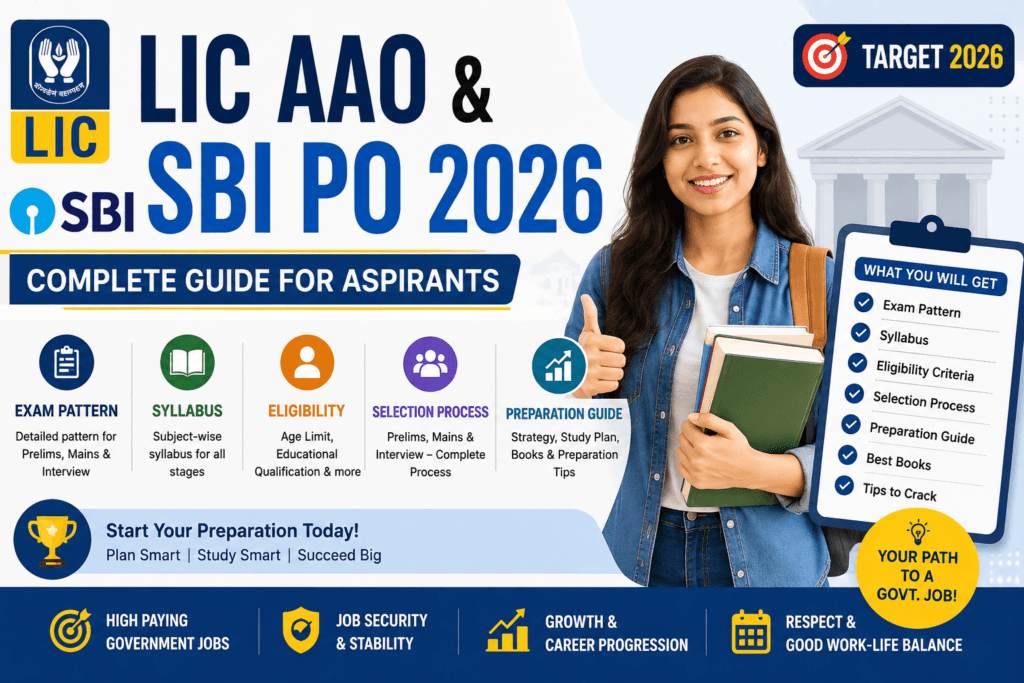
LIC AAO (Assistant Administrative Officer) and SBI PO (Probationary Officer) remain two of the most sought-after government jobs in the banking and insurance sectors for 2026. Both offer stable careers, good salaries, perks, and growth, but they differ in exam structure, job profile, work culture, and selection process. This detailed, SEO-optimised guide covers everything aspirants need: exam pattern, syllabus, eligibility, selection process, key differences, preparation strategy, and FAQs.
Quick Comparison: LIC AAO vs SBI PO 2026
| Aspect | LIC AAO | SBI PO |
| Conducting Body | Life Insurance Corporation of India (LIC) | State Bank of India (SBI) |
| Sector | Insurance | Banking |
| Selection Stages | Prelims → Mains → Interview → Medical | Prelims → Mains → Psychometric Test + Group Exercise + Interview |
| Negative Marking | Generally none (check official notification) | 1/4th mark deduction for wrong answers |
| Prelims Nature | Qualifying (English also qualifying) | Qualifying |
| Final Merit | Mains (Objective) + Interview | Mains + Interview/Group Exercise |
| Typical Vacancies | Hundreds (Generalist + Specialist) | Around 1500 (varies yearly) |
| Work Style | More administrative/office-based | Customer-facing, branch operations, targets |
| Work-Life Balance | Generally better (often 5-day week) | More dynamic, higher pressure, transfers |
Always verify the latest official notifications on licindia.in and sbi.co.in / sbi.bank.in, as patterns and dates can see minor updates.
SBI PO 2026 – Detailed Overview
Expected Timeline (based on recent cycles): Notification usually in June, applications open shortly after, Prelims in August, Mains in September, and Phase III (Psychometric + Group Exercise + Interview) in October–November.
Eligibility
- Age: 21–30 years (relaxations for reserved categories as per government norms).
- Education: Graduation in any discipline from a recognised university. Final-year students can apply provisionally if they produce proof of passing by the specified date (usually around September/October of the recruitment year).
- Nationality: Indian citizen (or eligible categories as per rules).
- Attempts: Limited for General/EWS (usually 4–6); more or unrestricted for reserved categories (check notification).
Selection Process
- Phase I – Preliminary Examination (qualifying)
- Phase II – Main Examination (Objective + Descriptive)
- Phase III – Psychometric Test, Group Exercise & Interview
SBI PO Prelims Exam Pattern
- Total: 100 questions | 100 marks | 60 minutes (sectional timing)
- English Language: 40 Q | 40 marks | 20 min
- Quantitative Aptitude: 30 Q | 30 marks | 20 min
- Reasoning Ability: 30 Q | 30 marks | 20 min
- Negative marking: 0.25 marks per wrong answer
- No sectional cut-off in some recent cycles (overall cut-off applies); marks not added to final merit.
SBI PO Mains Exam Pattern
- Objective Test: 170 questions | 200 marks | 3 hours
- Reasoning & Computer Aptitude: 40 Q | 60 marks | 50 min
- Data Analysis & Interpretation: 30 Q | 60 marks | 45 min
- General/Economy/Banking Awareness: 60 Q | 60 marks | 45 min
- English Language: 40 Q | 20 marks | 40 min
- Descriptive Test: 30 marks | ~30–50 minutes (Email/Letter, Situation Analysis, Report/Precis Writing – variations possible)
- Total Mains: 230 marks
- Negative marking applies to objective section.
SBI PO Syllabus Highlights
- Reasoning & Computer: Puzzles, Seating Arrangement, Syllogism, Input-Output, Coding-Decoding, Data Sufficiency, Computer basics (hardware, software, networking, MS Office, internet).
- Data Analysis & Interpretation: Tables, Bar/Line/Pie Charts, Caselets, Probability, Data Sufficiency, Arithmetic (Percentages, Ratio, Averages, Profit & Loss, Time & Work, SI/CI, etc.).
- English: Reading Comprehension, Cloze Test, Error Spotting, Para Jumbles, Vocabulary, Grammar.
- General/Banking Awareness: Current Affairs (last 6–8 months), Banking & Financial Awareness, Economy, Government Schemes, RBI policies, Static GK.
- Descriptive: Formal letter/email writing, essay, precis, report writing on banking/economy topics.
LIC AAO 2026 – Detailed Overview
Expected Timeline: Notification often around August–September; Prelims and Mains follow in subsequent months. Confirm on the official LIC website.
Eligibility
- Age: 21–30 years (slight variations for some specialist posts; relaxations applicable).
- Education: Bachelor’s degree from a recognised university (any discipline for Generalist; specific qualifications for Specialist posts such as IT, Legal, CA, Actuarial, Rajbhasha).
- Nationality: Indian citizen or eligible categories.
- Final-year students: Generally allowed if degree is produced at the time of joining/interview as per notification.
Selection Process
- Preliminary Examination (qualifying)
- Main Examination (Objective + Descriptive)
- Interview
- Pre-recruitment Medical Examination
Final merit is based primarily on Mains (Objective) + Interview marks. Prelims and Descriptive are usually qualifying.
LIC AAO Prelims Exam Pattern (Generalist)
- Total: 100 questions | 70 marks (English qualifying) | 60 minutes (sectional timing)
- Reasoning Ability: 35 Q | 35 marks | 20 min
- Quantitative Aptitude: 35 Q | 35 marks | 20 min
- English Language: 30 Q | 30 marks (qualifying only) | 20 min
- No negative marking in most recent cycles.
- English marks not counted for ranking; candidates must clear minimum qualifying marks in each section.
LIC AAO Mains Exam Pattern (Generalist)
- Objective Test: 120 questions | 300 marks | 120 minutes
- Reasoning Ability: 30 Q | 90 marks | 40 min
- Data Analysis & Interpretation / Professional Knowledge: 30 Q | 90 marks | 40 min
- General Knowledge & Current Affairs: 30 Q | 60 marks | 20 min
- Insurance & Financial Market Awareness: 30 Q | 60 marks | 20 min
- Descriptive Test (English): 2 questions | 25 marks | 30 minutes (Letter/Essay/Email/Report/Precis/Situation Analysis – qualifying)
- No negative marking in objective test in recent patterns.
- Sectional timing applies.
Note: Specialist posts may have a “Professional Knowledge” section instead of or in addition to Data Analysis.
LIC AAO Syllabus Highlights
- Reasoning: Puzzles, Seating Arrangement, Syllogism, Blood Relations, Coding-Decoding, Inequalities, Input-Output, Direction Sense, Statement-Assumption/Conclusion.
- Quantitative Aptitude / Data Analysis: Simplification/Approximation, Number Series, Data Interpretation (Tables, Graphs, Caselets), Arithmetic (Percentage, Ratio, Average, Profit-Loss, SI-CI, Time-Speed-Distance, Time & Work, Mixtures).
- English: Reading Comprehension, Grammar, Vocabulary, Cloze Test, Error Detection, Sentence Improvement, Para Jumbles.
- GK & Current Affairs: National & International news, Awards, Sports, Appointments, Government Schemes, Economy.
- Insurance & Financial Market Awareness: Basics of Insurance (Life, General, Health), LIC products & history, IRDAI, Financial markets, Banking terms, Budget, Economic survey highlights, Current financial news.
- Descriptive: Essay and letter writing focused on insurance, economy, or social topics; communication skills.
Common Syllabus Overlap (High-Weightage Topics)
Both exams heavily test:
- Reasoning: Puzzles & Seating Arrangement (very high weightage), Syllogism, Coding-Decoding, Blood Relations.
- Quant/Data Analysis: Data Interpretation, Simplification, Arithmetic word problems.
- English: Reading Comprehension, Grammar & Vocabulary.
- Awareness: Current Affairs (especially banking, insurance, economy) + static concepts.
Simple Yet Effective Preparation Plan (4–6 Months)
- Foundation (Weeks 1–4/6): Clear basic concepts of Quant (NCERT-level arithmetic + DI) and Reasoning (puzzles, seating). Build English vocabulary and grammar daily.
- Daily Current Affairs: Read banking/insurance/economy news (The Hindu, Economic Times, PIB, RBI/LIC websites). Maintain monthly notes. Focus extra on Insurance Awareness for LIC AAO.
- Practice: Solve previous year papers of both exams. Topic-wise practice (especially puzzles and DI).
- Mocks: Start weekly full-length mocks after 1–1.5 months; increase to 2–3 per week closer to exam. Analyse thoroughly (accuracy + time management).
- Descriptive Writing: Practice 2–3 essays/letters/emails every week. Focus on structure, clarity, and relevant content.
- Revision & Sectional Tests: Regular revision of weak areas. Sectional tests for timing.
- Interview Prep: Current affairs, personal background, banking/insurance knowledge, and mock interviews closer to the stage.
Pro Tips
- Accuracy over attempts (especially important for SBI PO due to negative marking).
- LIC AAO rewards strong Insurance Awareness and clean attempts (no negative marking advantage).
- Maintain a study timetable with fixed hours for each subject.
- Use reliable sources: Official websites, standard books (e.g., RS Aggarwal/Quantitative Aptitude by Arun Sharma for Quant, Banking Awareness books, monthly current affairs compilations).
Frequently Asked Questions (FAQs)
1. Is there negative marking in LIC AAO?
In recent cycles, there is generally no negative marking in Prelims and Mains objective tests. Always confirm in the official notification.
2. Can final-year students apply for SBI PO / LIC AAO?
Yes for SBI PO (provisionally, with proof of degree by the specified date). For LIC AAO, check the specific notification — many cycles allow it if the degree is available at joining.
3. Which exam is easier – LIC AAO or SBI PO?
Difficulty is comparable. LIC AAO has no/limited negative marking and a strong focus on Insurance Awareness, which some find manageable. SBI PO has negative marking and a broader banking awareness + computer aptitude component. Success depends on preparation consistency.
4. How many months of preparation is enough?
With consistent daily study (4–6 hours focused), 4–6 months is usually sufficient for average aspirants. Strong basics can reduce this; weaker areas may need more time.
5. Is the interview compulsory?
Yes. Both exams have an interview (or interview + group exercise for SBI PO) after Mains. Marks contribute to final selection.
6. What is the salary difference?
LIC AAO currently offers a higher starting basic pay (around ₹88,635 scale in recent revisions) with good insurance-sector benefits. SBI PO has competitive in-hand salary with banking allowances, leased accommodation options in some cases, and faster promotional growth. Exact figures vary by city and latest pay revision — check official notifications.
7. Job profile difference?
LIC AAO is more administrative (policy servicing, claims, underwriting, office work). SBI PO involves branch banking, customer handling, loans, sales targets, and managerial responsibilities with more frequent transfers.
Final Advice
Start early, stay consistent, and focus on accuracy + conceptual clarity. Both LIC AAO and SBI PO reward regular practice far more than last-minute cramming. Track official websites regularly for notifications, admit cards, and any pattern updates. Practice previous year papers and quality mocks, build strong current affairs + domain knowledge (banking for SBI, insurance for LIC), and work on descriptive writing and interview skills.
With disciplined preparation, both exams are highly achievable. Choose based on your preference for insurance vs banking work culture, and give your best effort. All the best for LIC AAO and SBI PO 2026!
Disclaimer: Exam patterns, eligibility, and vacancies are based on recent official cycles and reliable educational sources. Always refer to the latest official notifications from LIC and SBI for exact details.