
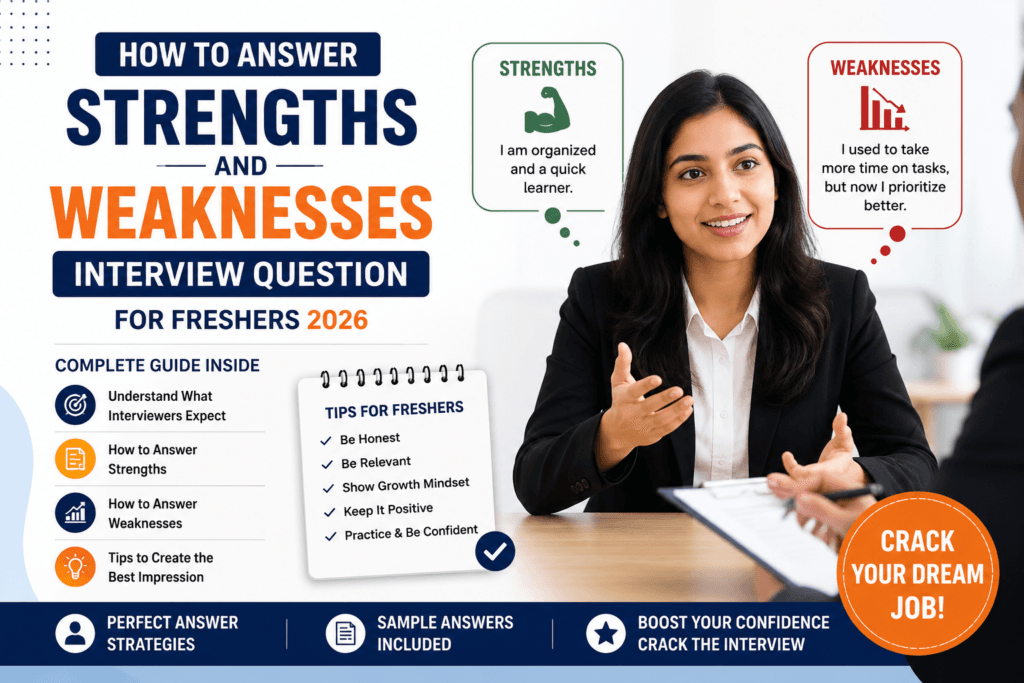
Confused about how to answer strengths and weaknesses as a fresher? Learn simple, honest answers that impress interviewers in 2026 job interviews.
This is one of the most common questions in fresher interviews. Recruiters ask “What are your strengths and weaknesses?” to check self-awareness, honesty, and whether you can grow. As a fresher in 2026, you do not need years of experience. You need clear examples from college projects, internships, college events, or self-learning.
How to Answer Strengths (Fresher Edition)
Pick 2–3 real strengths that match the job and back each one with a short, concrete example. Avoid generic words like “hard-working” without proof.
Good examples of strengths for freshers:
- “I am a quick learner. During my final-year project I learned Python from scratch in two weeks and delivered a working prototype on time.”
- “I work well in teams. In college I coordinated a group of five for our cultural fest. We finished all tasks smoothly and stayed within budget.”
- “I am organised and meet deadlines. I always submitted my assignments and project reports before the last date, even when I had multiple subjects.”
- “I communicate clearly. I presented our project findings to faculty and answered questions confidently.”
- “I adapt quickly. When our internship tool changed mid-way, I learned the new software within three days and continued without delay.”
Tip: Choose strengths that the job description values (teamwork, learning ability, organisation, communication, basic technical skills). Keep each point to 1–2 sentences.
How to Answer Weaknesses (Fresher Edition)
Never say “I have no weaknesses” or “I work too hard.” Interviewers hear these answers every day and they sound rehearsed. Choose a real, non-critical weakness and immediately show what you are doing to improve it.
Good examples of weaknesses for freshers:
- “I used to get nervous while speaking in public. I joined the college debate club and practised regularly. Now I feel more confident presenting in front of groups.”
- “I sometimes take extra time to finish tasks because I want them perfect. I am learning to manage time better by using daily to-do lists and setting realistic checkpoints.”
- “I was weak in Excel earlier. I took a free online course and practised with sample data. Now I can create basic dashboards and pivot tables.”
- “I used to hesitate before asking questions in meetings. I started preparing a short list of doubts before discussions and now I clarify doubts early.”
- “I sometimes over-commit when helping teammates. I am practising prioritising my own deadlines first so I can still support others without falling behind.”
Important rule: Pick a weakness that is not a core skill of the role. If the job needs strong Excel or public speaking, do not name those as your current weakness.
Simple Formula to Remember
Strength = Real skill + short example from college/internship/project
Weakness = Honest area for growth + clear action you are taking to improve
Keep the full answer under 40–45 seconds. Practice speaking it out loud so it sounds natural, not memorised.
Frequently Asked Questions (FAQs)
1. Can I say “I am a perfectionist” as a weakness?
Avoid it. Interviewers hear this too often and it usually sounds fake. Choose something more specific and show real improvement steps.
2. How many strengths should I mention?
Two or three is enough. Listing more makes the answer long and less focused.
3. Should the weakness be related to the job?
Yes, but choose something that is not a core requirement of the role. Show that you are actively fixing it.
4. Can I use the same answer in every interview?
You can keep the same structure, but change the examples to match the company, role, or your latest experience.
5. How long should the answer be?
Keep it short and clear — ideally under 40–45 seconds. Interviewers prefer focused answers over long stories.
Quick Practice Tips for 2026 Fresher Interviews
- Write your strengths and weaknesses on paper first.
- Record yourself speaking the answers.
- Match at least one strength to a skill mentioned in the job description.
- Always end the weakness part on a positive note (what you are doing now).
- Stay honest. Fake answers are easy to spot.
Practice these answers out loud a few times. In 2026 fresher interviews, honesty plus proof of improvement is what interviewers value most. Prepare your own real examples using the formula above, and you will sound confident and self-aware.