
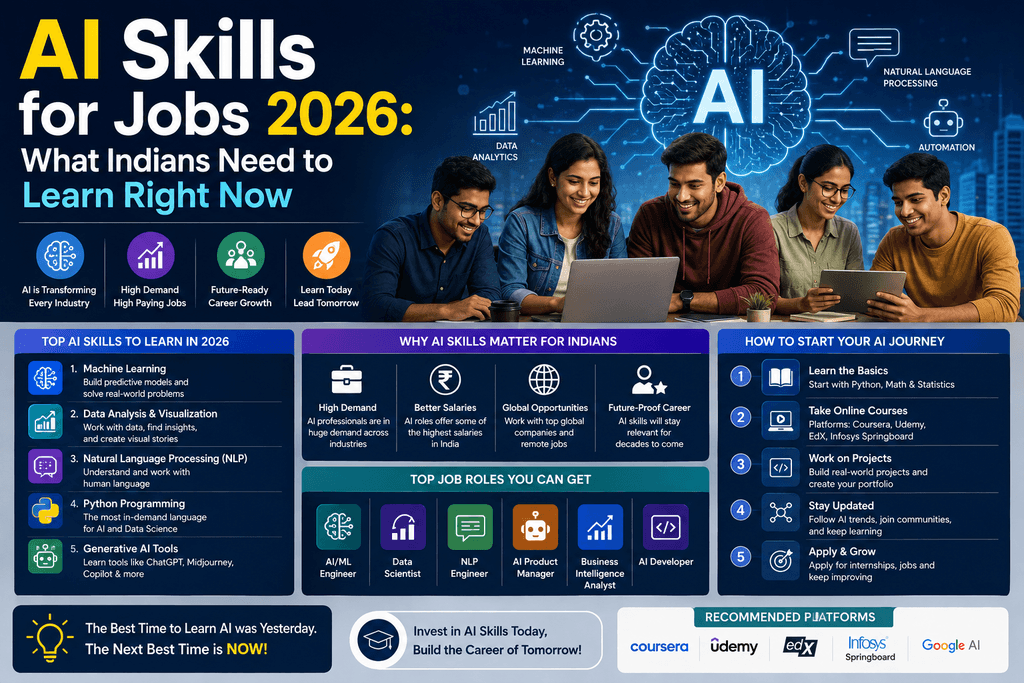
Mastering AI skills for jobs 2026 is essential for professionals looking to thrive in the evolving technology landscape. India needs nearly one million AI engineers, yet supply covers only about one in ten open roles. That gap is creating some of the highest-paying opportunities the country has seen in years. If you are a fresher, a working professional, or someone looking to switch careers, the right AI skills in 2026 can move your salary from the ₹4–6 LPA range into the ₹20–60 LPA bracket within months. For career switchers, mastering AI skills for jobs 2026 is the most reliable way to increase your earning potential.
This guide explains exactly which AI skills employers are asking for in India right now, how long it realistically takes to become job-ready, and the practical steps people are using to land roles at companies such as TCS, Infosys, Google, Microsoft, and the growing number of Generative AI startups.
Why AI Skills Matter More in 2026 Than Ever Before
According to industry reports from CII and Nasscom, demand for AI talent in India has risen roughly 30 percent since 2025. Nearly 47 percent of white-collar job descriptions on major Indian job portals now mention AI-related skills. Companies have moved past the pilot stage. They are putting AI systems into production across banking, e-commerce, healthcare, manufacturing and customer support.
ADP Research’s People at Work 2026 report found that 80 percent of employees in India use AI multiple times a week — the highest rate among all markets surveyed. Deloitte’s State of AI in the Enterprise report showed 40 percent of Indian respondents reporting significant or full AI usage, well above the global average of about 28 percent.
The practical result is simple: professionals who can work with AI tools, build AI systems, or apply AI inside their domain are being paid a clear premium. Investing time in AI skills for jobs 2026 helps professionals stay ahead of industry automation trends.
For comprehensive resources and guidance to navigate these changes, you can visit www.wisdomland.in.
AI Skills for Jobs 2026: Essential Requirements
To further your career growth, you can explore detailed career guides or review the latest NASSCOM Industry Insights to stay updated on market trends.
Recruiters and job descriptions in 2026 consistently highlight a core set of skills. Here is the current ranking based on analysis of thousands of live AI job ads:
1. Python Programming
Python appears in roughly 94 percent of AI job descriptions. It is non-negotiable. You need solid knowledge of data structures, libraries such as NumPy, Pandas, and the ability to write clean, maintainable code. Python is the foundation for most AI skills for jobs 2026 that recruiters are looking for.
2. SQL and Data Pipelines
About 78 percent of AI roles ask for SQL. You must be able to extract, clean and transform data. Building a strong data pipeline is another critical component of the AI skills for jobs 2026 checklist.
3. Deep Learning Frameworks (PyTorch or TensorFlow)
These appear in around 71 percent of postings. Most companies in India currently favour PyTorch for research and newer projects. Learning PyTorch is an excellent way to start developing advanced AI skills for jobs 2026.
4. Prompt Engineering and Generative AI Tools
Prompt design shows up in 64 percent of AI job ads. Employers want people who can design reliable prompts for customer support agents, content systems and RAG pipelines. Mastering prompts is a key differentiator among the AI skills for jobs 2026.
5. MLOps, Docker and Git
58 percent of roles now expect MLOps knowledge. Companies need people who can deploy models and keep them running in production. Deployment knowledge is increasingly vital for anyone aiming to demonstrate comprehensive AI skills for jobs 2026.
6. Cloud Platforms (AWS, GCP or Azure)
More than half of AI job descriptions list at least one major cloud. Cloud proficiency is a mandatory part of the AI skills for jobs 2026 requirements for top-tier companies.
7. LLM Fine-tuning, RAG and AI Agents
These specialised skills appear in nearly half of newer Generative AI postings. Frameworks such as LangChain, LangGraph and vector databases are becoming baseline expectations.
For deeper skill rankings refer to Naukri’s AI Skills Guide and Nasscom reports.
AI Career Outlook: Roles, Openings & Salary
| Job Role | Projected Openings | Salary Range (LPA) |
|---|---|---|
| AI Research Scientist | Part of 11.5M sector-wide openings | ₹30–80 LPA |
| Machine Learning Engineer | Part of 11.5M sector-wide openings | ₹20–55 LPA |
| Data Scientist | Part of 11.5M sector-wide openings | ₹15–40 LPA |
| Prompt Engineer | Part of 11.5M sector-wide openings | ₹15–40 LPA |
Highest-Paying AI Roles in India Right Now
• AI Research Scientist – ₹30–80 LPA
• Machine Learning Engineer – ₹20–55 LPA
• GenAI / Agentic AI Developer – ₹18–45 LPA
• Prompt Engineer – ₹15–40 LPA
• Data Scientist – ₹15–40 LPA
• AI Testing / Quality Engineer – ₹10–28 LPA
A Realistic 6-Month Plan to Become AI Job-Ready
By following this structure, you can systematically acquire the essential AI skills for jobs 2026 within half a year.
Months 1–2: Foundations
Master Python (4 hours a day), basic statistics and linear algebra. Learn SQL thoroughly.
Months 3–4: Core Machine Learning
Complete one solid deep-learning course using PyTorch or TensorFlow. Build 2–3 end-to-end projects and push them to GitHub.
Months 5–6: Generative AI and Deployment
Learn LangChain, build a RAG application, fine-tune a small open-source model, and deploy one project on AWS or GCP. Add Docker and basic MLOps practices.
Conclusion
The AI skills gap in India is real and large. The professionals who treat AI as a core workplace skill rather than a niche specialisation are the ones landing the better roles in 2026. Start with Python, SQL and one deep-learning framework, then move quickly into Generative AI tooling and deployment. Ultimately, the commitment to learning AI skills for jobs 2026 will pay dividends for your career growth.
Frequently Asked Questions (FAQ)
Q: What are the most important AI skills for jobs in India in 2026?
A: Python, SQL, one deep-learning framework (PyTorch or TensorFlow), prompt engineering / Generative AI tools, MLOps basics, and at least one cloud platform (AWS, GCP or Azure) form the core set that appears most frequently in job descriptions.
Q: How long does it take to become job-ready in AI?
A: With focused daily effort, many working professionals and final-year students become job-ready in about six months. The exact time depends on prior programming experience and the consistency of practice.
Q: Do I need a computer science degree for AI jobs in 2026?
A: No. Many employers now prioritise demonstrated skills and projects over formal degrees. A strong GitHub portfolio of shipped projects often carries more weight than the degree title alone.
Q: What is the salary range for AI roles in India in 2026?
A: Entry to mid-level roles commonly range from ₹10–40 LPA. Specialised roles such as ML Engineers and AI Research Scientists can reach ₹20–80 LPA depending on experience, location and company.
Q: Is prompt engineering still a valuable skill in 2026?
A: Yes. Prompt engineering has evolved into designing reliable systems that use large language models, including RAG pipelines and agent workflows. It remains in high demand across product companies and enterprises.
Q: Can non-engineers learn AI skills and get jobs?
A: Yes. Professionals from marketing, finance, HR and other domains who learn to apply AI tools inside their field are seeing career growth and salary increases. Nearly half of AI-enabled career outcomes now lie outside pure engineering roles.