
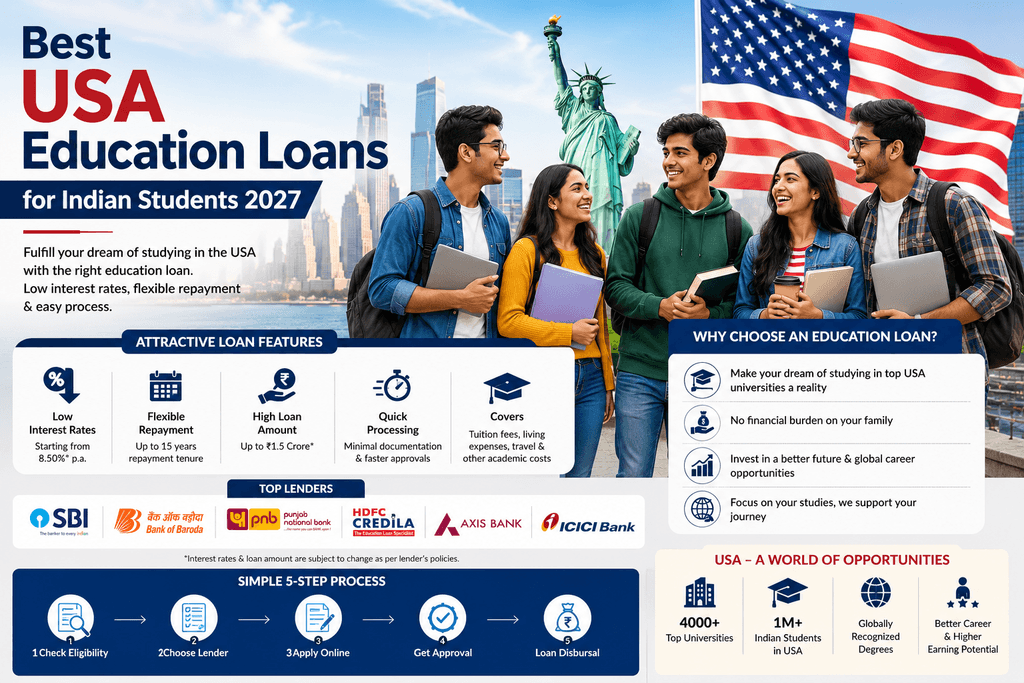
Introduction to USA Education Loans
USA education loans are a vital financial tool for Indian students planning to study in the United States. Tuition is only one part of the budget; students may also need to plan for housing, food, health insurance, books, travel and other living costs. For comprehensive information on managing these costs, students should consult the U.S. government’s official student aid portal. An education loan can help, but choosing the right loan requires careful comparison.
Indian students often compare banks in India with specialised international lenders. There is no single best option for every student. The right choice depends on the university, course, loan size, family finances, collateral availability and expected repayment capacity.
Important Considerations for USA Education Loans
- Credit History: A strong credit score significantly improves the chances of securing a loan with favorable interest rates.
- Loan Disbursement: Understand that disbursement happens in stages, usually directly to the university, not as a lump sum to the student.
- Repayment Options: Check for flexible repayment plans, including the option to pay only the interest during the study period.
- Insurance Requirements: Some lenders mandate education loan insurance to cover the loan in case of unforeseen events, adding to the total cost.
- Academic Performance: Maintain good academic standing, as some lenders may periodically review your progress.
- Co-signer Financial Strength: Ensure your co-signer has a stable income and a clean credit history, as this impacts the loan approval probability.
How Much USA Education Loans Funding Do You Actually Need?
Start with the university’s official cost-of-attendance information. Separate tuition from living expenses and identify scholarships, assistantships, savings and other confirmed funding.
Do not borrow the maximum amount simply because it is available. Borrow enough to cover genuine educational costs while keeping a reasonable emergency buffer. A larger loan means more repayment after graduation. You can learn more about general planning in our study abroad guides.
Types of USA Education Loans Available
Indian students may encounter secured loans from Indian banks, unsecured or collateral-free education loans, and specialised international student loans. Some loans require a co-applicant or co-signer; others may assess the university and future earning potential differently.
Each structure has advantages and disadvantages. A secured loan may involve property but could have a different pricing structure. An unsecured product can avoid collateral but may have different rates or eligibility conditions.
| Lender Type | Interest Rate (Approx) | Collateral Required | Key Benefit |
|---|---|---|---|
| Public Banks | 8.5% – 11% | Yes (Property) | Lowest Interest Rates |
| Private Banks | 9% – 12% | Often Required | Competitive Rates/Service |
| NBFCs | 10.5% – 14% | No / Flexible | Fast Processing/Higher Limits |
| International Lenders | 11% – 15% | No | No Indian Collateral Needed |
What Indian Banks Consider for USA Education Loans
Traditional lenders may look at the student’s academic record, admission to an eligible institution, course, co-applicant income, credit history and security where applicable. The exact requirements vary by bank and product.
When comparing banks, ask for the complete schedule of interest and fees. Do not rely only on the first number quoted by a relationship manager. For official Indian banking standards, refer to Ministry of Education resources.
Specialist Lenders for USA Education Loans
Specialist lenders focus on education financing for selected international programs. Some use university eligibility and future earning potential as part of their assessment. Prodigy Finance, for example, provides information for international students and has published details for Spring 2027 applicants. Eligibility and funding remain product-specific, so students should verify the exact offer before making a decision.
A specialist lender can be useful when a student does not have property to pledge, but students should compare the total repayment cost and currency implications carefully.
Key Loan Features to Compare
Interest rate: Check whether it is fixed or variable and how changes are determined.
Fees: Include processing, administration, origination and other charges.
Collateral: Confirm whether property or another asset is required.
Co-signer: Check whether a parent, relative or other person must guarantee the loan.
Moratorium: Understand when repayment begins and what happens to interest during study.
Tenure: A longer tenure can reduce the monthly payment but may increase total interest.
Prepayment: Check whether early repayment is allowed and whether charges apply.
Currency Risk
If the loan is denominated in a foreign currency, repayment can be affected by exchange rates if your future income is in Indian rupees. A loan in INR can have a different currency profile when your education costs are in US dollars.
Do not assume that one currency is automatically safer. Model possible exchange-rate changes and understand exactly which currency you will receive and repay.
Loan + Scholarship Strategy
Before borrowing, search for university scholarships, assistantships and department funding. Even a partial scholarship can reduce the loan principal and therefore future interest.
Keep proof of confirmed funding. If a scholarship is conditional, understand what happens if the condition is not met. Do not subtract uncertain future funding from today’s required loan unless you have a realistic backup plan.
Visa and Loan Planning
Loan approval and visa preparation can be connected because students may need to demonstrate how their education and living costs will be funded. For the United States, students should rely on official [U.S. Department of State student visa information](https://travel.state.gov/content/travel/en/us-visas/study/student-visa.html) and the instructions provided by their university and consular process.
A loan sanction is only one part of financial planning. Keep bank statements, scholarship letters and other funding evidence organised.
Tax and Repayment Planning
If you take an education loan in India, check whether applicable tax provisions such as Section 80E may apply. The Income Tax Department’s current guidance should be used rather than an old blog post.
After graduation, create a repayment budget based on conservative income assumptions. Do not assume you will immediately receive a high US salary. Consider job-search time, rent, insurance and other expenses.
A Practical Comparison Example
Imagine two students need the same amount. Student A chooses a secured loan with a lower quoted rate but pays substantial fees and pledges property. Student B chooses an unsecured loan with a higher rate but no property requirement. Student B is not automatically making the better decision.
The comparison should include the total expected repayment, fees, security risk, currency exposure, repayment start date and flexibility. The cheapest rate is only one piece of the decision.
Questions to Ask Every Lender
What is the effective interest rate? Is it fixed or variable? What is the processing fee? Is interest charged during the study period? When does repayment start? Is a co-signer required? What happens if the student changes university? Can I prepay? Are there currency conversion costs? What documents are required for each disbursement?
Ask for the answers in writing and compare the actual sanction or loan agreement, not just a brochure.
A Safer Decision Process
First calculate your total education budget and identify scholarships before shortlisting USA education loans. Fourth calculate repayment under different interest and exchange-rate scenarios. Fifth read the final agreement carefully before signing.
If you need help estimating monthly payments, use WisdomLand’s education loan EMI calculator as an initial planning tool. Then confirm the actual lender figures before making the final decision.
Frequently Asked Questions
Which is the best USA education loan for Indian students?
There is no single best loan. Compare the total cost, collateral, co-signer requirements, interest, fees, repayment and currency exposure.
Can I get a USA education loan without collateral?
Some specialist lenders and certain loan products offer unsecured financing to eligible students. Eligibility is not universal.
Do I need a co-signer?
It depends on the lender and product. Some loans require one; some specialist products may not.
Can an education loan cover living expenses in the USA?
Many education loans can include approved living expenses, but the amount and eligible categories depend on the lender.
Should I choose a bank or international lender?
Compare the actual offers. Consider rate, fees, security, repayment flexibility, currency and eligibility.
How much should I borrow?
Borrow enough for confirmed educational needs and a sensible buffer, while reducing the amount through scholarships and other confirmed funding where possible.
Final Takeaway
Choosing the right option requires more than looking at a headline number. If you are researching USA education loans, compare eligibility, total cost, practical benefits, risks and long-term value. Use official sources for rules and prices that may change, and keep written records of important applications, offers and payments.