
Home Loan Tax Benefits: Old vs New Tax Regime Compared (2026)
Author: Srinivas Joshi
Introduction
Buying a house is one of the biggest financial decisions for many Indian families. Along with the monthly EMI, homebuyers must consider registration charges, maintenance expenses, loan interest and income tax.
The good news is that eligible homeowners may receive tax benefits on certain home loan payments. However, the deductions available depend on the tax regime you choose, whether the property is self-occupied or rented, and the conditions of your loan.
The biggest question for many borrowers is: Should you choose the old tax regime or the new tax regime if you have a home loan?
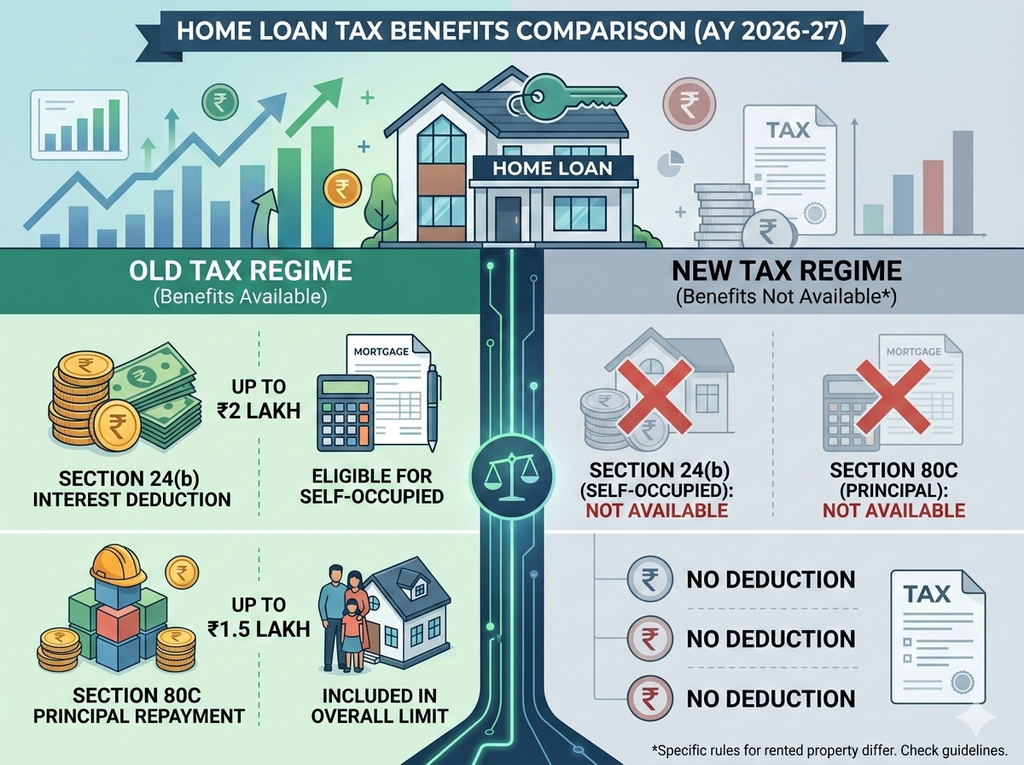
Under the old tax regime, eligible borrowers can generally claim a deduction for home loan interest under Section 24(b) and principal repayment under Section 80C. Under the new tax regime, these benefits are generally not available for a self-occupied property, although different rules apply to rented properties.
This guide explains the differences, provides examples and helps you understand what to check before choosing a tax regime.
Tax note: The familiar section references and limits below reflect official Income Tax Department guidance for Assessment Year 2026–27. Tax rules and statutory references can change, so check the provisions applicable to your particular financial year before filing.
Home Loan Tax Benefits: Old vs New Tax Regime
Here is a quick comparison of the main home loan tax deductions.
| Home Loan Tax Benefit | Old Tax Regime | New Tax Regime |
| Interest deduction on a self-occupied house under Section 24(b) | Generally available up to ₹2 lakh, subject to conditions | Not available |
| Principal repayment under Section 80C | Eligible within the overall ₹1.5 lakh limit | Not available |
| Stamp duty and registration charges under Section 80C | May qualify within the overall limit and applicable conditions | Not available under Section 80C |
| Interest on a rented property | Generally deductible when calculating house-property income, subject to applicable rules | Can be deducted in calculating house-property income, but loss restrictions apply |
| Set-off of house-property loss against salary or other income | Subject to statutory limits and conditions | House-property loss cannot be set off against other heads under the new regime |
| Additional home loan deductions under Sections 80EE or 80EEA | May apply to eligible loans meeting specific historical conditions | Generally unavailable under the new regime |
| Standard deduction from salary | Available under applicable rules | Available under applicable rules |
The table summarises common rules. Eligibility, limits and exceptions depend on the property, loan and relevant tax year.
Official references: Income Tax Department — New vs Old Tax Regime FAQs and Income Tax Department — Section 24.
1. Home Loan Interest Deduction Under Section 24(b)
Section 24(b) is one of the most important provisions for homeowners using the old tax regime. It allows an eligible deduction for interest payable on borrowed money used to acquire, construct, repair, renew or reconstruct a property, subject to the applicable conditions.
What Is the Maximum Deduction?
For a qualifying self-occupied property, the interest deduction can generally be up to ₹2 lakh per financial year when the applicable conditions are satisfied.
The limit may be lower in certain situations, including some loans used for repairs or reconstruction, or where the statutory conditions for the higher limit are not met.
For a let-out property, the interest deduction is generally based on the actual eligible interest, but the tax treatment of any resulting loss differs between regimes.
Example: Home Loan Interest Deduction
Suppose you paid ₹2.4 lakh in eligible home loan interest during the year on a qualifying self-occupied house.
| Particulars | Amount |
| Eligible interest paid | ₹2,40,000 |
| General maximum deduction for a qualifying self-occupied property | ₹2,00,000 |
| Interest above the stated limit | ₹40,000 |
In this example, the deductible amount under the old regime would generally be ₹2 lakh, assuming all eligibility conditions are satisfied.
Important: A deduction reduces taxable income; it does not mean the government refunds the entire interest amount. The actual tax saving depends on your applicable tax rate and overall tax calculation.
Is Section 24(b) Available Under the New Tax Regime?
For a self-occupied property, the deduction for home loan interest under Section 24(b) is not available under the new tax regime.
For a let-out property, eligible interest can still be considered when calculating income from house property. However, a resulting house-property loss cannot be set off against salary or other heads of income under the new regime, and the official guidance also restricts carrying that loss forward.
Read the Income Tax Department’s official tax-regime FAQ for details.
2. Home Loan Principal Repayment Under Section 80C
Under the old tax regime, eligible home loan principal repayment can qualify for a deduction under Section 80C.
The overall Section 80C limit is ₹1.5 lakh per financial year. This limit is shared with other eligible investments and payments, such as qualifying provident fund contributions, life insurance premiums and certain other specified expenses.
Example of Section 80C Home Loan Benefits
Suppose you repay ₹1 lakh of eligible home loan principal during the year and contribute ₹80,000 to other eligible Section 80C investments.
| Particulars | Amount |
| Eligible home loan principal repayment | ₹1,00,000 |
| Other eligible Section 80C investments | ₹80,000 |
| Total eligible payments | ₹1,80,000 |
| Maximum Section 80C deduction | ₹1,50,000 |
| Amount exceeding the overall limit | ₹30,000 |
Although your eligible payments total ₹1.8 lakh, the maximum deduction remains ₹1.5 lakh.
Under the new tax regime, the Section 80C deduction for home loan principal repayment is generally unavailable.
Do Stamp Duty and Registration Charges Qualify?
Certain stamp duty and registration charges paid for a qualifying residential property may also qualify under Section 80C, subject to the applicable conditions and overall limit.
These expenses do not create an additional ₹1.5 lakh deduction on top of the Section 80C limit.
Official reference: Income Tax Department — Section 80C Deductions.
3. Additional Home Loan Tax Benefits
Some borrowers may have heard of Sections 80EE and 80EEA, which provided additional interest deductions to eligible first-time homebuyers under specific conditions.
These benefits were linked to requirements such as loan sanction dates, property value and other eligibility criteria. They are not general deductions available to every person taking a new home loan today.
If you are claiming one of these deductions, verify the applicable historical conditions and your eligibility before including it in your tax return.
Do not assume that every first-time homebuyer can automatically claim an additional deduction beyond Section 24(b).
4. Home Loan Tax Benefits for a Self-Occupied Property
A self-occupied property is generally a house used as your own residence, subject to the applicable income-tax rules.
This is the situation where the difference between the old and new regimes can be especially important.
| Particulars | Old Tax Regime | New Tax Regime |
| Eligible home loan interest | Generally deductible up to ₹2 lakh, subject to conditions | Not deductible under Section 24(b) |
| Eligible principal repayment | May qualify under Section 80C | No Section 80C deduction |
| Stamp duty and registration | May qualify under Section 80C, subject to conditions | No Section 80C deduction |
| Other eligible tax deductions | Available where the relevant rules permit | Most common deductions are not available, although specified exceptions remain |
If you have a substantial home loan and other eligible deductions, the old regime may be worth evaluating carefully.
However, the old regime does not automatically result in lower tax. You must compare your total tax liability under both regimes.
5. Home Loan Tax Benefits for a Rented Property
The tax treatment can be different when you rent out the house instead of living in it.
Under the applicable house-property rules, rental income is generally calculated after prescribed adjustments, including a standard deduction equal to 30% of the annual value after municipal taxes where applicable. Eligible home loan interest is then considered under the relevant rules.
Old vs New Regime for a Rented House
| Feature | Old Tax Regime | New Tax Regime |
| Eligible home loan interest | Considered under house-property rules | Considered under house-property rules |
| Resulting house-property loss | Set-off against other heads may be available within statutory limits | Cannot be set off against other heads |
| Carry-forward of eligible house-property loss | Subject to applicable rules | Official guidance restricts carrying the loss forward under the new regime |
| Rental income reporting | Required under applicable rules | Required under applicable rules |
The full tax calculation depends on the property’s annual value, eligible expenses, interest and the rules applicable to the tax year.
If you own a rented property with a large home loan, compare the two regimes using the actual rental income and interest certificate rather than assuming the interest deduction will reduce your salary income in both regimes.
6. Joint Home Loan Tax Benefits
If a house is jointly owned and financed through a joint home loan, more than one co-owner may be eligible to claim tax benefits under the old regime.
However, being a co-borrower alone is not necessarily sufficient. The claim must meet the relevant ownership, borrowing, payment and other statutory conditions.
Before claiming benefits, check:
- Whether each person is a legal co-owner.
- Whether each person is a co-borrower.
- Each person’s ownership share and eligible payments.
- The home loan interest and principal amounts attributable to each person.
- Whether the property is self-occupied or rented.
- Whether each person has selected the old or new tax regime.
Each eligible co-owner’s claim must be calculated according to the applicable rules. Do not simply divide the loan deduction equally unless that matches the legal and financial facts.
7. Which Tax Regime Is Better for Home Loan Borrowers?
The answer depends on your income, tax slab, home loan interest, principal repayment, other deductions and property type.
The Old Tax Regime May Be Worth Comparing If:
- You pay substantial eligible home loan interest on a qualifying self-occupied property.
- You have eligible Section 80C investments and payments.
- You claim other deductions that are not generally available under the new regime.
- Your total eligible deductions materially reduce your taxable income.
The New Tax Regime May Be Worth Comparing If:
- You have relatively few eligible deductions.
- You benefit from the new regime’s tax slabs.
- Your home loan interest relates to a self-occupied property, where the Section 24(b) deduction is not available under this regime.
- Your overall tax calculation remains lower despite losing certain deductions.
Do not select a regime based only on the home loan interest amount. Compare your final tax payable under both options using the rules applicable to the relevant year.
8. Example: Comparing the Tax Regimes
Consider a hypothetical salaried homeowner who has eligible home loan interest and principal repayment.
Assume the person has:
- ₹2 lakh of eligible home loan interest.
- ₹1 lakh of eligible home loan principal repayment.
- ₹50,000 of other eligible Section 80C payments.
- Additional income and deductions that must be considered in the final tax calculation.
Under the old regime, the person may be able to claim the eligible Section 24(b) deduction and Section 80C deductions, subject to the relevant limits.
| Particulars | Old Regime | New Regime |
| Eligible self-occupied home loan interest deduction | Up to ₹2,00,000, subject to conditions | ₹0 |
| Eligible principal repayment under Section 80C | Included within the ₹1,50,000 overall limit | ₹0 |
| Other eligible Section 80C payments | Included within the same limit | ₹0 |
| Taxable income | Depends on all applicable deductions and income | Depends on the new regime’s rules |
| Final tax payable | Must be calculated | Must be calculated |
This example shows why a homeowner should calculate both options rather than relying on a general claim that one regime is always better.
Your tax saving will depend on your full income, deductions, rebates, applicable tax slabs and other relevant factors.
9. Documents Required to Claim Home Loan Tax Benefits
Keep the following documents ready when preparing your income tax return:
- Home loan interest certificate from the bank or lender.
- Home loan principal repayment statement.
- Loan sanction letter and account details.
- Property ownership documents.
- Possession or completion documents, where relevant.
- Stamp duty and registration receipts, if claiming eligible amounts.
- Rent details and relevant property expenses for a let-out property.
- Records supporting other deductions claimed under the old regime.
Your lender’s annual interest certificate is particularly useful because it separates principal repayment from interest paid.
10. How to Compare Old and New Tax Regimes Before Filing
Follow these steps to make a more informed decision.
- Calculate your annual income. Include salary and other taxable income as required.
- List eligible home loan payments. Separate interest and principal.
- Calculate eligible deductions. Check Section 24(b), Section 80C and other provisions that may apply.
- Review the property type. Self-occupied and rented properties can receive different treatment.
- Calculate tax under both regimes. Apply the correct rules and tax rates for the relevant year.
- Compare the final tax payable. Include applicable rebates, cess and other relevant items.
- Confirm the regime-selection procedure. The rules can differ depending on whether you have business or professional income.
For official guidance, use the Income Tax Department e-Filing Portal and its Old vs New Tax Regime Selection Guidelines.
Frequently Asked Questions (FAQs)
1. Can I claim home loan tax benefits under the new tax regime?
For a self-occupied property, the Section 24(b) home loan interest deduction is not available under the new regime, and Section 80C principal repayment benefits are generally unavailable. Eligible interest on a rented property is treated differently, but restrictions apply to house-property losses.
2. What is the maximum home loan interest deduction under Section 24(b)?
For a qualifying self-occupied property under the old regime, the deduction can generally be up to ₹2 lakh per year, subject to statutory conditions. Different limits or rules can apply in other situations.
3. Can I claim home loan principal repayment under Section 80C?
Eligible principal repayment can qualify under the old regime within the overall Section 80C limit of ₹1.5 lakh per year. The limit is shared with other eligible payments and investments.
4. Is Section 80C available under the new tax regime?
Most deductions under Section 80C, including the home loan principal repayment deduction, are not available under the new regime.
5. Can I claim both home loan interest and principal deductions?
Eligible borrowers under the old regime may claim both deductions if they satisfy the applicable conditions. The interest deduction and principal repayment deduction are calculated under separate provisions and have different limits.
6. Can I claim a tax deduction for a second house?
The answer depends on whether the property is self-occupied, deemed to be let out or actually rented, along with the applicable tax regime and statutory conditions. Do not assume the same deduction rules apply to every property.
7. Can both husband and wife claim home loan tax benefits?
Potentially, if both meet the applicable ownership, borrowing, payment and other eligibility conditions. Each person’s claim should reflect their eligible share and the rules applicable to their tax return.
8. Can I claim home loan tax benefits before taking possession?
The treatment of interest paid during the construction period differs from interest after the property is acquired or constructed. Under the applicable old-regime rules, eligible pre-construction interest may generally be claimed in five instalments beginning in the year of acquisition or completion, subject to the relevant limits and conditions. Confirm the rules for your specific case.
9. How can I know which tax regime saves more money?
Calculate your tax liability under both regimes using your income, eligible deductions, property type and the tax rates applicable for that year. The lower final tax liability is generally the more tax-efficient choice, assuming you meet the applicable requirements.
10. Where can I check the latest home loan tax rules?
Check the Income Tax Department website and the official Section 24 guidance. For complex cases, consult a qualified tax professional.
- Section 24(b) Official Guidelines: Income Tax Department — Section 24 Statutory Provisions & Deductions
- Section 80C Official Guidelines: Income Tax Department — Section 80C Principal Repayment & Stamp Duty Deductions
Final Takeaway
Home loan tax benefits can make a meaningful difference to your finances, but the amount you can claim depends on the tax regime, property use, eligible interest and principal payments, and other statutory conditions.
The old tax regime may offer valuable deductions under Section 24(b) and Section 80C for eligible homeowners. The new regime generally does not allow these deductions for a self-occupied property, although interest treatment for rented property differs.
Before filing your return, calculate the final tax payable under both regimes and verify the rules applicable to your financial year. A careful comparison can help you choose the option that best fits your overall financial situation.
Related Financial Guides & Tools
- Calculate your monthly payments using our Home Loan EMI Calculator.
- Compare current rates with our guide to Home Loan Interest Rates.
- Explore broader strategies for Tax-Saving Investments.
- Build a secure long-term plan with our Retirement Planning and Personal Finance Guides.
Disclaimer: This article is for general educational purposes and is not personalised tax or financial advice. Tax provisions, statutory references and eligibility requirements may change. Verify the applicable rules with the Income Tax Department or a qualified tax professional before filing.