
UPI Merchant Fee Update October 2026: Who Pays and What Changes?

UPI Merchant Fee Update October 2026: Latest News
The UPI Merchant Fee Update October 2026 is an important development for shopkeepers, online businesses and people who use digital payments.
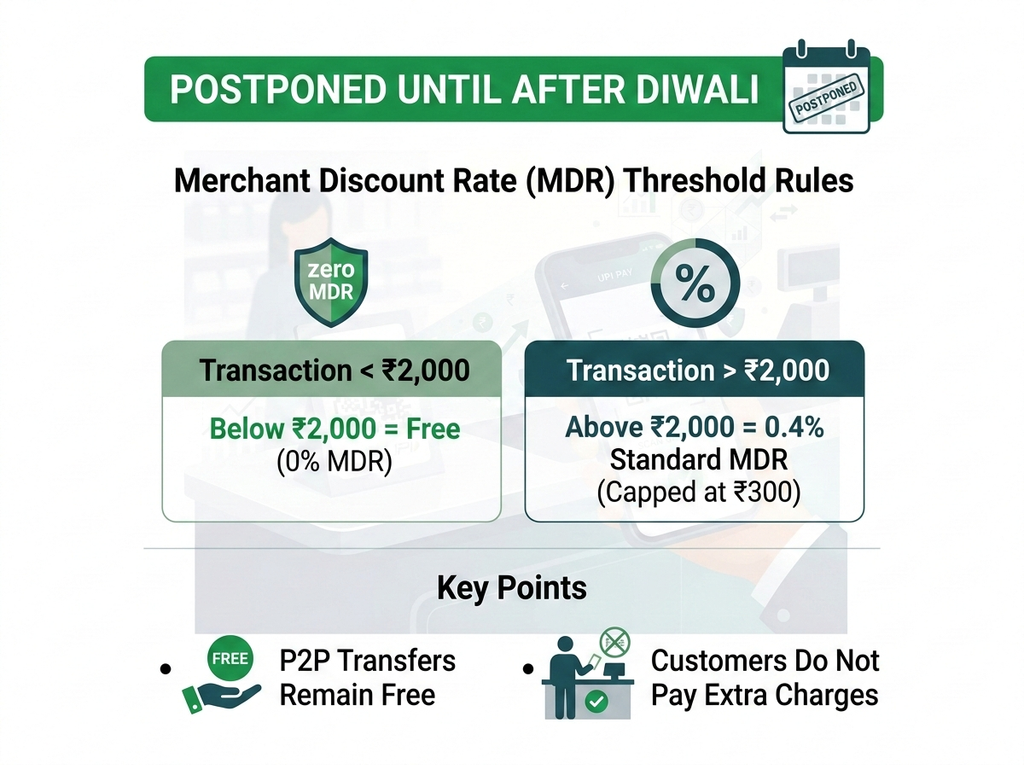
The National Payments Corporation of India (NPCI) had planned to introduce Merchant Discount Rate (MDR) charges on selected UPI merchant transactions from 15 October 2026. However, on 13 October, NPCI announced that the rollout would be postponed until immediately after Diwali. The new date will be announced separately.
Under the proposed rules, eligible merchant transactions above ₹2,000 may attract a 0.4% fee, subject to the applicable cap and exemptions. This is a merchant-side payment-processing charge, not a general fee on every UPI transaction.
What you need to know:
- The original start date of 15 October 2026 has been postponed.
- The proposed standard MDR is 0.4% on eligible merchant transactions above ₹2,000.
- The maximum standard MDR is ₹300 per transaction under the announced framework.
- Person-to-person UPI transfers will remain free.
- Eligible merchant transactions up to ₹2,000 will remain free of MDR.
- Qualifying small merchants and certain sectors have separate exemptions or fee arrangements.
- Customers should not be charged an extra fee simply for choosing UPI under the announced policy.
Sources: NPCI and Ministry of Finance announcement.
UPI Merchant Fee Update 2026: Overview
| Detail | Latest Information |
| Payment system | Unified Payments Interface (UPI) |
| Payment network | NPCI |
| Proposed charge | Merchant Discount Rate (MDR) |
| Standard proposed rate | 0.4% on eligible transactions |
| Standard transaction threshold | Above ₹2,000 |
| Standard MDR cap | ₹300 per transaction |
| Original start date | 15 October 2026 |
| Current status | Postponed until after Diwali |
| Revised start date | To be announced |
| Who pays the proposed MDR? | Eligible merchants |
| P2P transfers | Remain free |
| Official update | NPCI and Ministry of Finance |
The rate and exemptions above describe the announced framework. Because the rollout has been postponed, readers should check for the final implementation date and any updated instructions before assuming a charge is active.
Why Has NPCI Postponed the UPI Merchant Fee?
NPCI postponed the planned rollout because it coincided with the festive shopping season. Businesses often receive more payments during this period, particularly for electronics, clothing, jewellery, mobile phones and household products.
Introducing a new payment-processing charge during the busy season could have required merchants and payment companies to make changes to their systems and accounting processes at short notice.
The postponement gives businesses additional time to prepare. It does not mean the proposed MDR framework has been cancelled.
Read the latest report from Reuters.
What Is MDR in UPI Payments?
MDR stands for Merchant Discount Rate. It is a fee associated with processing an eligible payment made to a business.
For example, when a customer pays a shop using UPI, the payment passes through the relevant payment infrastructure. Under the proposed MDR framework, an eligible merchant may have to pay a processing fee on certain transactions.
The fee is intended to support the costs of operating and improving digital payment infrastructure, including payment processing and security.
MDR is different from a tax. It is a payment-processing fee distributed among participating payment ecosystem entities according to the applicable arrangements.
What Are the Proposed UPI Charges Above ₹2,000?
The announced standard MDR rate is 0.4% for eligible merchant transactions above ₹2,000, with a maximum charge of ₹300 per transaction.
Here are simple examples to show how the proposed standard rate would work.
| Payment Amount | Proposed Standard MDR | Calculation |
| ₹1,000 | ₹0 under the threshold rule | Up to ₹2,000 |
| ₹2,000 | ₹0 under the threshold rule | Up to ₹2,000 |
| ₹2,500 | ₹10 | 0.4% of ₹2,500 |
| ₹5,000 | ₹20 | 0.4% of ₹5,000 |
| ₹10,000 | ₹40 | 0.4% of ₹10,000 |
| ₹25,000 | ₹100 | 0.4% of ₹25,000 |
| ₹50,000 | ₹200 | 0.4% of ₹50,000 |
| ₹75,000 | ₹300 | Standard fee cap |
| ₹1,00,000 | ₹300 | Standard fee cap |
These examples illustrate the proposed standard rate and cap. Actual treatment depends on the transaction category, merchant eligibility and applicable exemptions. Certain sectors have different rates.
Who Will Pay the UPI Merchant Fees?
The proposed MDR applies to eligible merchant transactions, not to every person using UPI.
1. Retail shops
Eligible retail shops accepting higher-value UPI payments may fall under the standard MDR framework. The exact treatment depends on the merchant category and applicable exemptions.
2. Online businesses
E-commerce businesses accepting UPI payments may also be covered when transactions meet the relevant conditions.
3. Larger merchants
Businesses that receive higher monthly UPI payment volumes should contact their acquiring bank or payment provider to confirm how the rules apply to their merchant account.
4. Small merchants
Qualifying small merchants have an exemption under the announced framework. Not every small-looking shop automatically qualifies; the relevant monthly receipts and classification conditions matter.
Merchants should ask their payment provider for written confirmation of their status and any applicable charges.
Will Customers Have to Pay Extra for UPI?
Under the announced policy, customers are not supposed to pay a separate MDR just because they choose UPI.
For example, suppose you purchase a product worth ₹10,000 from an eligible merchant. Under the proposed standard rate, the merchant-side MDR would be ₹40 before considering any other applicable arrangements or exemptions.
That does not mean the customer should automatically be asked to pay ₹10,040. The announced policy says the MDR is a merchant-side charge.
If a shop adds an unexplained UPI surcharge to your bill, ask the merchant for clarification. Keep the receipt and transaction details, and contact your bank or payment provider if necessary.
For official policy details, read the Ministry of Finance announcement, which states that consumers will not face transaction charges under the announced policy.
Which UPI Transactions Will Remain Free?
The proposed framework distinguishes between personal transfers and merchant payments. It also provides special treatment for certain merchant categories.
| Transaction Category | Announced Treatment |
| Sending money to another person | Free |
| Eligible merchant payment up to ₹2,000 | No MDR under the threshold rule |
| Qualifying small merchants | Exempt under applicable conditions |
| Eligible standard merchant payment above ₹2,000 | Proposed MDR of 0.4%, subject to the cap |
| Certain essential-sector payments above ₹2,000 | Announced flat MDR of ₹5 per transaction |
| Eligible capital-market transactions | Announced MDR of 0.02%, subject to a ₹300 cap |
The special rates for essential sectors and capital-market transactions mean that not every payment above ₹2,000 will necessarily use the standard 0.4% rate.
The official framework identifies essential and thin-margin sectors such as railways, telecommunications, insurance, fuel and agricultural inputs for a flat fee arrangement. It also provides a separate rate for eligible capital-market transactions.
Read the Ministry of Finance’s detailed announcement for the announced categories and conditions.
Does the UPI Fee Apply to PhonePe, Google Pay and Paytm?
PhonePe, Google Pay and Paytm are commonly used to make UPI payments. The proposed MDR framework concerns eligible transactions and the merchant’s payment-processing arrangements, rather than imposing one blanket charge on every user of a particular app.
In practical terms:
- Sending money to a friend remains a person-to-person transfer.
- Paying a shop is a person-to-merchant transaction.
- The transaction type, merchant category and applicable exemptions determine the proposed treatment.
- Customers should not assume that using one UPI app automatically creates a separate customer fee.
Merchants should confirm how their payment provider will implement the framework once NPCI announces the new date and operational instructions.
How Will the UPI Merchant Fee Affect Small Businesses?
The effect will depend on a merchant’s eligibility, transaction size, payment volume and profit margins.
For example, a business receiving many eligible high-value payments could face a higher processing cost than a business whose transactions remain below the threshold or qualify for an exemption.
Potential effects include:
- Higher payment-processing costs for some merchants.
- Additional accounting and reconciliation work.
- Changes to payment-provider settlement statements.
- A need to update internal payment procedures.
- More questions from customers about UPI fees.
The actual financial impact cannot be calculated for every business using one rate because exemptions and special categories apply.
What should merchants do now?
- Contact the acquiring bank or payment provider.
- Confirm whether the business qualifies for an exemption.
- Ask for a written explanation of the applicable MDR rate and cap.
- Review merchant settlement reports and payment statements.
- Update accounting procedures when official instructions are issued.
- Follow NPCI announcements for the revised implementation date.
- Do not add a separate UPI surcharge without checking the applicable rules.
What Should UPI Users Do?
Most customers do not need to change their everyday payment habits because of this announcement.
- Check the amount before approving a payment.
- Never share your UPI PIN or OTP.
- Do not approve an unexpected payment request without verifying it.
- Keep payment notifications and receipts.
- Ask for clarification if a merchant adds an unexplained UPI surcharge.
- Follow official NPCI, RBI and government updates rather than forwarded messages on social media.
Remember: your UPI PIN is used to authorise payments. You do not need to share it to receive money.
Important Dates for the UPI Merchant Fee Update
| Event | Date or Status |
| MDR framework announced | September 2026 |
| Original planned implementation | 15 October 2026 |
| NPCI postponement announcement | 13 October 2026 |
| Revised implementation | Immediately after Diwali, on a date to be announced |
| Final operational instructions | Await NPCI and payment-provider updates |
As of 13 October 2026, the rollout has been postponed. Check the official sources before publishing any later implementation date.
Frequently Asked Questions
1. What is the latest UPI merchant fee update for October 2026?
NPCI has postponed the planned MDR rollout on selected merchant UPI transactions from 15 October until after Diwali. The revised implementation date will be announced separately.
2. Will UPI payments above ₹2,000 attract charges?
The announced framework proposes a 0.4% MDR on eligible standard merchant transactions above ₹2,000, capped at ₹300. Certain categories have separate rates or exemptions, and the rollout has been postponed.
3. Who pays the proposed UPI transaction charges?
Eligible merchants are expected to pay the MDR through the relevant payment-processing arrangement. Customers are not supposed to be charged a separate MDR under the announced policy.
4. Will sending money to friends or family cost more?
No. Person-to-person UPI transfers remain free under the announced framework.
5. Is a ₹2,000 UPI payment free?
Eligible merchant transactions up to and including ₹2,000 remain free of MDR under the stated threshold rule. Person-to-person transfers also remain free.
6. What is the maximum standard UPI merchant fee?
The proposed standard MDR is capped at ₹300 per eligible transaction. Other categories may have different rates.
7. Are small shops exempt from MDR?
Qualifying small merchants are covered by exemptions under the announced framework. Businesses should confirm their eligibility with their acquiring bank or payment provider.
8. Has NPCI cancelled the UPI merchant fee?
The 13 October 2026 announcement postponed the rollout until after Diwali. It did not announce cancellation of the proposed framework.
9. When will the new UPI merchant charges start?
NPCI has said the charges will be implemented immediately after Diwali, with the date to be notified separately. Check for a new official announcement before relying on a specific date.
10. Where can I check official UPI payment rules?
Visit the NPCI website, the Reserve Bank of India website and the Press Information Bureau.
Conclusion
The UPI Merchant Fee Update October 2026 matters to shopkeepers, online businesses and digital payment users. The main development is that NPCI has postponed the planned rollout of MDR charges until after Diwali.
The announced framework proposes a 0.4% standard MDR on eligible merchant transactions above ₹2,000, with a ₹300 cap. Person-to-person transfers, eligible low-value payments and qualifying small merchants remain exempt under the stated conditions. Certain sectors also have separate fee arrangements.
Customers should not assume that a new UPI fee has already started or that they must pay an additional charge at checkout. Merchants should confirm their eligibility and applicable rates with their payment provider and follow NPCI’s next announcement.
Last updated: 13 October 2026. Update this article when NPCI announces the revised implementation date or publishes further instructions.
For more detailed financial insights and updates, visit www.wisdomland.in.