
Study Abroad Cost for Indian Students in 2026: USA, UK, Canada and More
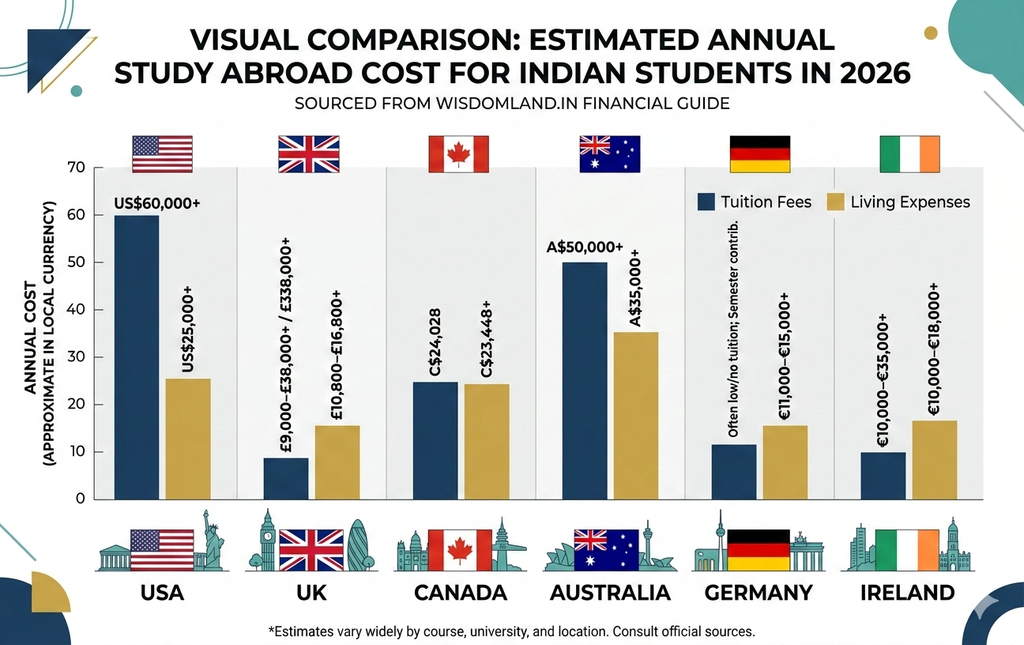
Studying abroad is a dream for many Indian students, but one important question comes first: how much money do you need to study in another country?
The total cost includes more than university fees. Students also need to plan for accommodation, food, health insurance, visa charges, flights, books and daily expenses. The amount can vary significantly depending on the country, university, course and city.
This guide explains the study abroad cost for Indian students in 2026, compares popular destinations such as the USA, UK and Canada, and provides practical budgeting tips to help students and parents plan their finances.
Whether you are planning a bachelor’s degree, master’s degree or MBA, this guide will help you estimate the cost before applying.
Study Abroad Cost for Indian Students in 2026: Quick Comparison
The following table provides indicative planning ranges for international students. These are broad estimates, not guaranteed university quotations. Actual costs can be considerably higher or lower depending on the course and institution.
| Country | Estimated annual tuition | Estimated annual living expenses | Typical course duration |
| USA | US10,000–60,000+ | US12,000–25,000+ | 1–4 years |
| UK | £9,000–£38,000+ | £10,800–£16,800+ | 1–3 years |
| Canada | C18,000–C50,000+ | C$23,448 or more for financial planning | 1–4 years |
| Australia | A20,000–A50,000+ | A25,000–A35,000+ | 1–4 years |
| Germany | Often low or no tuition at many public universities, but exceptions apply | €11,000–€15,000+ | 1–3 years |
| Ireland | €10,000–€35,000+ | €10,000–€18,000+ | 1–4 years |
These ranges are approximate budgeting guides, not official national averages for every course. They exclude some one-time costs, and professional programmes such as medicine and some MBA courses can cost much more. Verify fees with the university and financial requirements with the relevant government.
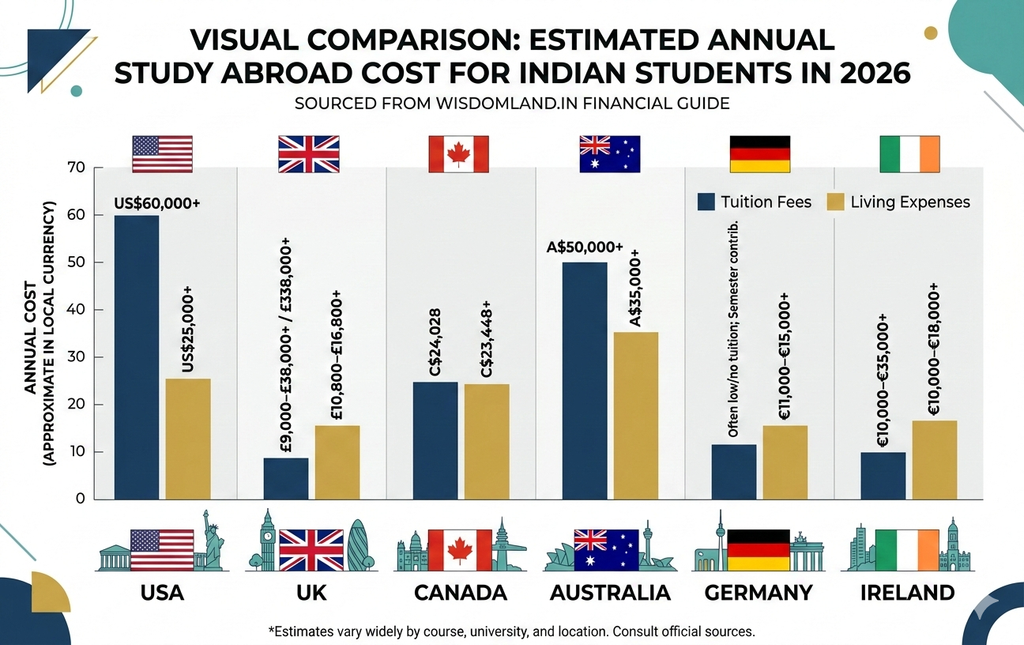
For Canada, Statistics Canada’s 2025/26 figures put average annual tuition at C41,746forinternationalundergraduatestudentsandC24,028 for international graduate students. The Canadian government also requires students applying from 1 September 2026 to show C$23,448 for one person’s living expenses outside Quebec, excluding tuition and transportation. Statistics Canada tuition figures and official Canadian financial requirements.
1. Cost of Studying in the USA in 2026
The United States is a popular destination for Indian students interested in engineering, computer science, business, data science, healthcare and research.
However, the cost of studying in the USA varies widely. A public university, private university and community college may have very different tuition fees. Living in a major city can also cost more than living in a smaller town.
Estimated USA study expenses
| Expense | Indicative annual budget |
| Tuition fees | US10,000–60,000+ |
| Accommodation | US6,000–15,000+ |
| Food and groceries | US3,000–6,000 |
| Health insurance | US1,000–3,000+ |
| Transport and personal expenses | US2,000–5,000 |
| Books and study materials | US500–1,500 |
These are planning estimates. University-specific costs should always be used for your final budget.
Example: USA master’s degree budget
Suppose you choose a two-year master’s programme with annual tuition of US25,000andestimatedlivingexpensesofUS18,000.
| Expense | Two-year estimate |
| Tuition | US$50,000 |
| Living expenses | US$36,000 |
| Estimated total | US$86,000 |
This example excludes flights, visa-related costs, initial accommodation deposits and other one-time expenses. Your actual total may be higher or lower.
How to reduce the cost of studying in the USA
- Compare public universities and private universities.
- Check scholarships offered by the university.
- Explore assistantships where available.
- Compare the total cost of the programme, not just first-year tuition.
- Consider living expenses when choosing the city.
- Check whether the university offers on-campus accommodation.
EducationUSA recommends evaluating tuition, fees and living expenses together because costs differ by institution and location. It also advises students to plan for possible annual tuition increases. Explore EducationUSA’s official funding guidance.
2. UK University Fees and Living Costs in 2026
The United Kingdom attracts Indian students because many master’s degrees can be completed in one year. A shorter course can reduce accommodation and daily living expenses compared with a similar programme lasting two years.
However, a shorter course does not automatically mean the UK is cheaper. Tuition fees, accommodation, city and course type all matter.
Estimated UK study expenses
| Expense | Indicative annual budget |
| Undergraduate tuition | £11,400–£38,000+ |
| Postgraduate tuition | £9,000–£30,000+ |
| Accommodation and bills | £5,000–£12,000+ |
| Food and groceries | £2,000–£4,000 |
| Transport and personal expenses | £1,500–£3,500 |
| Other study expenses | Varies by course |
The British Council’s Study UK guidance lists these tuition ranges and estimates living expenses at around £1,300–£1,400 per month in London and £900–£1,300 elsewhere in the UK. Read the Study UK cost guide.
UK student visa financial requirement
For a UK Student visa, applicants generally need to show the required course fees and living-cost funds.
The official financial requirement currently lists:
- London: £1,529 per month, for up to nine months.
- Outside London: £1,171 per month, for up to nine months.
This means the living-cost evidence can be as much as £13,761 for London or £10,539 outside London, in addition to the relevant outstanding course fees. These are immigration financial-evidence requirements, not a guarantee that the money will cover every student’s actual expenses. Check the official rules before applying because requirements can change. UK Student visa financial requirements.
Is the UK a good option for a one-year master’s degree?
A one-year master’s programme may reduce the number of months you pay for accommodation and daily expenses. But you should compare:
- Total tuition fees.
- Course duration and academic workload.
- Accommodation and living costs.
- Scholarship availability.
- Career opportunities relevant to your field.
- Visa and post-study work rules applicable to your situation.
Choose a course based on its overall value and suitability, not duration alone.
3. Canada Living Expenses and Tuition Fees in 2026
Canada is another popular destination for Indian students. Tuition and living costs vary by province, institution, programme and accommodation choice.
International students should budget for tuition, accommodation, food, transport, insurance and other expenses. They must also meet the government’s financial requirements for a study permit.
Average Canadian university tuition
Statistics Canada’s 2025/26 data reports the following average annual tuition fees for international students:
| Study level | Average annual tuition |
| Undergraduate | C$41,746 |
| Graduate | C$24,028 |
These are national averages for the reported academic year. They do not represent the fee at every university or programme. Source: Statistics Canada.
Canada’s living-expense financial requirement
For study permit applications made on or after 1 September 2026, a single applicant studying outside Quebec must show C$23,448 for one year of living expenses, excluding tuition and transportation.
This is a financial-capacity requirement. Students should budget according to their actual accommodation, food, transport and personal costs, which may be higher. Quebec has separate financial requirements.
The Canadian government says applicants must demonstrate funds for tuition, living expenses and transportation. Students in programmes longer than one year must also explain how they plan to fund the full duration of their studies. Read the official proof-of-funds guidance.
Example: Canada study budget
Suppose your annual tuition is C30,000andyoubudgetC23,448 for living expenses.
| Expense | One-year estimate |
| Tuition | C$30,000 |
| Living expenses | C$23,448 |
| Subtotal | C$53,448 |
| Flights, insurance and other costs | Additional budget required |
This example is for planning only. It does not include every expense, and your university’s tuition may be significantly different.
How to reduce the cost of studying in Canada
- Compare tuition across provinces and institutions.
- Check scholarships and bursaries for international students.
- Compare campus housing with private accommodation.
- Prepare a realistic food and transport budget.
- Consider the full course duration before choosing a programme.
- Do not depend on future part-time earnings to meet essential visa funding requirements.
4. Study Abroad Cost in Australia in 2026
Australia offers programmes in engineering, information technology, business, healthcare, research and other fields. The cost depends on the institution, course, city and lifestyle.
Estimated annual budget
| Expense | Indicative annual budget |
| Tuition | A20,000–A50,000+ |
| Accommodation | A10,000–A20,000+ |
| Food and groceries | A4,000–A7,000 |
| Transport and personal expenses | A3,000–A6,000 |
| Health cover and other costs | Varies |
These are approximate planning figures, not an official quote or immigration financial requirement. Check the university’s fees and the Australian government’s current student visa requirements before applying.
How to plan for Australia
Compare the full tuition fee for your course, the length of study, accommodation options and compulsory health cover. Keep a separate emergency fund for unexpected expenses.
Do not select a university solely because the tuition looks low. Check course recognition, facilities, internship opportunities and the suitability of the programme for your career plans.
5. Cost of Studying in Germany in 2026
Germany is often considered by students looking for public-university programmes with comparatively low tuition fees. However, not every German university or course is tuition-free.
Tuition can depend on the state, institution, programme and student category. Some universities charge tuition, particularly for certain international students or specialised programmes. Students may also need to pay semester contributions.
Common expenses to budget for
- Tuition fees, if applicable.
- Semester contribution.
- Accommodation and utilities.
- Food and groceries.
- Health insurance.
- Transport and personal expenses.
- Visa and residence-related expenses.
- Travel to and from India.
Germany may be worth researching if you want a public-university programme and are prepared to meet its admission, language and financial requirements.
Before applying, check the university’s official fee page and the current financial-proof requirements for your visa. Do not assume that low tuition means you can study without substantial savings.
6. Cost of Studying in Ireland in 2026
Ireland attracts students interested in technology, business, finance, pharmaceuticals, research and other areas.
Tuition varies by institution and course. Dublin may be more expensive than smaller cities, particularly for accommodation.
Expenses to include in your budget
- Annual tuition fees.
- Rent and utility bills.
- Food and groceries.
- Public transport.
- Health insurance.
- Visa and immigration-related costs.
- Books, equipment and other academic expenses.
- Flights and initial setup costs.
Before choosing Ireland, compare the total cost for the entire programme. Check the university’s current international fee schedule and the official immigration guidance for financial evidence.
Which Country Is Most Affordable for Indian Students?
There is no single cheapest country for every student. A lower tuition fee may be offset by living expenses, while a more expensive programme may offer a scholarship or a shorter course duration.
Use this comparison as a starting point:
| Your priority | Countries worth comparing |
| A one-year master’s programme | UK and selected other countries |
| Public universities with lower tuition in some programmes | Germany |
| A broad choice of universities and research programmes | USA |
| Different province and institution price points | Canada |
| Technology, business and research programmes | Ireland and Australia, alongside other destinations |
Compare the actual university offers rather than relying on country-wide generalisations.
Complete Study Abroad Budget for Indian Students
Before applying, prepare a budget that covers both one-time and recurring expenses.
One-time expenses
- University application fees.
- English-language or other entrance tests, if required.
- Passport and visa application costs.
- Document verification and translations, if required.
- Flight tickets.
- Initial accommodation deposits.
- Basic household items and local setup costs.
Recurring expenses
- Tuition fees.
- Rent and utilities.
- Food and groceries.
- Health insurance.
- Transport.
- Mobile and internet.
- Books and study supplies.
- Personal expenses.
Emergency expenses
Keep a reserve for unexpected travel, medical needs, accommodation changes or delays in receiving funds. The appropriate amount depends on your destination and personal circumstances.
A realistic budget should cover the period before you have settled into your new country, not just the first tuition payment.
How to Calculate Your Total Study Abroad Cost
Use this simple method to estimate the amount required for your chosen course.
Total estimated cost = Tuition fees + Living expenses + One-time costs + Emergency reserve
For a multi-year course, multiply annual expenses by the number of years and allow for potential fee increases.
Example calculation
Suppose a student chooses a two-year course with the following costs:
| Expense | Amount |
| Annual tuition | ₹18,00,000 |
| Annual living expenses | ₹10,00,000 |
| Course duration | 2 years |
| One-time travel and setup expenses | ₹1,50,000 |
The estimated tuition for two years is ₹36,00,000. Living expenses for two years are ₹20,00,000. Adding one-time costs gives a subtotal of ₹57,50,000, before any emergency reserve or future price changes.
This is a hypothetical example, not the cost of a specific country or university.
When converting foreign-currency costs into Indian rupees, use a current exchange rate and include a buffer for currency fluctuations. A weaker rupee can increase the amount your family needs to pay.
How to Fund Your Study Abroad Expenses
After estimating the total cost, identify how you will pay for it.
1. Scholarships
Check university scholarships, government scholarships and other legitimate funding programmes. Read the eligibility criteria and deadlines carefully.
A scholarship may cover only tuition, so check whether living expenses and travel are included.
2. Family savings
Calculate how much your family can contribute without affecting essential household expenses or emergency savings.
3. Education loans
An education loan can cover eligible study expenses, subject to lender approval and scheme conditions. Compare interest rates, processing fees, collateral requirements, co-applicant conditions and repayment terms.
Read our related guide on education loan interest rates in India 2026 and our guide to education loans without collateral for abroad studies to plan your finances effectively.
4. University financial aid
Some universities offer grants, tuition reductions, bursaries or assistantships. Availability depends on the institution, course, student category and application requirements.
5. Personal contribution and other funding
Some students combine savings, scholarships and approved loans. Make sure the funding is confirmed and available when tuition or visa-related payments are due.
Important: Do not build your core budget around uncertain future earnings from part-time work. Work permission and permitted hours depend on the destination’s current rules, and a job is not guaranteed.
How to Reduce Study Abroad Costs in 2026
You may not be able to change every expense, but careful planning can make a meaningful difference.
Choose the course carefully
Compare tuition, duration, required materials and the value of the qualification. A shorter course may reduce living expenses, but it should still meet your academic and career goals.
Apply for scholarships early
Check deadlines before applying to universities. Some scholarship applications must be submitted at the same time as the admission application.
Compare cities, not just universities
Accommodation and transport costs can vary significantly within the same country. Compare the total cost of living near each university.
Choose accommodation thoughtfully
University housing, shared rentals and private accommodation have different costs and conditions. Check commute time, bills, deposits and contract terms before committing.
Prepare your documents in advance
Incomplete applications can cause delays and additional expenses. Follow the university’s and visa authority’s official document checklist.
Avoid unnecessary agent fees
You can often find admissions, tuition and visa information directly from official university and government websites. If you use an adviser, check their credentials and understand the charges before paying.
Track your spending
Create a monthly budget for rent, food, transport and personal expenses. Review it regularly after arriving.
Common Mistakes Students Make When Estimating Study Abroad Costs
1. Looking only at tuition fees
Tuition is often the largest expense, but rent, food, insurance, travel and other costs can add substantially to the total.
2. Ignoring the full course duration
Compare the cost of the entire programme rather than the first year alone.
3. Confusing visa financial requirements with actual living costs
The amount required for immigration purposes may be a minimum evidence requirement. Your real expenses may be higher.
4. Forgetting currency changes
The amount payable in Indian rupees can change when exchange rates move. Keep a suitable buffer.
5. Depending entirely on part-time work
You may not find work immediately, and your schedule or visa rules may limit working hours. Arrange reliable funding before travelling.
6. Taking a loan without comparing terms
Compare the actual interest rate, fees, repayment conditions and total borrowing cost before accepting an education loan.
7. Using outdated information
University fees and visa requirements change. Verify details for your intended intake and application date.
Frequently Asked Questions
1. What is the study abroad cost for Indian students in 2026?
The cost depends on the destination, course and university. Students should budget for tuition, living expenses, insurance, travel, visa-related costs and other expenses. Use the university’s current fee schedule and the destination government’s financial requirements to prepare an accurate estimate.
2. Which country is cheapest for Indian students?
There is no universal cheapest country. Germany may offer low-tuition options at some public universities, while the overall cost depends on living expenses, tuition, course duration and funding. Compare specific universities before deciding.
3. How much money is required to study in the USA?
It depends on the university, course and location. Tuition and living expenses vary widely. Check the institution’s estimated annual cost and the funding amount required for your student visa process.
4. What is the UK university fee for Indian students?
The tuition fee depends on the course and university. The British Council’s Study UK guidance lists international undergraduate fees from £11,400 to £38,000 and postgraduate fees from £9,000 to £30,000, while some courses may cost more. Check the specific university’s current fee schedule.
5. How much money should I show for Canada in 2026?
For study permit applications made on or after 1 September 2026, a single applicant studying outside Quebec must show C$23,448 for one year of living expenses, excluding tuition and transportation. The tuition and travel costs must be budgeted separately. Check the current official rules before applying.
6. Can I study abroad without an education loan?
Yes, if your savings, family funding, scholarships or other confirmed financial support cover the costs and meet the relevant requirements. Make a complete budget before deciding whether a loan is necessary.
7. Can scholarships cover all study abroad expenses?
Some scholarships provide extensive funding, but many cover only part of the costs. Check whether tuition, living expenses, travel, insurance and other expenses are included.
8. Can part-time work pay for my studies abroad?
Part-time work may help with some expenses where permitted, but income is not guaranteed. Do not rely on it as your only source of funding for tuition or visa-required funds.
9. How much should I keep for emergencies?
There is no fixed amount suitable for every student. Consider your destination, accommodation, insurance, family support and access to funds. Keep a reserve for unexpected expenses in addition to your planned tuition and living budget.
10. When should I start planning my study abroad budget?
Start as soon as you begin shortlisting courses. You will need time to compare tuition fees, apply for scholarships, arrange funding, prepare financial evidence and meet payment deadlines.
Final Words
Planning your finances is one of the most important steps in preparing for international education. The study abroad cost for Indian students in 2026 depends on the university, destination, course duration, living arrangements and available financial support.
Compare the total cost of the entire course, not just the tuition fee. Check official university prices, current visa financial requirements, scholarship options and education loan terms before making a final decision.
A well-prepared budget helps you understand what you can afford, avoid unexpected expenses and focus on your studies with greater confidence.
Disclaimer: This article is for general educational purposes. Costs and visa financial requirements may change. Always verify current fees with your university and financial requirements with the relevant government authority before applying.