
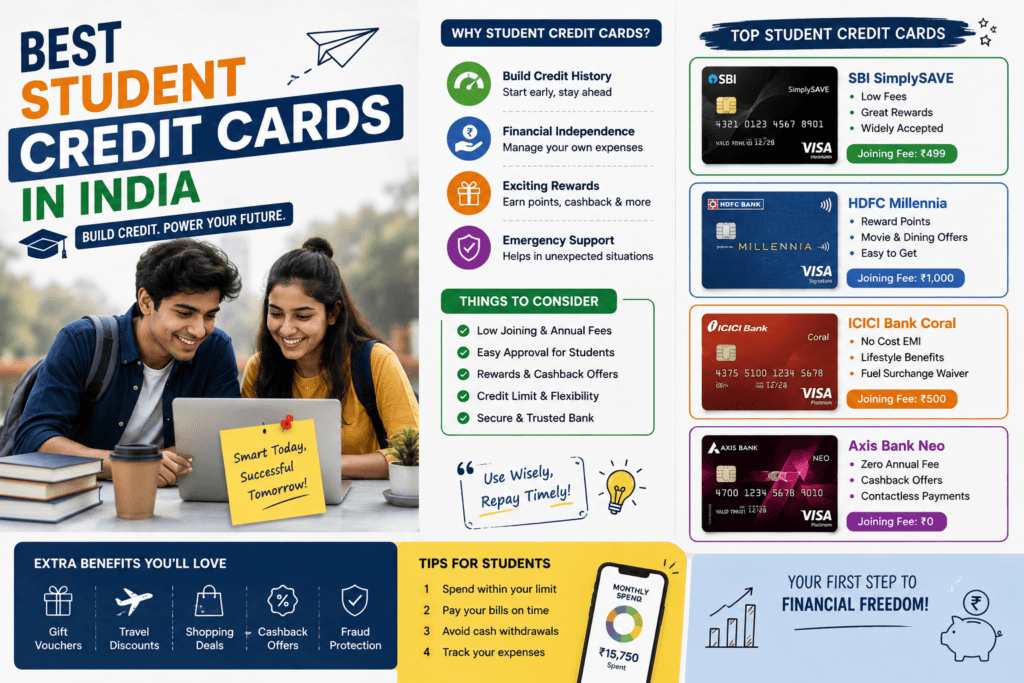
Student Credit Cards in India is the focus of this practical 2026 guide. Student Credit Cards in India for 2026: compare fees, eligibility, secured options, overseas charges and responsible credit use.
Explore more education and career resources on WisdomLand for related study-abroad, scholarships and career guidance.
Student Credit Cards in India: Can Students Get Credit Cards?
Student Credit Cards in India are not one single standardized product category. Eligibility depends on the issuer and may involve income, age, credit history, a fixed deposit, a co-applicant or other requirements. Students should therefore compare actual eligibility criteria rather than assuming every bank offers a dedicated student card.
For students without a regular income or credit history, secured credit cards backed by a fixed deposit may be an option where available. Terms differ, so read the issuer’s current documentation before applying.
What to Compare
Student Credit Cards in India: Key Strategies for 2026
Compare annual fees, joining fees, interest rates, late-payment charges, cash-advance costs, foreign-transaction fees and reward conditions. Student Credit Cards in India should be judged on total cost and usefulness rather than rewards alone.
If you are studying abroad, international transaction charges can matter significantly. A card with attractive domestic rewards may not be economical for overseas spending if the foreign-currency fee is high.
Credit Limit and Responsible Use
A credit card is a payment tool, not additional income. Keep spending within a budget and pay the full statement balance by the due date whenever possible. Carrying a balance can result in interest that quickly outweighs rewards.
Students should also avoid using credit cards for cash withdrawals unless there is a genuine emergency and they understand the cost. Cash advances can carry separate fees and interest terms.
Practical tip: Verify current eligibility, fees, work rules or payment terms directly with the relevant official source before making a decision.
Building a Credit History
Used responsibly, a credit card can help establish a credit history over time. Payment history and credit utilization can influence credit assessment. Check your credit report periodically and review it for errors.
The aim is consistency rather than maximizing the limit. A simple routine—use the card for planned expenses, monitor transactions and pay the statement on time—can be more valuable than chasing every reward offer.
Cards for Students Going Abroad
Students leaving India should compare international acceptance and overseas transaction costs. Also check whether the card requires travel notification, supports contactless transactions and provides a reliable way to report a lost card internationally.
Keep at least one alternative payment method. If your primary card is blocked or lost, a backup can help with essential expenses while the issue is resolved.
Common Mistakes to Avoid
Avoid applying for many cards at once, ignoring annual fees, paying only the minimum due without understanding the interest cost, and sharing OTPs or PINs. Read the most recent fee schedule and key terms before accepting a card.
Be particularly careful with unsolicited calls promising instant approval or asking for card details. Use official issuer channels to verify offers.
Practical tip: Verify current eligibility, fees, work rules or payment terms directly with the relevant official source before making a decision.
A Student-Friendly Decision Framework
Start with your purpose. If you need a card mainly for online purchases, prioritize security and low fees. If you expect overseas spending, compare foreign-transaction charges. If your goal is building credit, prioritize manageable limits and responsible repayment.
Student Credit Cards in India can be useful when matched to a realistic budget. Choose a product whose costs you understand and whose repayment you can comfortably manage every month.
Credit Card Features That Matter for Students
Another important consideration for Student Credit Cards in India is digital security. Look for transaction alerts, spending controls and a straightforward process for reporting unauthorized transactions. Students should also understand the difference between the billing date and payment due date.
If the card is used internationally, check the foreign-currency conversion fee and any additional tax or surcharge that may apply. A student traveling abroad should also confirm how the issuer handles emergency replacement and international customer support. These practical details can be more valuable than a small rewards bonus.
Choosing Based on Your Actual Spending
Before choosing Student Credit Cards in India, list the expenses you expect to put on the card. If most purchases are groceries and subscriptions, a simple low-fee card may be more useful than a premium rewards product. If you expect overseas purchases, international transaction costs deserve more attention.
Students should also understand statement reconciliation. Check each monthly statement against your own spending tracker so unauthorized or duplicate transactions are noticed quickly. This habit is useful whether the card is used in India or during an overseas semester.
Useful Official and Trusted Resources for Student Credit Cards in India
RBI — official or established resource for further verification.
CIBIL — official or established resource for further verification.
Final Thoughts on Student Credit Cards in India
The right student credit card is the one that fits your financial situation, not the one with the most advertising. Compare fees, overseas charges, eligibility and repayment terms, and use credit conservatively. Always verify current terms directly with the issuer. For 2026, Student Credit Cards in India should be approached with research, realistic budgeting and careful verification.