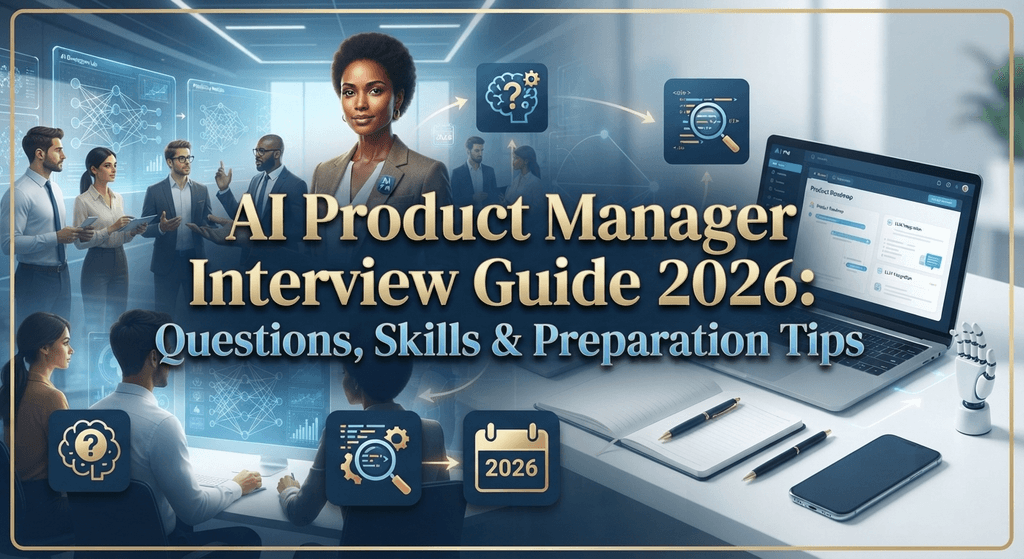
AI Product Manager Interview Guide 2026: Questions, Skills & Preparation Tips
Preparing for an AI product manager interview requires a strategy that blends traditional product management frameworks with a strong grasp of technical artificial intelligence concepts. If you are gearing up for an AI product manager interview, you need more than standard product-management knowledge.
AI product managers work at the intersection of product strategy, customer needs, technology, data and business goals. In 2026, many interviews can also explore generative AI, large language models, AI agents, evaluation, responsible AI, experimentation and product metrics.
You do not necessarily need to be a machine-learning engineer.
However, you should understand how AI products work well enough to communicate with engineers, data scientists, designers, business teams and customers.
This guide explains how to prepare for an AI product manager interview and the types of questions you may encounter.
What Does an AI Product Manager Do?
An AI product manager helps identify problems where AI can create useful customer or business outcomes.
The role can involve:
- Customer research
- Product strategy
- Problem definition
- AI use-case identification
- Product requirements
- Prioritization
- Collaboration with engineers
- Data strategy
- Model evaluation
- User experience
- Product launches
- Metrics
- Risk management
The product manager does not need to personally build every model.
Instead, the PM needs to understand the problem deeply enough to make good product decisions and communicate effectively with technical teams.
Why Every AI Product Manager Interview Is Different
A traditional product interview may focus heavily on product sense, prioritization and execution.
An AI-focused interview can additionally test your understanding of:
- Machine learning basics
- Generative AI
- LLMs
- Prompting
- Retrieval-augmented generation
- AI evaluation
- Hallucinations
- Model latency
- Cost
- Data quality
- Privacy
- Safety
- Responsible AI
The interviewer may ask you to design an AI-powered product and explain how you would measure whether it actually works.
Skills You Should Prepare
| Skill | What You Should Know |
| Product sense | Identify valuable customer problems |
| AI basics | Understand models, training and inference |
| Generative AI | Understand LLM-based products |
| Data | Understand data quality and availability |
| Evaluation | Define quality and business metrics |
| Strategy | Connect AI capabilities to business goals |
| Communication | Explain technical ideas clearly |
| Experimentation | Design tests and analyze results |
| Responsible AI | Understand safety, privacy and bias |
| Execution | Work with engineering and design teams |
1. Understand the Customer Problem First
One common mistake is beginning with technology.
For example:
“We should build an AI chatbot.”
That is not a product problem.
A stronger approach is:
“Customers spend too much time searching through complicated support documentation.”
Then you can ask whether an AI assistant could solve that problem.
During your interview, explain:
- Who is the customer?
- What problem are they experiencing?
- How frequently does it happen?
- What does the current solution look like?
- Why is the current solution insufficient?
- Can AI solve the problem?
- How will you measure success?
2. Learn Basic AI Concepts
To stand out in your AI product manager interview, you do not need to become an AI researcher, but you should understand common machine learning and generative AI terminology.
Training
Training is the process through which a model learns patterns from data.
Inference
Inference is when the trained model generates an output for new input.
Large Language Model
An LLM is a model designed to process and generate language.
Fine-Tuning
Fine-tuning adapts a model using additional task-specific training data.
Prompting
Prompting involves providing instructions or context to guide a model’s output.
RAG
Retrieval-augmented generation combines retrieval of relevant information with generation.
A product manager should understand when an approach is appropriate rather than automatically choosing the newest technology.
Key AI Product Manager Interview Concepts
An AI product often involves trade-offs.
For example:
Accuracy vs Cost
A larger model may provide better results but cost more.
Quality vs Latency
A complex system may produce better answers but take longer.
Automation vs Human Review
Full automation may be efficient but could introduce greater risk in sensitive situations.
Personalization vs Privacy
More user data can improve personalization, but privacy requirements must also be considered.
Mentioning these trade-offs can demonstrate practical product thinking.
4. Prepare for AI Product Design Questions
A common AI product manager interview question might be:
“Design an AI assistant for university students.”
Do not immediately start listing features.
Use a framework.
Step 1: Clarify the User
Ask:
- Which students?
- Undergraduate or postgraduate?
- Which country?
- What problem are we solving?
Step 2: Identify the Problem
Possible problems include:
- Finding course information
- Understanding assignments
- Planning study schedules
- Finding campus services
Step 3: Choose One Use Case
Do not attempt to solve everything.
For example:
“Let’s focus on helping students find accurate information about university policies and services.”
Step 4: Define the AI Solution
The assistant could retrieve approved university information and generate a concise answer.
Step 5: Consider Risks
Ask:
- Could the model hallucinate?
- What happens if information is outdated?
- How will private student information be handled?
- When should the system refer the student to a human?
Step 6: Define Metrics
Possible metrics:
- Answer accuracy
- Task completion
- User satisfaction
- Escalation rate
- Response latency
- Cost per interaction
How to Master the AI Product Manager Interview
Here are common areas to practise.
Mastering the AI Product Manager Interview Questions
AI Product Manager Interview Questions
Question: How would you build an AI travel assistant?
Explain the target user, problem, use case, AI capability, MVP and success metrics.
Question: Which AI feature would you add to a banking app?
Discuss customer value, feasibility, privacy and risk.
Technical Questions
Question: What is an LLM?
Explain it simply without using unnecessary jargon.
Question: What is RAG?
Explain that it allows a system to retrieve relevant information before generating an answer.
Question: What is an AI hallucination?
It is when an AI system generates information that appears plausible but is incorrect or unsupported.
Metrics Questions
Question: How would you measure an AI chatbot?
A strong answer should include both technical and business metrics.
For example:
- Accuracy
- Helpfulness
- Resolution rate
- Customer satisfaction
- Latency
- Cost
- Escalation rate
6. Learn AI Evaluation
AI products require systematic evaluation.
Suppose you launch an AI customer-support assistant.
You cannot measure success only by asking:
“Do users like it?”
You need to examine multiple dimensions.
Quality
Did the AI provide a correct answer?
Relevance
Did it answer the actual question?
Safety
Did it avoid inappropriate or harmful outputs?
Groundedness
Was the response supported by trusted information?
Business Impact
Did it reduce support workload or improve customer satisfaction?
7. Prepare for Product Metrics Questions
Imagine an interviewer asks:
“Your AI chatbot has 100,000 monthly users. What metrics would you track?”
You could organize metrics into four groups.
User Metrics
- Active users
- Repeat usage
- Session frequency
- Retention
Quality Metrics
- Correctness
- Relevance
- User ratings
- Escalation rate
Business Metrics
- Conversion
- Cost savings
- Revenue
- Customer retention
Technical Metrics
- Latency
- Error rate
- Model cost
- Availability
8. Understand Responsible AI
Responsible AI is particularly important for product managers.
Consider:
- Privacy
- Security
- Bias
- Transparency
- Safety
- Human oversight
- Copyright
- Data governance
For example, an AI system used in healthcare should have much stricter controls than a system generating restaurant descriptions.
Your product strategy should reflect the potential impact of incorrect output.
9. Prepare for Behavioral Questions
AI product manager interviews can include questions such as:
- Tell me about a difficult product decision.
- Describe a disagreement with an engineer.
- Tell me about a failed product.
- How do you prioritize competing requirements?
- Tell me about a time you used data to change a decision.
- How do you handle an unclear problem?
- Describe a product you launched.
Use the STAR method:
Situation → Task → Action → Result
Keep your answers specific.
Instead of saying:
“I worked with engineering to solve a problem.”
Say:
“Our customer-support team was receiving repeated questions about account setup. I worked with engineering to identify the highest-volume issues, proposed an automated workflow, tested it with a small user group and used resolution rate to determine whether to expand the feature.”
10. Build an AI Product Portfolio
A portfolio can help demonstrate your thinking.
You could create case studies such as:
Case Study 1: AI Resume Assistant
Explain:
- User problem
- Target audience
- AI capability
- User journey
- MVP
- Metrics
- Risks
Case Study 2: AI Customer Support Assistant
Explain:
- Existing workflow
- AI opportunity
- RAG approach
- Human escalation
- Evaluation
- Cost
Case Study 3: AI Education Assistant
Explain:
- User problem
- Data sources
- Personalization
- Safety
- Success metrics
A good portfolio does not need 20 projects.
Three well-developed case studies can demonstrate structured thinking.
11. A 30-Day AI Product Manager Interview Plan
Week 1: Product Management
Study:
- Product discovery
- User research
- Prioritization
- Roadmaps
- Product metrics
Week 2: AI Fundamentals
Study:
- Machine learning basics
- LLMs
- Prompting
- RAG
- Fine-tuning
- Inference
- AI evaluation
Week 3: Case Studies
Practise:
- Product design
- Metrics
- Strategy
- Technical discussions
Try answering questions aloud.
Week 4: Mock Interviews
Conduct mock interviews covering:
- Product sense
- AI concepts
- Execution
- Strategy
- Behavioral questions
Record yourself if possible.
Then review whether your answers are clear and structured.
12. Common Mistakes to Avoid
Mistake 1: Using Too Much Jargon
You do not impress an interviewer simply by using technical words.
Explain concepts clearly.
Mistake 2: Starting With Features
Always begin with the user problem.
Mistake 3: Ignoring Costs
AI products can have significant inference and infrastructure costs.
Mistake 4: Ignoring Evaluation
A product is not successful simply because the model produces impressive demonstrations.
Mistake 5: Forgetting Safety
AI systems can create privacy, security and reliability risks.
Mistake 6: Giving Generic Behavioral Answers
Use specific examples and measurable results.
Example Interview Answer
Question: “How would you build an AI assistant for an e-commerce company?”
A structured answer could begin:
“I would first identify the highest-value customer problem rather than assuming we need a chatbot. Suppose research shows that customers frequently struggle to choose the right product. I would explore an AI shopping assistant that asks questions about the customer’s needs, retrieves relevant product information and explains recommendations.”
Then continue with:
- Target users
- MVP
- Data sources
- AI architecture
- Evaluation
- Safety
- Business metrics
- Cost
- Rollout plan
This shows product thinking rather than simply AI enthusiasm.
AI Product Manager Interview Preparation Checklist
Before the interview, make sure you can explain:
- What an LLM is
- What RAG means
- Difference between training and inference
- Basic AI evaluation
- AI hallucinations
- AI product metrics
- Product prioritization
- Customer discovery
- AI risks
- Data privacy
- AI cost considerations
- Product experimentation
- Behavioral examples
Frequently Asked Questions
Do I need coding skills to become an AI product manager?
You do not necessarily need to be a full-time programmer. However, technical literacy is valuable because you will work closely with engineers and data scientists.
Do I need a machine-learning degree?
Not necessarily. Product management experience combined with practical AI knowledge can be valuable. Requirements vary between companies and roles.
What should I study for an AI product manager interview?
Focus on product management, AI fundamentals, generative AI, product metrics, experimentation, responsible AI and communication.
Should I learn Python?
Basic Python can be useful for understanding technical workflows and experimenting with data or AI tools, although the required level depends on the job.
How can I practise for the interview?
Use product-design case studies, AI scenario questions, technical fundamentals and mock interviews.
Final Thoughts
To succeed in an AI product manager interview, think like a product leader first and an AI enthusiast second.
The interviewer wants to understand whether you can identify meaningful customer problems, evaluate AI as a possible solution, work with technical teams and measure real-world outcomes.
Prepare your fundamentals, practise structured answers and build a few realistic AI product case studies.
The strongest preparation is not memorizing 100 interview answers. It is learning how to approach unfamiliar problems logically and communicate your decisions clearly.
Recommended Resources & External Links
For further learning and industry guidelines on AI product management, explore these resources:
- Product School: Insights, guides, and courses on modern product management best practices.
- Google AI: Research, principles, and tools for building responsible AI products.
- DeepLearning.AI: Technical and foundational courses on machine learning and generative AI.
- Wisdom Land: Comprehensive guides, interview preparation strategies, and AI learning resources.