
Car Insurance Renewal: How to Compare Quotes and Avoid Overpaying in India (2026)
Last Updated: 14 October 2026
Introduction
Renewing your car insurance is an important annual task for every car owner in India. But many people simply renew with their existing insurer without checking whether they could get better coverage or a more competitive premium elsewhere.
For broader advice on managing your personal finances, explore our Personal Finance Guide.
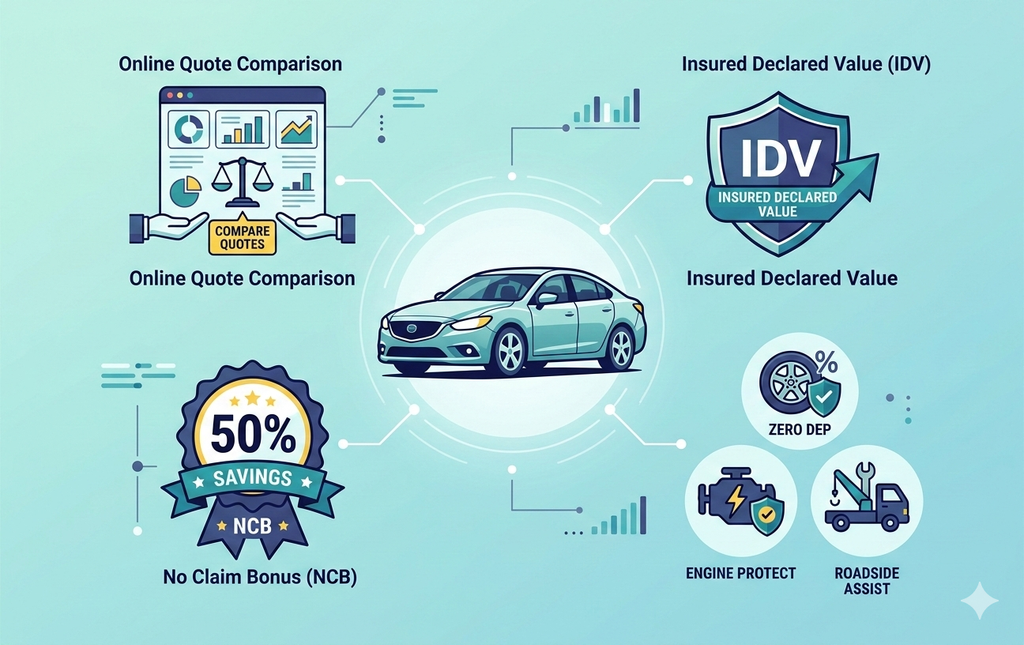
The good news is that you can compare car insurance quotes online, check different coverage options, preserve your No Claim Bonus (NCB) and avoid paying for add-ons you do not need.
However, choosing the cheapest policy is not always the best decision. A lower premium might come with a lower Insured Declared Value (IDV), a higher deductible or fewer useful benefits.
In this guide, you will learn how car insurance renewal works, how to compare quotes, which add-ons are worth considering and what to check before paying your premium.
Car Insurance Renewal: Key Things to Check
Before renewing your policy, review these important details.
| What to Check | Why It Matters |
| Premium | Compare the total price for similar coverage |
| IDV | Affects the insured value of your car in eligible total-loss claims |
| No Claim Bonus | Can reduce the own-damage premium if you qualify |
| Third-party cover | Mandatory for vehicles used on public roads in India |
| Own-damage cover | Helps cover eligible damage to your own vehicle |
| Add-ons | Provide additional benefits for an extra premium |
| Deductible | Determines the amount you must pay towards a covered claim |
| Cashless garages | Check whether your preferred repair garages are in the insurer’s network |
| Policy expiry date | Helps prevent a break in insurance coverage |
| Exclusions | Explain situations and expenses that the policy does not cover |
The Insurance Regulatory and Development Authority of India (IRDAI) recommends comparing at least three quotes and reviewing coverage, deductibles and IDV rather than focusing only on the premium. See the official IRDAI motor insurance guidance.
1. Understand Your Car Insurance Renewal Options
Before requesting quotes, understand which type of policy you currently have and what protection you need.
Third-Party Car Insurance
Third-party liability insurance is mandatory for vehicles used on public roads in India. It covers eligible legal liabilities for injury, death or property damage caused to third parties, subject to the policy and applicable law.
However, it does not cover damage to your own car under the third-party-only section.
This option may be suitable for someone who needs the legally required liability cover, but it offers limited financial protection for damage to their own vehicle.
Comprehensive or Package Car Insurance
A comprehensive or package policy generally combines third-party liability cover with own-damage protection, subject to policy terms.
It may cover eligible losses caused by events such as accidents, theft, fire and certain natural disasters.
The exact coverage, exclusions and deductibles depend on the policy wording.
Standalone Own-Damage Insurance
If you already have valid third-party cover, you may be able to purchase a separate own-damage policy to cover eligible damage to your car.
Check that the dates and terms of your third-party and own-damage policies are appropriate for your vehicle.
Which should you choose? If your car is valuable or you would struggle to pay for major repairs, consider whether own-damage cover is worth the additional premium. Compare the available policies and their exclusions before deciding.
2. How to Compare Car Insurance Quotes Online
Comparing car insurance quotes is one of the simplest ways to find suitable coverage without overpaying.
Step 1: Keep Your Vehicle Details Ready
You may need the following information:
- Vehicle registration number.
- Registration Certificate (RC) details.
- Car make, model and variant.
- Fuel type and registration year.
- Existing policy number and expiry date.
- Previous claim history.
- No Claim Bonus details, if applicable.
- Details of any modifications or additional accessories.
Provide accurate information. Incorrect details can cause delays or disputes during a claim.
Step 2: Collect at Least Three Quotes
Compare quotes from your existing insurer and at least two alternatives.
You can visit insurers’ official websites or use a reputable comparison platform. Confirm that you are comparing the same type of policy and broadly similar benefits.
Step 3: Compare Coverage, Not Just Price
Review IDV, deductibles, exclusions, add-ons, claim procedures and garage networks.
A policy that costs slightly more may offer better value if it provides coverage that matters to you.
Step 4: Check the Final Premium
Review the final amount payable, including applicable taxes and any add-on charges shown in the quotation.
Step 5: Read the Policy Documents
Before paying, check the policy wording, coverage schedule and applicable terms. Keep a copy of the renewed policy and payment receipt.
3. Car Insurance Quote Comparison Table
Use this table to compare quotes before renewing.
| Feature | Insurer A | Insurer B | Insurer C |
| Annual premium | ₹_____ | ₹_____ | ₹_____ |
| Policy type | _____ | _____ | _____ |
| IDV | ₹_____ | ₹_____ | ₹_____ |
| No Claim Bonus | _____ | _____ | _____ |
| Compulsory deductible | ₹_____ | ₹_____ | ₹_____ |
| Voluntary deductible | ₹_____ | ₹_____ | ₹_____ |
| Zero-depreciation add-on | Yes/No | Yes/No | Yes/No |
| Engine protection | Yes/No | Yes/No | Yes/No |
| Roadside assistance | Yes/No | Yes/No | Yes/No |
| Preferred garage in network | Yes/No | Yes/No | Yes/No |
| Important exclusions | _____ | _____ | _____ |
Tip: Compare like-for-like policies. A quote with a lower IDV or fewer add-ons is not directly comparable with a quote that provides higher coverage.
4. What Is IDV in Car Insurance?
IDV stands for Insured Declared Value. It represents the insured value of your car for relevant total-loss or constructive-total-loss claims, subject to the policy terms.
IDV is an important factor when comparing car insurance renewal quotes.
Generally, the IDV of an older car decreases over time because of depreciation. The amount offered by an insurer depends on the vehicle’s age, condition, policy rules and valuation method.
Why Does IDV Matter?
- A higher IDV can mean a higher own-damage premium.
- A lower IDV may reduce the premium but can also reduce the amount payable for an eligible total-loss claim.
- An unrealistically high IDV does not mean you will automatically receive that amount in every claim.
- The insurer’s valuation method and policy terms matter.
Example: Comparing IDV and Premium
Suppose two insurers offer quotes for the same car.
| Particulars | Insurer A | Insurer B |
| Annual premium | ₹12,000 | ₹10,800 |
| IDV | ₹6,00,000 | ₹5,20,000 |
| Difference in premium | — | ₹1,200 lower |
| Difference in IDV | — | ₹80,000 lower |
Insurer B is cheaper by ₹1,200, but its quoted IDV is ₹80,000 lower.
These figures are illustrative, not actual market quotations. The example shows why you should compare IDV alongside the premium instead of choosing the lowest price automatically.
5. How to Save Money With No Claim Bonus (NCB)
No Claim Bonus is a discount on the own-damage premium for eligible claim-free policy periods.
For many private car policies, the commonly used NCB progression is:
| Consecutive Claim-Free Policy Periods | Common NCB Rate |
| After 1 claim-free year | 20% |
| After 2 consecutive claim-free years | 25% |
| After 3 consecutive claim-free years | 35% |
| After 4 consecutive claim-free years | 45% |
| After 5 consecutive claim-free years | 50% |
Check the NCB shown in your policy and renewal quotation to confirm the rate applicable to your circumstances.
Important Facts About NCB
- NCB applies to the own-damage premium, not the third-party liability premium.
- Making a claim may affect your NCB at renewal, subject to policy terms and any applicable NCB protection add-on.
- NCB belongs to the policyholder, not the vehicle itself.
- If you change insurers at renewal, you can generally transfer your eligible NCB by providing the required proof.
- When you sell your car, the NCB does not transfer to the buyer. The eligible policyholder may be able to use it for another vehicle.
The IRDAI motor insurance guidance explains how NCB works and what evidence may be needed when switching insurers.
Example: How NCB Can Reduce Your Premium
Suppose the own-damage component of your premium before NCB is ₹10,000 and you qualify for a 35% NCB.
| Particulars | Amount |
| Own-damage premium before NCB | ₹10,000 |
| NCB at 35% | ₹3,500 |
| Own-damage premium after NCB | ₹6,500 |
This example excludes third-party premium, add-ons, taxes and other adjustments. Your actual saving depends on the premium components and terms of your policy.
Should You Make a Small Claim or Pay for Repairs Yourself?
If the repair bill is small, compare the cost of the repair with the potential loss of your NCB and any applicable deductible.
For example, paying a modest repair bill yourself might sometimes be cheaper than making a claim that affects your future premium. But the decision depends on the actual repair cost, policy terms, NCB level and financial circumstances.
Do not avoid reporting an incident when you are required to do so under the policy or law. For significant damage, injury or third-party involvement, follow the appropriate reporting and claims procedure.
6. Which Car Insurance Add-Ons Are Worth Buying?
Add-ons extend the benefits of your base policy for an additional premium. Their value depends on your car, driving conditions, repair costs and existing coverage.
| Add-On | What It May Cover | Who May Consider It |
| Zero depreciation | Reduces the impact of depreciation deductions on eligible parts claims, subject to terms | Owners of newer cars or cars with costly replacement parts |
| Engine protection | Covers specified engine-related losses that may be excluded from standard cover, subject to conditions | Drivers in flood-prone areas or locations with waterlogging risks |
| Roadside assistance | Provides specified help for breakdowns or emergencies | People who travel long distances or drive in unfamiliar areas |
| Return to invoice | May pay an amount based on invoice value or specified costs after eligible total loss or theft, subject to conditions | Owners of newer or higher-value cars |
| NCB protection | Helps preserve eligible NCB after specified claims, subject to policy terms | Drivers who have accumulated a substantial NCB |
| Consumables cover | Covers specified items such as nuts, bolts and certain fluids when eligible | Owners who want broader protection against repair-related expenses |
Not every insurer offers every add-on, and the conditions can vary significantly.
Is Zero Depreciation Cover Worth It?
Zero-depreciation cover can reduce depreciation deductions on eligible parts during a covered claim. It does not mean that every repair expense will be paid in full.
Check the number of permitted claims, eligible parts, exclusions, deductibles and the age or vehicle eligibility limits.
For an older car, the additional premium may not be worthwhile if the benefit is limited or the car is nearing the end of its useful life.
Is Engine Protection Necessary?
Engine protection may be useful in areas where flooding or waterlogging is a concern. Standard motor policies may exclude certain engine losses arising from water ingress or continued attempts to start a flooded engine.
Read the add-on wording carefully. Do not assume it covers every mechanical failure, wear-and-tear issue or maintenance problem.
Should You Buy Roadside Assistance?
Consider roadside assistance if you frequently drive long distances or want access to services such as towing, breakdown help or emergency support.
Check the permitted distance, number of service calls and other limits. Some car manufacturers or existing memberships may already provide similar benefits.
Best approach: Choose add-ons according to realistic risks, not simply because they are offered during checkout.
7. Common Mistakes to Avoid During Car Insurance Renewal
Avoid these mistakes when renewing your motor insurance.
Mistake 1: Choosing the Cheapest Quote
A cheaper premium may come with a lower IDV, higher deductible or less useful coverage.
What to do: Compare the full policy details before making a decision.
Mistake 2: Forgetting to Apply NCB
If you qualify for NCB but it is missing from your quotation, you may pay more than necessary.
What to do: Check the NCB shown on your expiring policy and provide proof if you switch insurers.
Mistake 3: Buying Every Add-On
Additional cover can increase the premium without providing much practical value for your particular car.
What to do: Select add-ons according to your car’s age, location, driving habits and likely repair expenses.
Mistake 4: Choosing an Unnecessarily High Deductible
A voluntary deductible may reduce the premium, but it increases the amount you must pay when making an eligible claim.
To learn more about managing credit products and borrowing responsibly, see our Loans & Credit Guide.
What to do: Choose a deductible you could comfortably afford after an accident.
Mistake 5: Ignoring the Garage Network
A policy may have attractive pricing but limited cashless repair options near your home.
What to do: Check whether the insurer has suitable network garages in your area and understand its cashless repair process.
Mistake 6: Renewing After the Policy Expires
A break in cover can leave you uninsured for own-damage losses and create additional renewal requirements.
What to do: Start comparing quotes well before the expiry date.
Mistake 7: Providing Incorrect Details
Incorrect information about your vehicle, previous claims, modifications or usage can create problems during claim settlement.
What to do: Review all the information in the proposal form before submitting it.
8. When Should You Renew Your Car Insurance?
Start comparing quotes around two to three weeks before the expiry date. This gives you time to review coverage, ask questions and complete the renewal without rushing.
IRDAI advises approaching the insurer at least 15 days before expiry. Its guidance also notes that a break in insurance may require vehicle inspection and additional charges.
What Happens if Your Car Insurance Expires?
If your policy expires before renewal:
- You may have no active cover for the expired policy’s risks.
- Your vehicle must not be used on public roads without the legally required third-party insurance.
- The insurer may require an inspection before providing own-damage cover.
- A break in cover may affect NCB eligibility, depending on the duration and applicable rules.
Do not assume that a motor insurance policy has a grace period during which you remain covered after expiry.
If your policy has already expired, contact the insurer and arrange the required renewal or inspection before driving the car.
9. Documents Required for Car Insurance Renewal
Keep these details ready:
- Vehicle Registration Certificate (RC).
- Existing insurance policy.
- Vehicle registration number.
- Previous claim details.
- NCB certificate or renewal notice, if applicable.
- Valid contact details.
- Details of any vehicle modifications or accessories that need to be declared.
Additional documents may be requested depending on the insurer and whether the policy has expired.
10. How to Renew Car Insurance Online
The online renewal process is usually straightforward.
- Visit your existing insurer’s official website or a reputable comparison platform.
- Enter your vehicle registration number or the requested vehicle details.
- Review your existing policy and expiry date.
- Declare your previous claim history accurately.
- Compare quotes and check the IDV, deductible and add-ons.
- Confirm the NCB shown in the quotation.
- Read the coverage schedule and relevant policy wording.
- Pay through the official payment channel.
- Download the policy document and receipt.
- Check the vehicle details, policy period and coverage after receiving the policy.
If you switch insurers, make sure the new policy starts at the appropriate time and that you have submitted the necessary NCB evidence.
11. Where to Compare and Verify Car Insurance
Use official insurer websites and reliable policy information before making your final decision.
| Resource | Why Use It | Link |
| IRDAI motor insurance guidance | Understand mandatory cover, IDV, NCB, add-ons and quote comparisons | IRDAI Motor Insurance |
| IRDAI non-life insurer information | Find information about regulated non-life insurers | IRDAI Non-Life Insurers |
| Policyholder guidance | Review practical motor insurance buying tips | Dos and Don’ts for Motor Insurance |
You can also obtain quotations directly from insurers. Compare at least three options with similar coverage before deciding.
Frequently Asked Questions (FAQs)
1. How can I get the cheapest car insurance renewal in India?
Compare at least three quotes, check your eligible NCB, review add-ons and avoid unnecessary extras. Make sure the IDV and deductible are suitable, because the cheapest policy may not provide the best protection.
2. Can I change my car insurance company at renewal?
Yes. You can generally switch insurers at renewal. Check the new policy’s coverage, start date, IDV, deductible and exclusions. Provide the required evidence to transfer your eligible NCB.
3. What is NCB in car insurance?
No Claim Bonus is a benefit for eligible claim-free policy periods. It usually reduces the own-damage premium, not the third-party liability premium.
4. How much NCB can I get on car insurance?
The commonly used progression for private car policies ranges from 20% after one claim-free year to a maximum of 50% after five consecutive claim-free years. Check the terms and NCB shown in your policy.
5. Is comprehensive car insurance compulsory in India?
Third-party liability insurance is mandatory for vehicles used on public roads. Comprehensive insurance is not universally mandatory, but it adds own-damage protection that may be valuable depending on your vehicle and financial situation.
6. What is IDV in car insurance renewal?
IDV stands for Insured Declared Value. It is the insured value used for relevant total-loss or constructive-total-loss claims, subject to policy terms. Compare IDV alongside the premium when choosing a policy.
7. Is zero-depreciation cover worth it?
It may be useful for newer cars or vehicles with costly replacement parts. Compare the additional premium, permitted claims, eligible parts and exclusions before purchasing it.
8. What happens if I renew car insurance late?
A break in cover may leave you uninsured and may require vehicle inspection before own-damage coverage is issued. It can also affect NCB eligibility under applicable rules. Arrange renewal as soon as possible and do not drive without the legally required third-party cover.
9. Can I transfer my NCB to a new car?
NCB belongs to the eligible policyholder rather than the vehicle. When you sell your car, the buyer does not receive your NCB. You may be able to use your eligible NCB on a replacement vehicle by following the insurer’s transfer procedure.
10. Should I claim insurance for a small scratch?
Compare the repair cost with the deductible and possible impact on your NCB. Paying for minor repairs yourself may sometimes be more economical, but the decision depends on your policy and circumstances. Follow all required reporting procedures for accidents and third-party incidents.
Final Takeaway
Car insurance renewal is an opportunity to review your coverage, compare prices and make sure you are not paying for benefits you do not need.
Before renewing, compare at least three quotes, check the IDV, confirm your NCB, review the deductible and choose add-ons according to your car’s risks. Do not select a policy based on premium alone.
Most importantly, renew before the policy expires and keep a copy of your updated documents. A few minutes spent comparing coverage can help you make a better-informed decision and avoid unnecessary expenses.
Disclaimer: This article is for general information only and does not constitute personalised insurance or financial advice. Policy coverage, premiums, add-ons and eligibility vary by insurer and vehicle. Read the current policy wording and verify the details with your insurer before purchasing.