
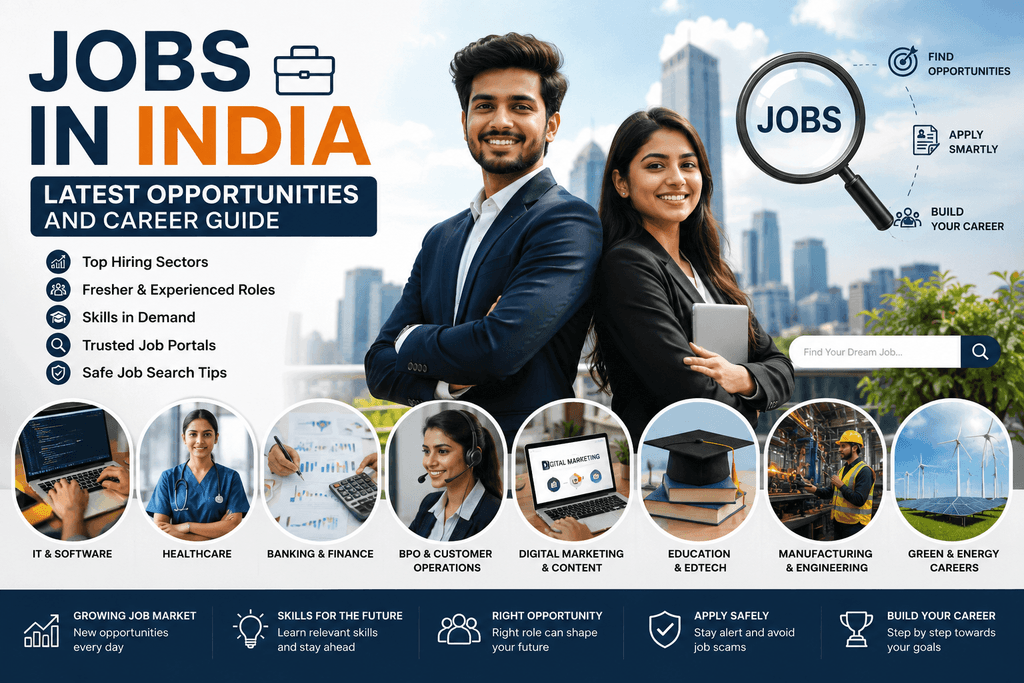
Finding good jobs in India can feel confusing because thousands of vacancies appear online every day. The good news is that you do not need to apply to every job. A smarter approach is to understand which sectors are hiring, choose roles that match your skills, and apply through trusted channels. As of August 2026, the latest Naukri JobSpeak data available for June showed white-collar hiring up 6% year over year, with AI/ML and fresher hiring among the stronger areas. The Government of India’s National Career Service (NCS) also provides job search, career-centre, internship and skill-course services.
What is the job market in India like in 2026?
India’s job market is changing quickly. Technology is important, but opportunities are not limited to software companies. Healthcare, insurance, education, operations, sales, travel, manufacturing, finance, digital marketing and customer support can also offer entry-level and experienced roles.
The latest Naukri JobSpeak report available by 24 August 2026 reported 6% year-over-year growth in white-collar hiring for June 2026. Fresher hiring has also shown strong growth in several 2026 reports. This does not mean every company is hiring at the same speed, so candidates should look at role-specific demand instead of assuming that one industry is always safe.
Global research also points to a mixed future. The World Economic Forum says technology skills such as AI, big data, networks and cybersecurity are rising in importance, while human skills such as analytical thinking, resilience and creative thinking remain valuable.
Top sectors to explore for jobs in India
IT and software: Software development, cloud, cybersecurity, data, testing, technical support and AI-related roles.
Healthcare and life sciences: Hospital operations, medical coding, laboratory work, pharmacy-related roles, healthcare administration and digital health.
Banking, financial services and insurance: Banking operations, relationship management, financial analysis, insurance sales and claims-related work.
Business process management and customer operations: Customer support, back-office operations, quality checking, process management and international voice or chat support.
Digital marketing and content: SEO, social media, content writing, performance marketing, email marketing and marketing analytics.
Education and EdTech: Online tutoring, academic counselling, curriculum support, student operations and content development.
Manufacturing and engineering: Production, quality, maintenance, supply chain, procurement and technical support.
Green and energy-related work: Renewable energy, electric mobility, environmental engineering and related technical roles are gaining attention as businesses adapt to the energy transition.
Best places to find jobs in India
National Career Service is a useful government starting point. It lets jobseekers search vacancies, explore career centres, find internships and look at skill courses.
Large private job portals can help you find many openings, but always open the employer’s official career page before sharing sensitive information or paying anything.
LinkedIn is useful for professional networking and recruiter outreach. A complete profile should clearly show your skills, projects, internship experience and preferred roles.
Company career pages are especially useful when you already know the employer you want to join.
College placement cells, alumni networks, professional communities and verified recruitment agencies can also uncover opportunities that are not visible in a simple job search.
How to choose the right job
Start with your education and strongest skills. A graduate with strong communication may fit customer success, sales, HR operations or content roles, while someone with technical training may prefer development, testing or technical support.
Then check the job description. Look for the must-have skills, experience level, location, shift timing, salary information and employment type.
Finally, compare the role with your long-term plan. A job is more useful when it teaches skills that can help you move into better roles later.
Skills that can improve your chances
Basic computer skills, spreadsheets and professional email writing are useful in many office jobs.
AI literacy is becoming useful across many roles. You do not need to become an AI engineer to benefit from AI tools; learn how to use them responsibly for research, productivity, analysis or drafting.
Communication, analytical thinking, teamwork and problem-solving remain important even when technology changes.
Build one or two job-specific skills instead of collecting dozens of certificates. A small project that proves your ability can be stronger than a long list of courses.
A simple job application plan
· Pick two or three target job titles.
· Create one clean, ATS-friendly resume for those roles.
· Prepare a short professional introduction for recruiters.
· Build a small portfolio if your field allows it.
· Apply to relevant roles every week instead of mass-applying randomly.
· Track applications in a spreadsheet.
· Prepare for interviews using the actual job description.
· Follow up politely and continue applying until you have a written offer.
How to avoid job scams
Never pay a recruiter simply to receive an interview, offer letter or job ID.
Be careful when someone promises unusually high pay for very easy work and asks for money first.
Check the sender’s email domain and verify the vacancy on the employer’s official website.
Do not share OTPs, banking passwords, UPI PINs or unnecessary identity documents with unknown people.
Treat WhatsApp or Telegram messages as leads, not proof that a job is genuine.
Jobs in India in 2026: what should you focus on?
The phrase jobs in India covers a very large market. A graduate searching for an office role, an experienced professional changing careers and a student looking for an internship are all searching for different opportunities. That is why a good job search begins with a clear role, not with a huge list of random vacancies.
If you search for jobs in India without a target, it is easy to spend hours reading advertisements that do not match your education or experience. Instead, choose two or three job titles and study the skills employers repeatedly ask for. This simple step makes your search faster and more focused.
Another useful idea is to think in terms of skills rather than only degrees. A degree can open a door, but practical skills help you stay competitive. For example, a graduate may combine a general degree with Excel, customer service, SEO, analytics, coding, accounting or project-management skills.
Growing areas worth watching
Technology continues to influence hiring across industries. AI, cloud services, cybersecurity, data work and software development are obvious examples, but the effect also reaches marketing, finance, healthcare and operations.
Healthcare and life sciences can offer roles for people with both specialist and non-specialist backgrounds. Hospitals, insurers, diagnostic companies and health-tech businesses need people for operations, customer support, claims, data and administration.
Digital business is another useful area to explore. Small businesses increasingly need help with websites, search visibility, social media, online advertising and customer communication. This creates entry-level opportunities for people who can combine communication with basic digital skills.
How to make your application stronger
Before applying for jobs in India, read the complete job description. Highlight the five skills that appear most important. Then adjust the top part of your resume so the recruiter can see those skills quickly.
A strong application is not necessarily a long application. It is a clear application. Recruiters should understand what you can do, what role you want and what evidence you have within a few seconds.
After applying, keep a simple record. Write down the company, job title, application date, source, interview date and current status. This prevents repeated applications and helps you prepare when a recruiter calls.
More Practical Search Tips
Readers comparing jobs in India should look at the role, required skills, location, work mode and growth path before applying.
Good jobs in India are easier to find when your search is based on a clear target role rather than a broad title.
Fresh graduates can use jobs in India searches to discover entry-level roles, internships and trainee positions that match their skills.
Experienced candidates can use jobs in India searches to compare new roles, industries and opportunities without changing their entire career direction.
Before applying for jobs in India, read the employer website and the full job description so you know exactly what the role requires.
Quick Action Plan
1. Choose one clear target role.
2. Study current job descriptions and note repeated skills.
3. Update your resume for that target.
4. Create one practical project or portfolio sample.
5. Apply consistently and track applications.
6. Review interview feedback and improve each week.
Important Things to Remember
· Verify current information on official sources.
· Do not pay money for guaranteed jobs or scholarships.
· Do not claim skills, marks or experience you do not have.
· Use internal links naturally to help readers discover related Wisdomland content.
· Update time-sensitive information when official sources publish a new cycle.
Final Takeaway
The best approach to jobs in India is simple: choose a target, build the required skills, apply carefully and keep learning. A focused search is usually more productive than sending the same resume everywhere.
If you are starting from zero, do not wait until you feel completely ready. Start with one practical skill, one good resume and a small weekly application target. Your first opportunity can become the foundation for your next one.
Frequently Asked Questions
Where can I find genuine jobs in India?
Start with the National Career Service, established private job portals, LinkedIn and the official career pages of companies. Verify the vacancy before sharing personal information.
Which skills are useful for jobs in India in 2026?
AI literacy, analytical thinking, communication, digital skills, problem-solving and role-specific technical skills are useful. The best combination depends on the job you want.
Can freshers get jobs in India without experience?
Yes. Many entry-level roles accept graduates with little or no experience. Internships, projects, certifications and strong interview preparation can help prove your ability.
How can I avoid fake jobs?
Do not pay for an interview or guaranteed job. Verify the vacancy on the employer’s official website and never share OTPs, UPI PINs or passwords.
Useful Wisdomland Internal Links
· Wisdomland.in — Jobs & Career Resources
· Top 10 High Salary Jobs in India 2026 Without an Engineering Degree
· How to Find Remote Jobs in India for Freshers 2026
Trusted External Sources
· National Career Service — Government of India
· World Economic Forum — Future of Jobs Report 2025
Freshness note: job vacancies and hiring conditions can change quickly, so update statistics and examples when new reports are available.