
When you stand at the crossroads of your professional life perhaps as a final-year student or a fresh graduate the question inevitably arises Internship vs Job? Should you dive into the deep end with a full-time role, or test the waters with an internship?
In the rapidly evolving 2026 job market, the answer isn’t as simple as it once was. Both paths offer unique advantages, but choosing the wrong one can lead to burnout or missed opportunities. This blog post breaks down the core differences, the financial impact, and the long-term career growth potential of both options to help you make an informed decision.
MUST READ
Common Mistakes to Avoid When Searching for Jobs Abroad: Your 2026 Strategy Guide
Abroad Jobs for Indians How to Get Job in Abroad from India in 2026
AI Jobs in UAE and Market Trend (2026 Guide)
How to Calculate CTC and Salary Hike Calculator
What is the Difference? Internship vs Job at a Glance
Lets see Before we dive into the details, let’s establish a clear baseline. While both involve work, the expectations and legal structures differ significantly.
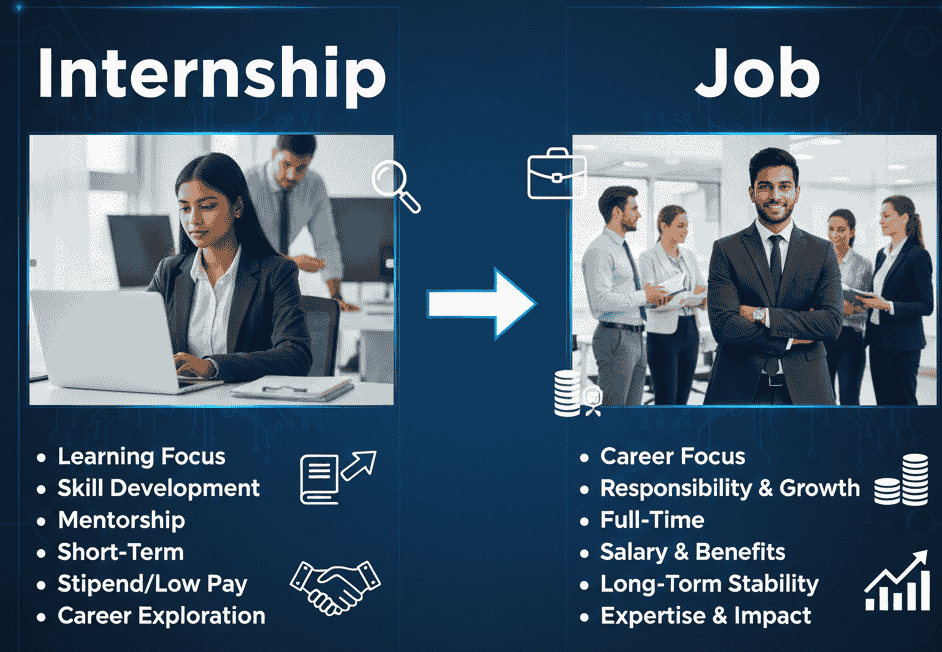
Internship vs Full-Time Job
| Feature | Internship | Full-Time Job (Entry-Level) |
| Primary Goal | Learning and skill acquisition | Delivering results and value |
| Duration | Temporary (3–6 months) | Permanent/Long-term |
| Responsibility | Supervised, lower-risk tasks | Independent, high-impact roles |
| Compensation | Stipend or academic credit | Competitive salary + benefits |
| Onboarding | High mentorship and training | Rapid integration and delivery |
The Learning Curve Mentorship vs. Autonomy
The Internship Learning Experience
An internship is essentially an extension of your education. You are there to observe, ask questions, and make mistakes under the guidance of a mentor. In 2026, many companies use internships as a “test drive” to see if you fit their culture.
- Safety Net: You are expected to be a beginner.
- Breadth: You often get to rotate through different departments.
The Job Performance Expectation
A full-time job shifts the focus from receiving to contributing. While you will still receive training, the company is paying for your output.
- Depth: You specialize in one area and become an expert.
- Accountability: Your performance directly impacts the company’s bottom line.
Financial Stability: Stipend vs. Salary
- Internship Stipends: In India and globally, internships typically offer a stipend. While some tech giants pay handsomely, most stipends cover only basic expenses (₹10,000–₹30,000 per month).
- Full-Time Salaries: A job offers a fixed salary, usually starting much higher, along with benefits like health insurance, paid time off (PTO), and retirement contributions (PF/401k).
Note: If you are financially independent or have student loans, a job is often the necessary path. However, if you can afford a few months of lower pay, a high-prestige internship can sometimes lead to a much higher starting salary later.
Career Growth and Networking
When looking at career growth, both paths have their merits.
- The Internship Advantage: It allows you to build a network without the pressure of a long-term contract. It is much easier to “pivot” industries after a 3-month internship than after a 2-year job.
- The Job Stability: A full-time role allows you to climb the internal corporate ladder. You gain titles, seniority, and a proven track record of handling responsibility.
How to Decide: Which Path is Right for You?
Choosing between an internship vs job depends on your current stage of life and your long-term goals.
Choose an Internship if:
- You are still a student: Most full-time jobs require a completed degree.
- You want to explore: You aren’t sure if you prefer Marketing or Finance.
- You want a “foot in the door”: You want to work for a “Big 4” or FAANG company that rarely hires freshers directly into full-time roles.
Choose a Job if:
- You have the experience: You’ve already done 2-3 internships during college.
- You need financial security: You have bills to pay and need a stable income.
- You are ready to commit: You know exactly what career path you want and are ready to start building your legacy.
FAQ
Can an internship count as work experience?
Yes! Most recruiters and graduate schools view internships as valid professional experience, especially if they are relevant to the role you are applying for.
Is it better to have one long internship or multiple short ones?
Multiple internships in different fields help you find your “niche,” while a long-term internship (6 months+) shows depth and often leads to a full-time offer (PPO).
Can I apply for an internship after I graduate?
Absolutely. Many “Graduate Internships” are designed specifically for recent grads to help them transition into the professional world.
Do companies prefer hiring former interns?
Yes. Data shows that “conversion hires” (interns turned full-time) have higher retention rates and require less training, making them the preferred choice for HR.
Latest News & Update
-

10 Top Freelancing Skills That Pay ₹1 Lakh/Month in India (2026)
Are you tired of the traditional 9-to-5 grind and a salary that barely covers the bills? You’re not alone. In 2026, the Indian job market…
-
Best Skills to Learn for Online Earning in India (2026) Start Earning from Home Today
The traditional job market in India is undergoing a massive shift. With inflation rising and the “9-to-5” grind offering less financial security, thousands of students,…
-

Chat Support Jobs Work From Home for Freshers (2026 Guide)
The demand for remote jobs in India is growing rapidly, especially for roles that do not require prior experience. Among these, chat support jobs that…