Fully funded scholarships remove the biggest barrier Indian students face when dreaming of studying overseas: money. These awards typically cover full tuition, living expenses, airfare, health insurance, and sometimes even a monthly stipend. For the 2027 intake, competition is rising, yet new opportunities keep appearing across the UK, USA, Canada, Europe, Australia, and Asia.
If you are an Indian student aiming for undergraduate, master’s, or doctoral study without draining family savings, this guide walks you through the strongest fully funded scholarships available right now, key 2026–2027 deadlines, eligibility patterns, and a practical application framework that works.
Why Fully Funded Scholarships Matter More in 2027
Global education costs continue climbing. Average annual tuition for international master’s programs in the UK and USA often exceeds ₹25–40 lakh. Add living costs and the total can cross ₹50–70 lakh for a two-year degree. Fully funded scholarships change that equation completely.
According to recent higher-education mobility data, Indian students remain one of the largest groups seeking overseas education. Governments and universities in destination countries actively recruit talent through full funding packages. Many of these programs now prioritise STEM, sustainability, public policy, and social impact fields.
Key takeaway: A fully funded scholarship is not just free tuition—it is a complete financial safety net that lets you focus on academics and career growth.

Fully funded scholarships Indian students 2027 – young Indian graduate celebrating with international university campus in background
Top Fully Funded Scholarships for Indian Students (2027 Intake)
Here are some of the most reliable and competitive fully funded options that Indian students can target for 2027 entry.
1. Chevening Scholarships (UK)
Chevening remains one of the most prestigious fully funded scholarships for one-year master’s degrees in the UK. It covers tuition, living allowance, return airfare, and additional grants. Eligibility usually requires a bachelor’s degree, at least two years of work experience, and a clear leadership vision. Applications typically open in August and close in early October for the following year’s intake. Indian students have historically performed well in this scheme.
2. Fulbright-Nehru Master’s and Doctoral Fellowships (USA)
The Fulbright-Nehru program offers full funding for master’s and PhD studies in the United States. Benefits include tuition, living stipend, health insurance, and travel allowance. These awards favour candidates with strong academic records and a commitment to return and contribute in India. Deadlines usually fall in May–June for the next academic year.
3. Commonwealth Scholarships (UK and other Commonwealth countries)
Funded by the UK government and partner nations, these scholarships support master’s and PhD study. They cover full tuition, living costs, and travel. Priority fields often include climate change, health systems, and inclusive growth. Indian students applying through the Indian nomination process should watch for announcements from the Ministry of Education or the Commonwealth Scholarship Commission.
4. Erasmus Mundus Joint Master Degrees (Europe)
Several Erasmus Mundus programmes offer full scholarships that include tuition, monthly stipend, travel, and installation costs. Students study in at least two European countries. These are excellent for interdisciplinary and specialised master’s degrees. Application windows usually open between October and January.
5. Australia Awards Scholarships
Australia Awards provide full funding for master’s and some undergraduate pathways. Coverage includes tuition, living allowance, overseas student health cover, and return airfare. The program prioritises development-related fields and requires a strong development impact statement. Applications typically open in February–April.
6. DAAD Scholarships (Germany)
DAAD offers numerous fully or almost fully funded opportunities, especially for master’s and doctoral research. Many German public universities charge little or no tuition, so DAAD funding primarily supports living costs and research. Deadlines vary by programme but often fall between August and November.
7. Additional Strong Options
• Gates Cambridge Scholarships – Full funding for postgraduate study at the University of Cambridge.
• Knight-Hennessy Scholars – Stanford University’s fully funded leadership programme.
• Swiss Government Excellence Scholarships – For research and PhD levels.
• Japanese Government (MEXT) Scholarships – Full funding for undergraduate, master’s, and PhD study in Japan.
Always verify the latest guidelines on official websites, as criteria and deadlines shift slightly each year.
2026–2027 Application Timeline and Deadlines
Most fully funded scholarships for 2027 entry follow this approximate cycle:
• August–October 2026: Major UK and European applications open (Chevening, some Erasmus, DAAD).
• October 2026–January 2027: Peak application season for many master’s programmes.
• February–May 2027: Australia Awards and some US-linked programmes.
• May–June: Fulbright-Nehru typical window.
Start preparing documents at least 6–8 months in advance. English test scores (IELTS/TOEFL), recommendation letters, and a polished Statement of Purpose take time.
Practical tip: Create a simple tracking sheet with columns for scholarship name, deadline, required documents, and status. Review it weekly.
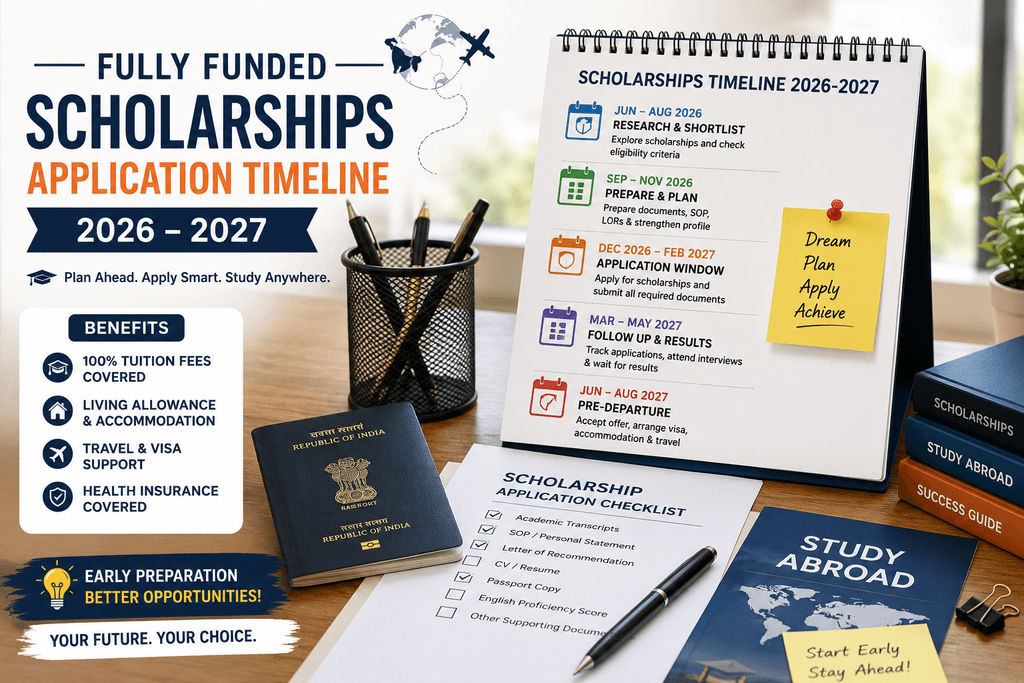
Fully funded scholarships application timeline 2026-2027 – calendar and documents on desk with Indian passport
Step-by-Step Framework to Win a Fully Funded Scholarship
Follow this proven sequence used by successful Indian applicants:
1. Clarify your academic and career goals. Write a one-page note on why this degree and country matter for your long-term plans in India or globally.
2. Shortlist 5–8 scholarships that match your profile (field, level, work experience, leadership evidence).
3. Build a strong academic foundation. Aim for a solid GPA and relevant projects or publications if targeting research degrees.
4. Prepare standardised tests early. Many programmes require IELTS (usually 6.5–7.0 overall) or GRE/GMAT for specific fields.
5. Craft a compelling personal narrative. Focus on impact, leadership, and how the scholarship will help you contribute after graduation. Avoid generic statements.
6. Secure strong recommendation letters. Choose professors or supervisors who know your work deeply and can give concrete examples.
7. Apply early and carefully. Submit well before the deadline. Double-check every form field and attachment.
8. Prepare for interviews. Many final-stage scholarships include interviews. Practice answering questions about your motivation, leadership, and future plans.
Common Mistakes That Cost Applicants the Award
• Submitting a generic Statement of Purpose used for multiple scholarships.
• Ignoring the specific leadership or development criteria of the funder.
• Applying with incomplete or late documents.
• Underestimating the importance of work experience or extracurricular impact.
• Failing to research the host country’s development priorities.
Avoid these traps and your chances rise sharply.
Latest 2026 Insights and Trends
In 2026, several trends shape fully funded scholarships:
• Greater emphasis on climate, sustainability, public health, and digital transformation.
• Increased funding for women and students from underrepresented regions within India.
• More joint and multi-country programmes (especially Erasmus Mundus and similar).
• Growing preference for candidates who can demonstrate clear post-study contribution plans.
External data from organisations such as the British Council and UNESCO continue to show rising outbound mobility from India, which keeps competition high but also expands the total number of awards.
For authoritative statistics on global student mobility, refer to the latest reports from the UNESCO Institute for Statistics https://uis.unesco.org and the British Council https://www.britishcouncil.org.
Practical Checklist Before You Apply
• Valid passport with at least 18 months validity
• Academic transcripts and degree certificates
• English proficiency test scores
• Updated CV highlighting leadership and impact
• 2–3 strong recommendation letters
• Tailored Statement of Purpose / Motivation Letter
• Research proposal (for PhD or research master’s)
• Proof of any relevant work or volunteer experience
Bold takeaway: Treat the application process like a part-time job for three to four months. Consistency beats last-minute brilliance.
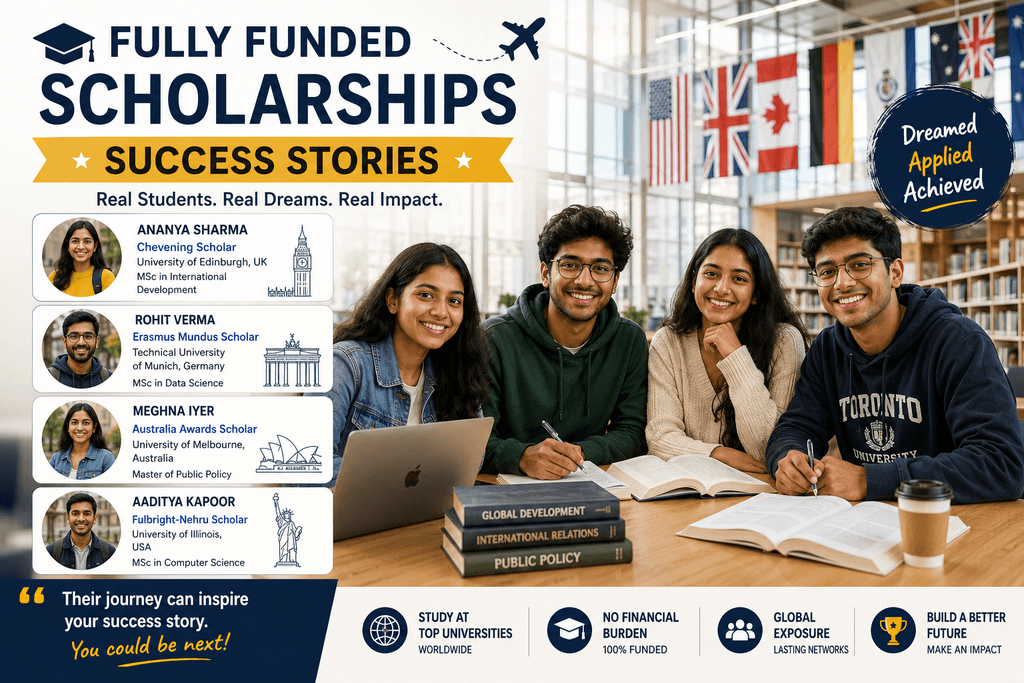
Fully funded scholarships success stories – diverse group of Indian students studying abroad in a modern library
FAQ – Fully Funded Scholarships for Indian Students
Q1. Do fully funded scholarships cover living expenses as well as tuition?
Yes. Most true fully funded programmes include tuition, a monthly living stipend, health insurance, and return airfare. Always check the exact benefits listed by the scholarship provider.
Q2. Can final-year undergraduate students apply for master’s fully funded scholarships?
Yes, provided you will complete your degree before the scholarship start date. Many schemes accept applications from final-year students.
Q3. Is work experience mandatory for all fully funded scholarships?
Not for every programme. Chevening and some leadership-focused awards usually require it. Many university-specific and research scholarships do not.
Q4. How competitive are these scholarships for Indian students?
Highly competitive. Success rates often range between 5–15% depending on the programme. A strong, well-aligned application still gives you a realistic chance.
Q5. Can I apply to multiple fully funded scholarships at the same time?
Yes. In fact, most successful applicants submit to several programmes. Just ensure each application is carefully tailored.
Fully funded scholarships remain one of the most powerful tools available to Indian students who want world-class education without the crushing financial burden. Start early, choose programmes that genuinely match your profile, and tell a clear story of impact. The 2027 cycle is already taking shape—use the months ahead wisely.