Accounting Jobs for Freshers in India 2026: The Ultimate Career Guide
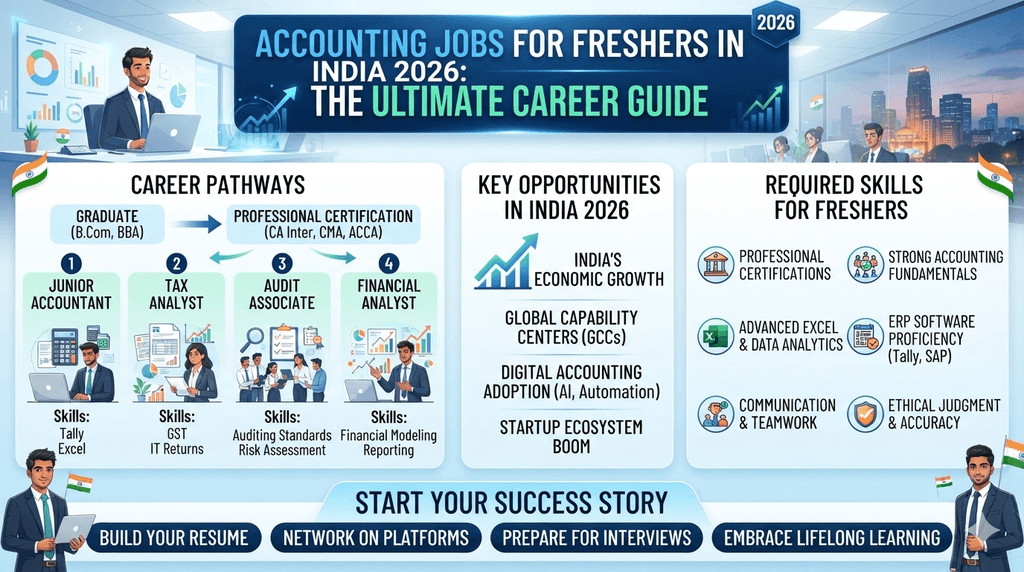
Securing accounting jobs for freshers in India 2026 represents one of the most reliable and rewarding entry pathways into the modern corporate landscape. As the Indian economy expands across manufacturing, information technology, e-commerce, healthcare, and financial services, the continuous demand for rigorous financial oversight, compliance management, and statutory reporting has never been higher. Finding a suitable entry-level finance role requires a combination of practical domain knowledge, familiarity with financial software, and a strategic understanding of employer expectations in a digitally evolving market. For comprehensive career resources and job guidance, explore Wisdomland.
The broader employment landscape spans diverse organizational structures, ranging from traditional domestic enterprises and public sector undertakings (PSUs) to Global Capability Centres (GCCs), Big Four accounting firms, and high-growth technology startups. Understanding this ecosystem enables new commerce and finance graduates to align their educational background with targeted industry niches.
Entering the job market as a novice allows candidates to take up diverse entry-level designations such as Accounts Executive, Junior Accountant, Accounts Payable Associate, Accounts Receivable Associate, Audit Associate, and Finance Operations Associate. Successfully applying for these positions provides early exposure to foundational corporate operations, setting the stage for long-term professional advancement and leadership roles.
Why Accounting Jobs for Freshers in India 2026 Are a Good Starting Career
Choosing accounting as an entry point into the business world offers unmatched employment stability and practical learning opportunities. Every commercial entity, regardless of economic cycles or market volatility, must maintain accurate books of accounts, satisfy statutory tax requirements, and ensure operational cash flow. Consequently, accounting jobs for freshers in India 2026 act as a recession-resilient gateway into the broader financial services domain.
During their initial years, freshers gain hands-on expertise across critical operational areas:
- Financial Statements: Understanding how balance sheets, profit & loss accounts, and cash flow statements interconnect.
- Business Transactions: Recording, classifying, and verifying day-to-day commercial activities and ledger entries.
- Taxation Fundamentals: Grasping Goods and Services Tax (GST), Tax Deducted at Source (TDS), and corporate tax frameworks.
- Reconciliation Processes: Performing bank, vendor, and customer reconciliations to eliminate discrepancy risks.
- Financial Reporting: Generating Management Information System (MIS) reports to support executive decision-making.
- Statutory Compliance: Navigating Indian accounting standards (Ind AS) and regulatory filing schedules.
- Enterprise Systems: Utilizing advanced ERP solutions, spreadsheets, and specialized accounting software platforms.
Acquiring these practical skills makes entry-level finance roles an exceptional foundation for long-term career growth, paving the way toward advanced positions in corporate finance, financial planning & analysis (FP&A), forensic accounting, internal audit, and executive management.
Detailed Profiles of Popular Entry-Level Accounting Roles
1. Accounts Executive
Accounts Executives act as the backbone of day-to-day corporate financial management. They handle routine ledger postings, process incoming and outgoing payments, verify expense claims, and perform monthly bank reconciliations. Graduates with a B.Com or BBA degree frequently start their professional journey in this position, as it offers direct exposure to core accounting workflows and internal control procedures.
- Invoices
2. Junior Accountant
Junior Accountants work alongside senior accounting professionals and finance managers to assist in complex financial record-keeping. Key tasks include entering journal vouchers, maintaining asset registers, preparing preliminary trial balances, and organizing tax documentation. This role serves as a crucial learning ground for mastering accounting principles and company policies.
3. Accounts Payable (AP) Associate
Accounts Payable Associates manage vendor relationships and ensure that organizational expenditures are processed accurately and punctually. Their scope of work includes 3-way matching of purchase orders, goods receipt notes, and invoices, calculating vendor TDS, scheduling disbursements, and resolving billing discrepancies. This role is prevalent in multinational companies and shared service centers.
4. Accounts Receivable (AR) Associate
Accounts Receivable Associates concentrate on managing business inflows and maintaining healthy liquidity. Responsibilities include issuing sales invoices to clients, recording incoming receipts, monitoring aging reports, following up on outstanding payments, and managing customer credit terms. Strong analytical and interpersonal communication skills are highly beneficial in this function.
5. Audit Associate
Audit Associates work in chartering firms or corporate internal audit departments to evaluate financial statements, operational processes, and risk management systems. Freshers in audit learn to perform vouching, physical stock verification, internal control testing, and statutory compliance checks, making it an ideal path for those seeking deep insight into governance and financial accuracy.
6. Tax Associate
Tax Associates specialize in direct and indirect taxation. In India, this involves assisting clients or internal teams with GST monthly return filings (GSTR-1, GSTR-3B), TDS reconciliation, income tax computations, and preparing documentation for tax assessments. This role offers strong specialization opportunities for commerce graduates and semi-qualified CAs.
7. Finance Operations Associate
Finance Operations Associates focus on streamlined financial processes within global capability centers and IT enterprises. Their duties involve automating record-to-report (R2R) cycles, managing intercompany transactions, and tracking financial metrics. This role bridges standard accounting practices with corporate operational efficiency.
Educational Qualifications and Eligibility Pathways
Candidates aspiring to secure accounting jobs for freshers in India 2026 can choose from several educational and professional qualification backgrounds depending on their desired role complexity and long-term career target:
- Bachelor of Commerce (B.Com): The most standard degree providing essential instruction in financial accounting, cost accounting, business law, and auditing.
- Bachelor of Business Administration (BBA – Finance): Combines fundamental accounting concepts with broader business operations and financial strategy management.
- Master of Commerce (M.Com): Offers advanced theoretical knowledge, making candidates attractive for senior entry-level positions, research roles, and academic paths.
- Chartered Accountancy (CA): The premier professional qualification administered by the ICAI, opening doors to high-level auditing, taxation, and financial management roles.
- Cost and Management Accountant (CMA): Administered by the Institute of Cost Accountants of India (ICMAI), this qualification focuses on cost structure analysis, operational budgeting, cost auditing standards, and strategic management accounting across industrial and manufacturing sectors.
- Association of Chartered Certified Accountants (ACCA): A globally recognized credential awarded by ACCA Global that is highly valued by Global Capability Centres (GCCs), Big Four organizations, and multinational financial consulting practices.
- MBA in Finance: Combines financial analysis with management decision-making, suitable for corporate finance and strategy positions.
To help map educational backgrounds to corporate roles, the following matrix summarizes standard requirements across entry-level openings:
| Accounting Role | Primary Qualification | Key Responsibilities | Average Salary Range |
| Accounts Executive | B.Com / BBA (Finance) | Ledger postings, payment processing, expense verification, and monthly bank reconciliations. | ₹2.5 LPA – ₹4.5 LPA |
| Junior Accountant | B.Com / M.Com | Assisting in financial record-keeping, journal entries, maintaining asset registers, and trial balance preparation. | ₹3.0 LPA – ₹5.0 LPA |
| Accounts Payable/Receivable Associate | Graduate in Commerce or Finance | 3-way invoice matching, vendor payments, client billing, aging reports, and cash inflow tracking. | ₹3.2 LPA – ₹5.5 LPA |
| Audit Associate | CA Inter / Semi-Qualified CA / M.Com | Performing vouching, physical stock verification, internal control testing, and statutory compliance checks. | ₹4.5 LPA – ₹8.0 LPA |
| Tax Associate | B.Com / LLB / CA Inter / ACCA | GST monthly return filings (GSTR-1, GSTR-3B), TDS reconciliation, and tax computation preparation. | ₹4.0 LPA – ₹7.5 LPA |
While specialized positions require professional certifications, numerous general accounting roles prioritize practical technical skills, analytical aptitude, and software proficiency over specific advanced degrees.
Core Technical and Soft Skills Required for Success
1. Advanced Excel and Data Analytics
Modern accounting relies heavily on electronic spreadsheets for data compilation, reconciliation, and reporting. To stand out when applying for accounting jobs for freshers in India 2026, candidates should develop proficiency in advanced functions such as XLOOKUP, VLOOKUP, INDEX-MATCH, Pivot Tables, SUMIFS, logical statements, conditional formatting, and basic macro automation.
2. Accounting Software and ERP Platforms
Familiarity with industry-standard accounting software and Enterprise Resource Planning (ERP) systems is highly beneficial. Small and medium enterprises (SMEs) in India widely utilize Tally Prime and Zoho Books, while larger corporations and MNCs rely on robust ERP suites like SAP S/4HANA, Oracle Financials, and Microsoft Dynamics 365. Specialized skill-building courses and software training modules can be found on Wisdomland.
3. Statutory Taxation and GST Compliance
Understanding Indian tax regulations is essential for entry-level roles. Candidates should be comfortable with GST concepts, including e-invoicing requirements, Input Tax Credit (ITC) matching, e-way bills, and GSTR reporting. Additionally, sound knowledge of TDS deduction rules, payment schedules, and quarterly tax filings is crucial for smooth financial operations.
4. Key Government Compliance Portals
Modern accounting professionals interact daily with essential government portals to maintain compliance and fulfill regulatory obligations. Key platforms include:
- Income Tax e-Filing Portal: Utilized on the Income Tax e-Filing Portal for processing Tax Deducted at Source (TDS) statements, managing corporate income tax returns, and verifying tax credits.
- GST Portal: Accessed via the official GST Portal for e-invoicing, monthly GSTR return filing, and performing Input Tax Credit (ITC) reconciliations.
- Ministry of Corporate Affairs (MCA): Used through the Ministry of Corporate Affairs (MCA) for statutory filings, Registrar of Companies (ROC) compliances, and uploading audited corporate financial disclosures.
4. Financial Reporting and Analytical Skills
- Beyond basic bookkeeping, securing entry-level roles requires candidates to analyze financial information to identify variances and operational trends. Understanding how to interpret trial balances, profit & loss statements, balance sheets, and cash flow reports allows accounting professionals to deliver actionable value to business leaders from day one in accounting jobs for freshers in India 2026.
ICAI Placement Programs and Official Initiatives
The Institute of Chartered Accountants of India (ICAI) plays a central role in organizing professional opportunities for qualified finance practitioners across the country. Its official placement drives connect newly qualified Chartered Accountants directly with major employers seeking candidates for accounting jobs for freshers in India 2026, offering structured career pathways across corporate and advisory sectors.
ICAI regularly hosts national placement campus programs designed to bridge the gap between fresh qualification and top-tier employment. These drives attract domestic banks, IT giants, manufacturing conglomerates, and international consulting firms, making them a key recruiting hub for qualified professionals.
Through initiatives like the Career Catalyst program, ICAI also provides guidance on emerging accounting domains, including Global Capability Centres (GCCs), offshore taxation, management consulting, investment banking support, forensic auditing, and environmental, social, and governance (ESG) reporting.
These formal institutional initiatives demonstrate how structured accounting qualifications create pathways into broader, high-impact corporate finance leadership positions.
Salary Trends and Compensation Structure in 2026
Remuneration for entry-level accounting positions in India varies depending on candidate qualifications, geographic location, organizational scale, and technical proficiency. As the demand for skilled financial professionals continues to rise across sectors, understanding the market expectations for accounting jobs for freshers in India 2026 helps candidates evaluate job offers effectively. Entry-level salaries generally fall into distinct tier structures based on background and role complexity:
- B.Com / BBA Freshers: Typically receive starting compensation packages ranging between ₹2.5 LPA and ₹4.5 LPA in small-to-medium businesses, shared services, and corporate offices.
- M.Com / MBA (Finance) Graduates: Average starting packages range from ₹3.5 LPA to ₹6.5 LPA, depending on institutional reputation and prior internship experience.
- Semi-Qualified CAs / ACCA Affiliates: Generally command starting packages between ₹4.5 LPA and ₹8.0 LPA in audit firms, tax consultancies, and MNCs.
- Newly Qualified Chartered Accountants (CAs): Secure premier compensation starting from ₹9.0 LPA to ₹15.0+ LPA during corporate placement drives.
In addition to educational credentials, job location plays a significant role in salary determination. Major metropolitan hubs like Bengaluru, Mumbai, Delhi NCR, Hyderabad, Chennai, and Pune typically offer higher base compensation to offset living costs, whereas Tier-2 and Tier-3 cities provide steady starting roles in regional businesses and industrial centers.
Evaluating these salary structures helps candidates align their background with realistic career and financial expectations when searching for entry-level finance positions in the current market.
How to Find and Apply for Accounting Jobs
Finding open positions requires a proactive, multi-channel job search strategy. With thousands of opportunities opening up across public and private sectors, candidates exploring accounting jobs for freshers in India 2026 must leverage both official government portals and modern digital job platforms. The Ministry of Labour and Employment’s National Career Service (NCS) portal offers verified public and private sector accounting openings across various states, providing a reliable starting point for new graduates.
Candidates can maximize their search efficiency by utilizing several key avenues:
- Job Portals and Educational Platforms: Maintain updated profiles on major platforms like Naukri.com, LinkedIn, Indeed, and Wisdomland, setting alerts for relevant keywords.
- Company Career Pages: Apply directly to career portals of target MNCs, Global Capability Centres (GCCs), and Big Four firms.
- Institutional Portals: Qualified CAs, CMAs, and ACCA students should regularly check their respective institutional job boards for exclusive postings.
- Campus Drives: Participate in placement drives organized by universities and commerce colleges.
- Professional Networking: Connect with alumni, practicing CAs, and finance recruiters on LinkedIn to discover unadvertised openings.
- Specialized Recruitment Agencies: Partner with reputable staffing agencies specializing in finance and accounting placements.
How to Build an Impactful Accounting Resume
An effective accounting resume should highlight practical technical competencies, academic achievements, and software familiarity. Employers reviewing applications for accounting jobs for freshers in India 2026 look for concise, well-structured CVs that demonstrate accuracy and attention to detail.
- Academic Background: Clear listing of degrees, university names, graduation years, and GPA/marks percentages.
- Software Proficiency: Explicitly mention tools such as Tally Prime, Excel, SAP, or QuickBooks.
- Core Competencies: Highlight skills like Bank Reconciliation, GST Filing, Ledger Accounts, and Trial Balance Preparation.
- Internships & Projects: Detail practical experience gained during college internships or articleship training, highlighting measurable contributions.
- Certifications: Include relevant industry certifications, such as NCFM modules, Tally certifications, or advanced Excel credentials.
Keep the resume layout clean, professional, and error-free. Ensure contact details are accurate, highlight how your specific skills align with target positions, and tailor key achievements to stand out for accounting jobs for freshers in India 2026.
Comprehensive Interview Preparation Guide
Succeeding in entry-level accounting interviews requires a blend of conceptual understanding and practical problem-solving. Expect interview questions covering fundamental accounting principles, statutory rules, and practical scenarios:
- Golden Rules of Accounting: Real, Personal, and Nominal Account classification rules.
- Accounting Equation: Explaining Assets = Liabilities + Owner’s Equity with real-world transaction examples.
- Bank Reconciliation Statement (BRS): Identifying timing differences, unpresented cheques, and direct deposits that cause discrepancies between cash books and bank statements.
- Depreciation Methods: Comparing Straight-Line Method (SLM) versus Written-Down Value (WDV) techniques.
- Accrual vs. Cash Accounting: Understanding revenue recognition and matching principles.
- GST & TDS Application: Calculating tax rates, understanding thresholds, and explaining input tax credit eligibility.
- Working Capital Management: Managing current assets and liabilities to maintain healthy operational liquidity.
Demonstrating clarity, logical reasoning, and structured problem-solving during technical interviews significantly improves selection chances for accounting jobs for freshers in India 2026. Preparing concise real-world examples from internships or coursework will help convey readiness for entry-level accounting responsibilities.
Common Pitfalls to Avoid During Job Search
Freshers navigating the job market should avoid several common mistakes:
- Generic Applications: Sending identical resumes to different job openings without tailoring skills to the specific job description.
- Overstating Technical Capabilities: Claiming expertise in advanced ERP software without practical understanding.
- Neglecting Practical Tools: Focusing solely on theoretical accounting concepts while ignoring spreadsheet proficiency.
- Falling for Placement Scams: Paying money to fraudulent placement agencies promising guaranteed job offers.
Long-Term Career Growth and Professional Pathways
Starting in entry-level accounting positions provides a structured progression route. After securing early experience in accounting jobs for freshers in India 2026, professionals can advance through defined organizational tiers:
- Years 0–3 (Entry-Level): Accounts Executive / Junior Accountant / Audit Associate.
- Years 3–6 (Mid-Level): Senior Accountant / Accounting Lead / Tax Manager / Assistant Audit Manager.
- Years 6–10 (Management Level): Finance Manager / FP&A Manager / Internal Audit Head / Controller.
- Years 10+ (Leadership Level): Chief Financial Officer (CFO) / Vice President of Finance / Director of Accounting.
Continuous upskilling through certifications (such as CA, CMA, ACCA, or CFA) and mastering emerging technologies like financial analytics, AI-assisted auditing, and automated reporting systems accelerate this upward trajectory.
Frequently Asked Questions (FAQs)
1. Is a B.Com degree sufficient to secure accounting jobs for freshers in India 2026?
Yes, a B.Com degree provides solid eligibility for many entry-level roles such as Accounts Executive, Junior Accountant, and AP/AR Associate. Pursuing certifications in Tally, GST compliance, or advanced Excel further enhances job prospects for those seeking accounting jobs for freshers in India 2026.
2. What software skills are most in-demand for entry-level accounting roles?
Advanced Excel is universally essential. In addition, knowing Tally Prime or Zoho Books is advantageous for SMEs, while SAP, Oracle, or Microsoft Dynamics are valued by enterprise firms and MNCs.
3. Can fresh graduates start directly in audit or tax specialized roles?
Yes, commerce graduates, semi-qualified CAs, and ACCA affiliates can start as Audit Associates or Tax Associates in professional accounting firms, tax consultancies, and corporate internal audit teams.
Final Thoughts
Navigating accounting jobs for freshers in India 2026 provides strong career stability and structured growth.
Start with accounting fundamentals, Excel and practical software. Then decide whether you want to specialise in audit, taxation, corporate accounting, finance operations or professional accounting.