
RWA Investment Options in India: How to Invest, Platforms, Returns and Risks
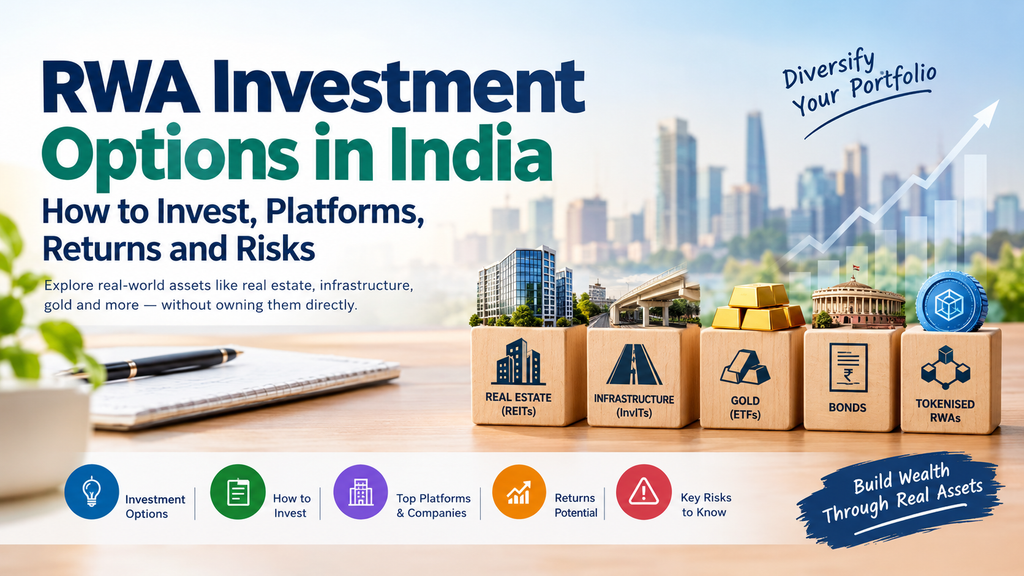
RWA investment in India is gaining significant attention as investors seek opportunities to invest in property, infrastructure, gold, and other assets without purchasing them directly.
In India, there are several ways to explore real-world asset opportunities. You can buy units of a Real Estate Investment Trust (REIT), explore Small and Medium REITs (SM REITs), invest in Infrastructure Investment Trusts (InvITs), buy gold ETFs, or invest in eligible bonds. Another emerging option is tokenised real-world assets, expanding the scope of RWA investment in India where digital tokens represent rights connected to an underlying asset.
However, these investments are not all the same. Some operate within established securities-market regulations, while others may involve complex legal arrangements and additional risks.
This guide explains RWA investment in India, how to invest, which companies and platforms to research, how returns work, and what to check before investing your money.
Information reviewed on 11 October 2026. Always verify current regulations, investment availability and product documents before making a financial decision.
What is RWA investing?
RWA stands for Real-World Assets. These are physical or financial assets such as:
- Commercial buildings and rental properties
- Roads, power transmission and other infrastructure
- Gold and other commodities
- Government and corporate bonds
- Loans and other financial claims
Choosing an RWA investment in India means gaining exposure to these real-world assets through a regulated investment product or legal arrangement.
There are two common approaches.
Traditional RWA investments: These include REITs, InvITs, gold ETFs, and eligible bonds. Investors can learn more about general financial education at Wisdomland before purchasing units or securities under applicable market rules.
Tokenised RWA investments: These use digital tokens to represent certain rights associated with an asset. Depending on the structure, a token might represent a contractual claim, a security or an interest in an entity that owns an asset.
For example, buying a listed REIT unit gives you rights as a unit holder under that trust’s legal structure. Buying a token advertised as being backed by a building may give you different rights altogether. You must read the legal documents to understand what you actually own.
RWA investment options in India: Comparison table
| Investment option | What you invest in | Where to start | Main risk |
| Listed REITs | Income-generating real estate portfolios | Stockbroker and demat account | Property-market risk and price fluctuations |
| SM REITs | Units in eligible real estate schemes | Registered trust and official offer documents | Property concentration, fees and liquidity |
| InvITs | Infrastructure-related assets | Stockbroker or applicable offer process | Project, debt and operating risks |
| Gold ETFs | Gold-price exposure through a fund | Stockbroker and demat account | Gold-price fluctuations |
| Bonds | Debt issued by governments or companies | Authorised investment channels | Interest-rate and credit risk |
| Tokenised RWAs | Digital tokens representing specified asset-related rights | Issuer or platform, after due diligence | Legal, regulatory, custody and resale risks |
Important: This table is for comparing investment types, not recommending one over another. The right choice depends on your goals, time horizon and ability to tolerate losses.
1. REIT investment in India
A Real Estate Investment Trust, or REIT, allows investors to invest in a portfolio of real estate assets through units instead of buying an entire office building or shopping centre.
REITs may generate income from rent and other property-related activities. Investors may receive distributions, and the market price of their units can rise or fall.
SEBI explains how REITs work in its investor education guide: Understanding REITs and InvITs. For further educational resources on RWA investment in India, visit Wisdomland.
REITs to research in India
The following names appear on SEBI’s official registered REIT list as of the latest available record dated 28 September 2026. Registration does not, by itself, confirm that every trust is currently listed and trading.
| REIT name | General property exposure | Useful link |
| Embassy Office Parks REIT | Commercial offices | Official website |
| Mindspace Business Parks REIT | Commercial office parks | Official website |
| Brookfield India Real Estate Trust | Commercial real estate | Official website |
| Nexus Select Trust | Retail real estate | Official website |
| Bagmane Prime Office REIT | Commercial office real estate | Check SEBI’s REIT records |
| Office Realty Trust | Commercial office real estate | Check SEBI’s REIT records |
Source: SEBI’s registered REIT list. Confirm the latest listing status, trading availability and offer documents before investing.
How to invest in a listed REIT
- Open a demat and trading account with an appropriately registered broker.
- Search for the REIT by its correct name or ticker.
- Read its latest financial results and investor presentation.
- Check the property portfolio, occupancy, debt and tenant concentration.
- Review its distribution history, expenses and current unit price.
- Place an order only after understanding the risks.
The amount you need depends on the current unit price and applicable trading requirements.
How do REIT investors earn money?
There are two potential sources of return:
- Distributions: Payments made to investors according to the trust’s financial performance and applicable rules.
- Price changes: You may gain if you sell units for more than you paid, or lose money if the price falls.
Neither income nor capital appreciation is guaranteed. Historical distributions do not ensure future payments.
2. SM REITs: A way to explore fractional real estate investment
Small and Medium REITs, known as SM REITs, are a regulated structure for fractional real estate investment and a growing form of RWA investment in India.
They may appeal to investors who want exposure to specific property assets without purchasing an entire property themselves. However, they are not the same as buying a registered share of a building directly.
Which SM REITs are registered in India?
SEBI’s published registered SM REIT list contains the following six names:
| Name on SEBI’s list | Official link or verification source |
| Property Share Investment Trust | Property Share |
| hBits Investment Trust | hBits |
| Emberstone SM REIT | SEBI registered list |
| IMPACT R SM REIT | SEBI registered list |
| Amsa Small and Medium Real Estate Investment Trust | SEBI registered list |
| Yield Foundry SM REIT | SEBI registered list |
Source: SEBI — Registered SM REITs. The displayed list is dated 1 April 2025, so check SEBI for any newer updates before investing.
Registration does not mean an investment offer is open. You must check whether the specific scheme has an approved or applicable offer document and is currently accepting investments.
How to invest in an SM REIT
- Visit the official website of the trust or platform.
- Identify the exact property scheme you are considering.
- Verify the trust’s registration on SEBI’s website.
- Read the offer document and understand the legal rights attached to the units.
- Check the minimum investment, fees, property valuation, debt and distribution policy.
- Understand the resale process and whether you can exit when needed.
- Invest only through the authorised process described in the official documents.
What should you check before investing in a property scheme?
Ask these questions:
- Is the property already rented, or is future income only projected?
- How many tenants does the property have?
- What happens if a major tenant leaves?
- What are the property management and transaction fees?
- Is there debt attached to the property?
- How is the property valued?
- Can you sell your units easily?
Do not choose a scheme only because its advertised rental yield looks attractive.
3. InvITs: Investment options linked to infrastructure
Infrastructure Investment Trusts, or InvITs, provide exposure to infrastructure assets or projects. These can include roads, power transmission networks and other eligible infrastructure businesses.
InvITs allow investors to gain exposure to infrastructure-related cash flows and represent an important avenue for institutional and retail RWA investment in India.
How to invest in an InvIT
- Visit SEBI’s official registered InvIT list.
- Identify the trust and check whether its units are listed or whether an offer is available.
- Read the portfolio, financial results and distribution history.
- Review debt, project performance, contractual arrangements and other risks.
- Use an authorised investment channel for the relevant product.
Useful link: SEBI — Registered Infrastructure Investment Trusts.
InvIT distributions and unit prices can fluctuate. Infrastructure projects can be affected by debt costs, operating expenses, traffic volumes, regulation and project-specific problems.
4. Gold ETFs: Investing in gold without storing it yourself
Gold exchange-traded funds (ETFs) allow investors to gain exposure to gold prices through a fund structure. They are an alternative to purchasing and storing physical gold.
How to invest
- Open a demat and trading account.
- Compare the available gold ETFs.
- Read the scheme information document.
- Check the expense ratio, tracking difference, trading spread and liquidity.
- Buy units through the applicable exchange process.
Gold ETFs do not guarantee profits. Gold prices may fall, and returns depend on market movements and fund expenses.
For general investor education, visit SEBI Investor. Check each fund’s official website and documents for its current terms.
5. Bonds: Investing in government and corporate debt
Bonds are another way to pursue an RWA investment in India by holding financial claims linked to real economic activity. When you buy a bond, you lend money to an issuer under specified conditions.
Depending on the instrument, you may receive interest payments and repayment of principal. However, payments depend on the bond’s terms and the issuer’s ability to meet its obligations.
Where can you research bonds?
- RBI Retail Direct for eligible government securities.
- SEBI for securities-market information and regulatory updates.
- Recognised stock exchanges and authorised intermediaries for eligible listed debt securities.
Before investing, check the issuer, maturity date, credit rating, yield calculation, interest payment terms and ability to sell the bond before maturity.
A quoted yield is not automatically a guaranteed realised return. The market price can change, and the issuer may fail to pay.
6. Tokenised RWA investments: What Indian investors should know
Tokenised assets represent a modern approach to RWA investment in India, using digital tokens to represent certain rights associated with real estate, bonds, funds, or other tangible investments.
A platform might advertise a digital token linked to rental income or a fraction of a property. Before investing, you need to know exactly what the token represents.
For example, the token could represent:
- Shares or an interest in a company that owns an asset
- A contractual claim to certain payments
- An interest in a fund or investment structure
- Another type of digital or financial right
These arrangements have different legal implications. A token does not automatically give you legal title to a building or direct ownership of the underlying asset.
Is RWA tokenisation regulated in India?
The regulatory position depends on the asset, issuer, instrument, offering structure and applicable law.
IFSCA published a consultation paper on 26 February 2025 proposing an approach to tokenisation of certain real-world assets in GIFT IFSC. A consultation paper is a proposal for discussion, not proof that every tokenised investment platform is approved or regulated.
Read the official document: IFSCA — Consultation Paper on Regulatory Approach towards Tokenization of Real-World Assets.
For newer developments, check the IFSCA official website.
Who is offering tokenised RWA investments?
Online searches may show companies advertising fractional property, tokenised debt or blockchain-based asset investments. Their services and legal status must be checked individually.
I would not treat a platform as a verified investment provider solely because it advertises RWA tokens, shows a property photograph or claims to offer high returns. Before naming a provider as a suitable investment option, confirm its current authorisation, the legal issuer, the offer documents and the rights given to investors.
Before investing, verify:
- The full legal name of the issuer.
- Which company or entity owns the underlying asset.
- What rights the token gives you.
- Whether the offer and relevant intermediaries are appropriately authorised.
- How the asset is valued and held.
- What happens if the platform closes.
- Whether you can legally transfer or resell the token.
- How income distributions and taxes are handled.
If these details are missing or unclear, do not assume that the token is a safe or regulated investment.
7. How much money do you need to start RWA investing?
There is no single minimum investment amount required to start an RWA investment in India.
| Investment | What determines the minimum? |
| Listed REIT | Current unit price and trading requirements |
| SM REIT | The specific scheme’s minimum subscription and offer terms |
| InvIT | Current unit price or offer requirements |
| Gold ETF | Unit price and order requirements |
| Bond | Instrument denomination and applicable purchase terms |
| Tokenised RWA | The issuer’s offer terms, subject to applicable law |
A smaller minimum investment does not automatically mean lower risk. Compare fees, liquidity, legal rights and the possibility of losing your capital before choosing a product.
8. What returns can you earn from RWA investments?
Returns depend on the selected asset class, market trends, and the performance of your chosen RWA investment in India.
| Investment type | Possible source of return | Main risk |
| REIT | Distributions and changes in unit price | Rental income and property-market conditions |
| SM REIT | Scheme distributions and changes in unit value | Property, tenant and liquidity risks |
| InvIT | Distributions and changes in unit price | Infrastructure performance and debt |
| Gold ETF | Changes in gold prices | Gold-price declines |
| Bond | Interest and changes in market price | Default and interest-rate changes |
| Tokenised RWA | Depends on the legal and financial structure | Legal enforceability and liquidity |
Do not assume that an advertised annual yield will be paid every year. Some figures are forecasts, some are historical results, and others may be gross figures before expenses.
Before comparing returns, calculate fees, taxes and other costs, and understand whether the advertised number is contractual or only projected.
9. RWA investing vs direct property investment
| Feature | REIT or InvIT | Direct property | Tokenised RWA |
| Initial investment | Often lower than buying a property or project | Often substantial | Depends on the offering |
| Ownership | Units in a trust | Legal ownership of the property, subject to title and registration | Depends on the token’s legal rights |
| Income | May receive distributions | Rent, if the property is leased | Depends on the contractual structure |
| Liquidity | Exchange trading may provide an exit, but is not guaranteed at a desired price | Usually difficult to sell quickly | Depends on legal transfer rights and buyer demand |
| Management | Handled by the trust and its appointed managers | Owner handles or pays for management | Depends on the issuer and service providers |
| Main risks | Market, asset, debt and operating risks | Title, tenant, maintenance and market risks | Legal, platform, custody and resale risks |
There is no universally best option. Consider what you legally own, the costs involved, and how easily you can access your capital. For additional personal finance guides, check out Wisdomland.
10. Tax on RWA investments in India
Tax treatment depends on the product’s legal structure, the type of income, the holding period and the applicable tax rules.
For example, interest from bonds, distributions from REITs or InvITs, gains from selling listed units, gold ETF gains, direct rental income and returns from tokenised products may be treated differently.
Do not assume that a token linked to a property automatically receives the same tax treatment as directly owning that property.
Before investing:
- Read the product’s tax disclosures.
- Check the latest Income Tax Department guidance.
- Keep records of purchases, sales, fees and distributions.
- Consult a qualified tax professional if the investment involves overseas issuers or complex contractual rights.
Official link: Income Tax Department of India.
11. Important risks of RWA investing
Before investing, understand these risks.
Regulatory risk: A product’s legal status depends on its structure and the rules that apply to it. Marketing claims are not proof of authorisation.
Liquidity risk: You may not be able to sell an investment quickly or at the price you expect.
Asset valuation risk: The advertised value of a property or other asset may differ from the price a buyer would pay.
Income risk: Tenants may leave, borrowers may default, and distributions may be reduced.
Platform risk: A technology company can experience financial, operational or cybersecurity problems. You need to understand what happens to investors’ rights if it fails.
Fraud risk: Be cautious of guaranteed returns, pressure to invest immediately, anonymous promoters and requests to transfer money to personal accounts or unverified crypto wallets.
Useful resource: SEBI Investor for investor education and information on financial-market risks.
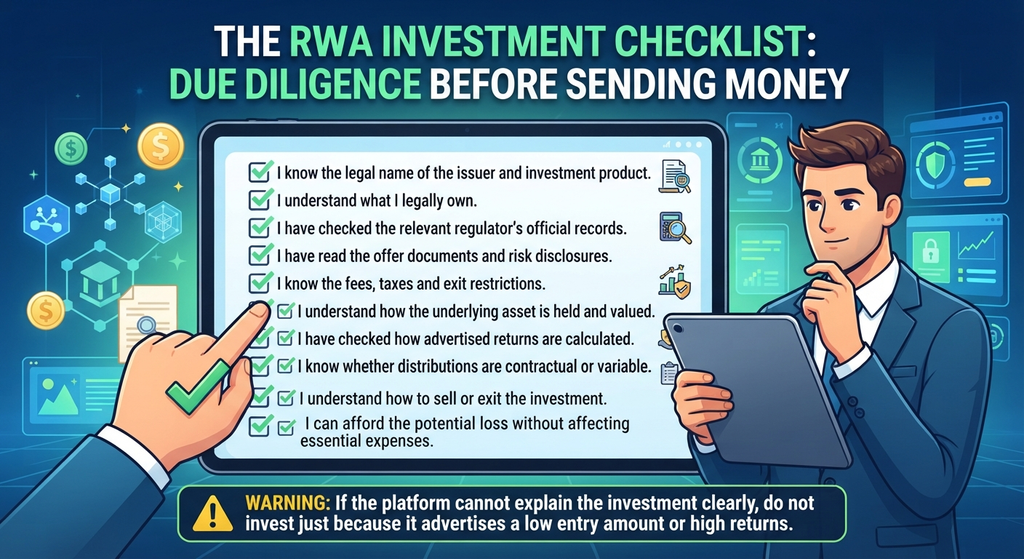
12. Checklist before investing in any RWA platform
Use this checklist before sending money.
- I know the legal name of the issuer and investment product.
- I understand what I legally own.
- I have checked the relevant regulator’s official records.
- I have read the offer documents and risk disclosures.
- I know the fees, taxes and exit restrictions.
- I understand how the underlying asset is held and valued.
- I have checked how advertised returns are calculated.
- I know whether distributions are contractual or variable.
- I understand how to sell or exit the investment.
- I can afford the potential loss without affecting essential expenses.
If the platform cannot explain the investment clearly, do not invest just because it advertises a low entry amount or high returns.
Frequently asked questions about RWA investing in India
What is the best RWA investment in India?
There is no single best option for everyone. REITs, SM REITs, InvITs, gold ETFs, bonds and tokenised products have different legal structures, risks and liquidity. Compare the actual product terms before investing.
Can I invest in real estate without buying a whole property?
Yes. Listed REITs allow investors to buy units in a real estate portfolio. SM REITs provide another regulated structure for eligible real estate schemes. These are not identical to directly owning a registered property.
Which companies offer RWA investments in India?
Investors can research listed REIT issuers such as Embassy Office Parks REIT, Mindspace Business Parks REIT, Brookfield India Real Estate Trust and Nexus Select Trust. For SM REITs, check SEBI’s registered list, which includes Property Share Investment Trust and hBits Investment Trust among others. Registration and active investment availability must be checked separately.
Can I start RWA investing with ₹5,000?
It depends on the product’s current price and minimum investment terms. Some products may be accessible at relatively small amounts, while others require more capital. Always check the official terms and do not confuse a low minimum with low risk.
Are tokenised RWAs safe?
Not automatically. The existence of an underlying asset does not guarantee that token holders can enforce a claim against it. Check the issuer, legal rights, custody arrangements, regulatory position and exit process.
Do RWA investments provide monthly income?
Some investments may make regular distributions, but the payment frequency and amount depend on the product and its cash flows. Monthly income is not guaranteed merely because a platform advertises it.
Are RWA investments regulated by SEBI?
Some RWA-related products, such as REITs, SM REITs and InvITs, fall under SEBI’s regulatory frameworks. Other products may be subject to different rules depending on their structure. Do not assume that every digital token or RWA platform is regulated by SEBI.
Conclusion
Understanding RWA investment in India includes exploring multiple avenues, from listed REITs and SM REITs to infrastructure trusts, gold ETFs, bonds, and tokenised assets.
If you are researching this area for the first time, begin by understanding the investment structure. Check the issuer’s legal status, read the official offer documents, compare fees and returns, and understand how you can exit.
For tokenised assets in particular, verify what the token actually represents. A digital token is not automatically proof of ownership of the underlying property, and advertised returns are not guaranteed.
Disclaimer: This article is for educational purposes only and is not personalised investment, legal or tax advice. Investments can lose value. Verify current product terms and regulatory information before investing, and consult a qualified financial adviser if you need advice tailored to your circumstances.