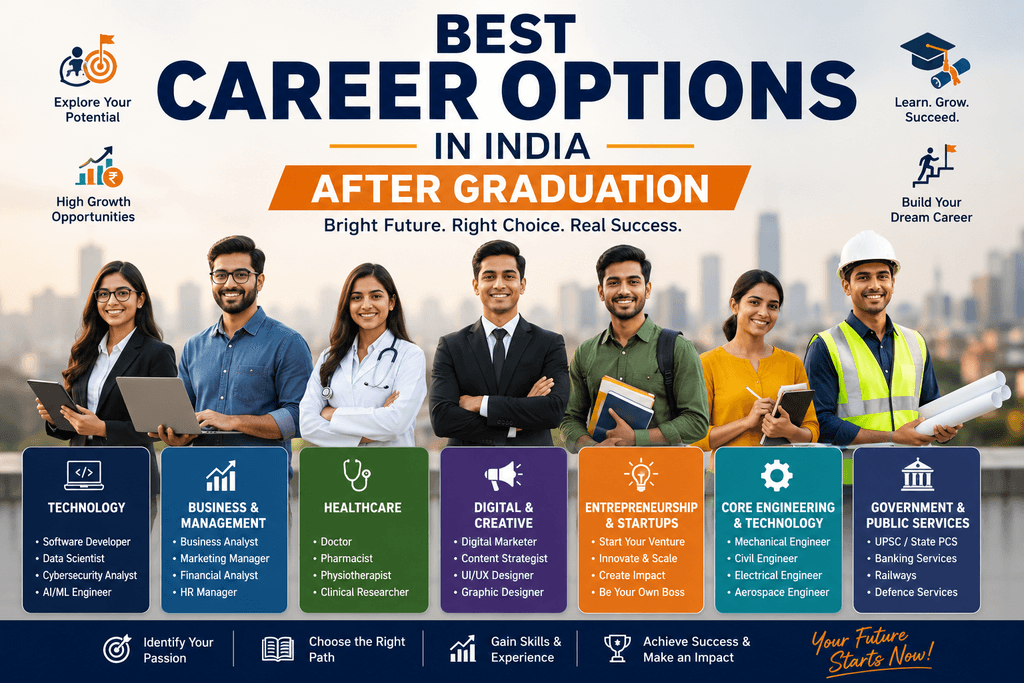
Understanding Career Options After Graduation
Graduation can feel like the end of a journey, but it is really the beginning of career decision-making. Many students finish a degree and immediately hear advice to take a government exam, do an MBA, learn coding or accept the first job available. None of these is automatically right for everyone.
The best career options after graduation depend on your degree, interests, skills, financial situation and the type of work you want to do. This guide gives you a practical framework rather than one “perfect” answer.
Current Career Openings
| Role | Company | Industry | Estimated Salary/Package |
|---|---|---|---|
| Customer Success & Growth Executive | Aerimak Business Solutions | Service/Operations | ₹2,00,000 /year |
| Sales & Operations Executive | ELEVOR | Sales | ₹2,10,000 – 2,35,000 /year |
| Business Development Associate | EDU TANTR | Sales | ₹4,80,000 – 6,00,000 /year |
| Product Marketing Associate | Webmobi | Marketing | ₹4,00,000 – 7,00,000 /year |
| Digital Marketing Associate | EDU SHIKSHAVERTEX | Marketing | ₹5,40,000 – 6,30,000 /year |
| Key Relationship Manager | Generali Central Life Insurance | Finance/Sales | ₹4,50,000 – 5,50,000 /year |
| Customer Service Coordinator | Oracle | Customer Service | Upto ₹8,00,000 /year |
Do Not Confuse a Degree With a Job
Your degree is a foundation. It does not always determine your final profession. A commerce graduate can move into finance, analytics, sales or marketing. A science graduate can explore research, data, education or technology. An arts graduate can build careers in communications, HR, content, sales, design and operations.
Start by asking what problems you can solve rather than what job title your degree guarantees.
Private-Sector Careers
Companies recruit graduates for sales, customer support, operations, HR, recruitment, finance, marketing and technology. These private-sector career options after graduation can provide valuable experience quickly, especially when you are still building professional skills.
Before accepting an offer, compare fixed salary, variable pay, work location, hours, probation, notice period and learning opportunities. Do not judge an offer only by the CTC printed in the offer letter.
Technology and Digital Careers
Graduates from different backgrounds can enter selected digital roles by learning practical skills. When exploring technology-focused career options after graduation, fields like SEO, digital marketing, analytics, content operations, UI/UX, QA testing and some entry-level development paths can be accessible with focused preparation.
Build proof of work. For example, create an SEO audit, marketing case study, analytics dashboard, design portfolio or small software project. Employers can then see what you can actually do.
Government and Public-Sector Careers
Government jobs remain attractive for many graduates because recruitment follows structured processes and selected roles offer long-term stability. Competitive examinations can lead to careers across banking, staff selection, civil services, railways and state departments.
The main consideration is time. Exam preparation can take a long period, and selection is competitive. Set a target preparation period and keep a backup career plan.
Higher Education
A master’s degree can be useful when it changes your career options or gives you specialised knowledge. Before enrolling, compare course content, fees, placement outcomes, internships and the skills employers request.
If you are considering study abroad, do not choose a course only because friends are applying. Compare the total cost and likely career outcome. WisdomLand’s [education loan EMI calculator](https://wisdomland.in/blog/career-essentials/education-loan-emi-calculator/) can help you model borrowing scenarios, while your final financing decision should use current lender terms.
Freelancing
Freelancing can be a useful way to gain experience and is becoming one of the most flexible career options after graduation. Writing, design, web development, SEO, video editing, bookkeeping and marketing are examples of services that can be offered independently.
The Future of Work
The professional landscape is undergoing a massive shift as artificial intelligence, automation, and remote work technologies redefine traditional roles across every industry. This evolution means that the traditional career options after graduation now require a high degree of digital literacy and adaptability to survive and thrive in a tech-driven economy.
Exploring Current Trends
Beyond technical shifts, the importance of continuous learning cannot be overstated; staying updated with rapidly changing market demands is essential when evaluating career options after graduation. Candidates who proactively upskill are better positioned to navigate these trends. To help manage these new insights, you can use the Seven-Day Career Plan as a practical framework. For additional support, the National Career Service is a highly recommended resource for job seekers in India.
Start with one service rather than ten. Create samples, set clear deliverables and keep payment records. Never accept a job that asks you to perform illegal or suspicious financial transactions.
Entrepreneurship
Starting a business immediately after graduation can work for some people, but it is not a shortcut to easy income. Start by identifying a real customer problem and testing a small solution.
If possible, gain industry knowledge before investing heavily. A small service business can teach sales, delivery, customer support and cash-flow management without the cost of a large startup.
How to Choose Your Path
Use a simple scorecard. Rate each career from 1 to 5 for interest, skill fit, entry opportunities, earning potential, learning, cost of entry and lifestyle fit.
Then speak to people who actually work in those roles. Ask what a normal day looks like, what beginners struggle with and what skills helped them progress. Real job descriptions are also useful because they show current employer expectations.
Seven-Day Career Plan
Day 1: List strengths and interests.
Day 2: Choose three possible career paths.
Day 3: Read 20 job descriptions for each.
Day 4: Identify common skills.
Day 5: Choose one skill to learn for 30 days.
Day 6: Build a small proof-of-work project.
Day 7: Apply for suitable jobs, internships or training.
This approach turns uncertainty into action without forcing you to decide your entire life in one week.
Frequently Asked Questions
What is the best career after graduation?
There is no single best career. The right choice depends on your skills, interests, opportunities and long-term goals.
Can I change careers after graduation?
Yes. Many graduates move into new fields by learning relevant skills and building practical experience.
Should I do a master’s immediately?
Only if it has a clear purpose. Compare cost, curriculum and career outcomes.
Government or private job—which is better?
Neither is universally better. Compare stability, growth, work style and your personal priorities.
How can a fresher gain experience?
Internships, apprenticeships, projects, freelancing and volunteering can build practical evidence.
Final Takeaway
Choosing the right option requires more than looking at a headline number. If you are researching career options after graduation, compare eligibility, total cost, practical benefits, risks and long-term value. For more personalized guidance and resources to help you decide, visit WisdomLand. Use official sources for rules and prices that may change, and keep written records of important applications, offers and payments.