
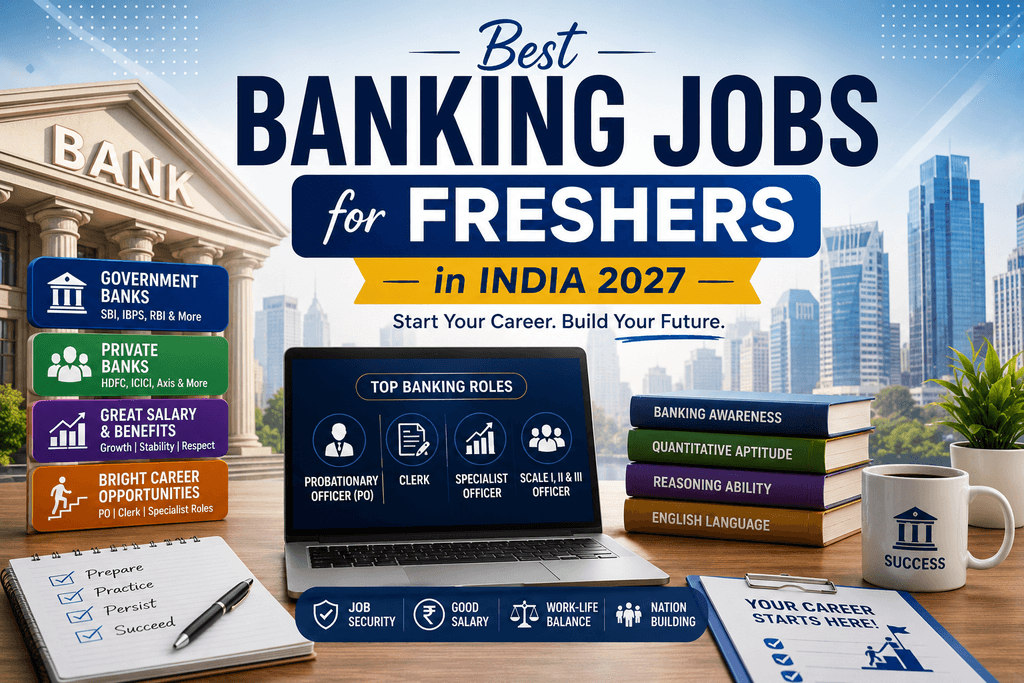
Introduction: The Phygital Era of Indian Banking
In 2027, the Indian financial landscape has matured into a global powerhouse, characterized by a seamless blend of innovation and stability. The traditional banking model has evolved into a “Phygital” ecosystem, harmoniously merging physical branch presence with high-velocity digital infrastructure.
This shift has fundamentally transformed the industry, making the pursuit of banking jobs for freshers one of the most dynamic career paths for modern graduates. As the world’s third-largest banking sector, the industry is currently fueled by a massive infrastructure push and the widespread adoption of technologies like UPI 3.0.
This rapid expansion creates a vast mosaic of opportunities for diverse talent looking for banking jobs for freshers. Whether you are a tech enthusiast or a commerce graduate, the sector offers a rewarding professional journey.
Key reasons to pursue these opportunities include:
- Diverse Career Paths: Openings are no longer limited to commerce graduates; there are high-impact roles for engineers, tech enthusiasts, and liberal arts majors.
- Financial Inclusion & Reach: Growth is deeply rooted in both urban hubs and rural micro-lending ecosystems, ensuring widespread impact.
- Professional Growth: The sector offers a unique blend of long-term financial security, social prestige, and a steep learning curve aligned with the latest fintech trends.
In this comprehensive guide, we will break down the essential roles and strategic preparation steps required to help you secure the best banking jobs for freshers in this rapidly evolving landscape.
Our goal is to equip you with the insights needed to navigate the hiring process and stand out in a competitive market.
[Image Placeholder: A modern, glass-walled bank branch with digital kiosks and customers interacting with bank staff using tablets]
Why Choose a Banking Career? Trends for 2027
Choosing a career in banking in 2027 is a strategic decision that offers a unique blend of “Old World” security and “New World” agility. While other sectors have faced volatility, the Indian banking sector remains a “safe haven” for professional growth.
Fortified by the Reserve Bank of India (RBI), these banking jobs for freshers provide a solid foundation for long-term career success.
1. Financial Security and Competitive Remuneration: Salary structures have seen a significant upward revision post-2025. An entry-level officer now enjoys a package that rivals top-tier IT roles.
These banking jobs for freshers are complemented by low-interest staff loans and comprehensive health insurance. This ensures a lifestyle of stability and peace of mind from day one.
2. Social Prestige and Trust: In the Indian context, being a “Banker” still carries immense social weight. You are seen as a custodian of public trust, a role that is highly respected in society.
This prestige makes banking jobs for freshers particularly attractive for those who value ethical oversight. You will play a critical role in preventing digital fraud and helping citizens manage their wealth.
3. The Green Finance Boom: As India pushes toward Net Zero, banks are the primary vehicles for sustainable lending. This has created niche departments specifically for graduates entering the workforce.
Modern banking jobs for freshers now include roles focused on ESG (Environmental, Social, and Governance) standards. It is a personally fulfilling way to contribute to the planet’s future.
4. Technological Exposure: Working in a bank today means working with AI-driven personalization tools and blockchain ledgers. It is no longer about “counting cash”; it is about being a digital financial consultant.
Platforms like Wisdomland have documented how this tech-pivot has accelerated the promotion cycles for banking jobs for freshers. You will gain cutting-edge skills that are highly valuable in the modern economy.
Top Banking Job Roles for Freshers
[Image Placeholder: Infographic showing the 10-year growth trajectory of a Probationary Officer vs. a Private Sector Associate]
1. Probationary Officers (PO): Premier Banking Jobs for Freshers
The PO role remains the most sought-after entry point into the banking hierarchy. In 2027, many private institutions have rebranded this as “Assistant Manager (Digital Operations).”
As one of the top banking jobs for freshers, a PO starts as a trainee rotating through various departments. You will gain exposure to treasury, credit, and marketing operations.
Specific Responsibilities:
- Credit Appraisal: Analyzing the creditworthiness of MSMEs using AI-risk scoring models.
- Digital Relationship Management: Onboarding high-net-worth individuals into the bank’s digital wealth ecosystem.
- Branch Oversight: Ensuring the physical kiosks and automated tellers are functioning within regulatory uptime standards.
Starting Salary: ₹58,000 – ₹72,000 per month.
2. Clerks / Junior Associates: Frontline Banking Jobs for Freshers
In 2027, the traditional “Clerk” role has evolved into a “Universal Banking Associate.” With the automation of basic transactions, the role now focuses on digital troubleshooting and customer education.
These banking jobs for freshers serve as the frontline ambassadors of the bank’s mobile applications. You will be instrumental in helping customers navigate the digital banking ecosystem.
Specific Responsibilities:
- KYC Assistance: Helping customers complete biometrically verified digital KYC.
- Cross-selling: Identifying customer needs for insurance, mutual funds, or SIPs through CRM dashboards.
- Lead Generation: Feeding potential high-value leads into the centralized sales funnel.
Starting Salary: ₹32,000 – ₹42,000 per month.
3. Specialist Officers (SO): Niche Banking Jobs for Freshers
The SO cadre is reserved for graduates with niche professional degrees like IT, Law, or Agriculture. The 2027 landscape has seen a massive surge in demand for these specialized roles.
If you have a professional background, these are some of the most rewarding banking jobs for freshers available today. They allow you to apply your expertise directly to the financial sector.
IT & Cybersecurity Officers: Tasked with defending the bank’s cloud perimeter and managing the transition to quantum-safe encryption. They work closely with ethical hackers to maintain system integrity.
Agricultural Field Officers (AFO): Utilizing satellite imagery and IoT data to assess crop yields for agricultural loans. This role is pivotal for the “Bharat” credit expansion.
Marketing & Content Officers: Managing the bank’s presence on the Metaverse and traditional social platforms to attract Gen Alpha and Gen Z customers.
4. Fintech and Digital Banking Roles
Neobanks and digital-first subsidiaries (like SBI YONO 2.0 or HDFC Sky) have introduced roles that didn’t exist five years ago. These fast-paced environments are perfect for tech-native graduates.
Exploring banking jobs for freshers in the fintech space offers a unique opportunity to work at the intersection of finance and software. You will be at the heart of India’s digital revolution.
Digital Product Analyst: Tracking “drop-off” rates in the loan application journey and suggesting UI/UX improvements.
Anti-Money Laundering (AML) Analyst: Using machine learning tools to flag suspicious transaction patterns in real-time.
Essential Skills for Success
To land banking jobs for freshers in 2027, a degree is merely the entry ticket. Your “skill stack” will ultimately determine your success in this competitive field.
Focus on developing a blend of technical expertise and interpersonal strengths. This holistic approach will make you a highly desirable candidate during the hiring process.
Technical Skills
- Data Literacy: You don’t need to be a data scientist, but you must be able to interpret dashboards and understand customer data patterns.
- Fintech Proficiency: Familiarity with blockchain basics, digital wallets, and Neo-banking interfaces.
- Cybersecurity Awareness: Understanding the basics of phishing, social engineering, and secure transaction protocols is mandatory for every bank employee.
Soft Skills
- Adaptability: The banking software you use today might be upgraded by next quarter. You must be a “forever learner.”
- Emotional Intelligence (EQ): As AI takes over routine tasks, the human element of banking—empathy and complex problem solving—becomes more valuable.
- Communication: The ability to explain complex financial products to a layperson in a simple, transparent manner.
Comprehensive Preparation Strategy (12-Week Plan)
Cracking the exams conducted by IBPS or SBI requires a phased approach. The 2027 exam pattern emphasizes logical reasoning and data interpretation over rote memorization.
To secure the best banking jobs for freshers, you need a disciplined study plan. Here is a 12-week strategy to help you ace the entrance tests.
Weeks 1-4: The Foundation Phase
- Quant: Focus on Vedic maths for speed and basic arithmetic concepts.
- English: Start reading The Hindu or LiveMint daily. Focus on the editorial section for vocabulary and comprehension.
Weeks 5-8: The Speed & Accuracy Phase
- Reasoning: Practice complex seating arrangements and floor-based puzzles.
- Mocks: Take one sectional mock test every two days.
Weeks 9-12: The Mains & Interview Phase
- General Awareness: Deep dive into the last 6 months of banking news. Use Wisdomland for mock interview panels and personality development workshops.
Phase 1: Foundation (6 Months Prior)
Phase 2: Intensive Practice (3 Months Prior)
Phase 3: The Interview (Post-Mains)
[Image: Infographic of Banking Exam Timeline from Notification to Joining Letter]
The Impact of Digital Banking: AI, RPA, and the Future
In 2027, the fear of AI replacing jobs has been debunked; instead, it has acted as a “force multiplier.” Robotic Process Automation (RPA) now handles 90% of back-office entries, freeing up employees for higher-value work.
This shift means that banking jobs for freshers now focus on strategic advisory and complex problem solving. You will be viewed as a solution provider rather than just an entry-level clerk.
[Image Placeholder: A split graphic showing a 1990s bank branch (paper files) vs. a 2027 bank branch (holographic displays and mobile connectivity)]
If you are looking for specific resources to bolster your resume, visiting Wisdomland can help you identify which certifications are currently most valued by top-tier Indian banks.
Conclusion
A Day in the Life of an Entry-Level Banker in 2027
Understanding the reality of banking jobs for freshers requires looking beyond the brochure. In 2027, a typical day is a blend of high-tech interface and high-touch human interaction.
You might start your morning with a “Digital Huddle” to analyze customer segments. By mid-morning, you could be assisting a customer with an augmented reality (AR) onboarding process for their first business account.
Modern banking is as much about teaching as it is about transacting. Post-lunch, the focus shifts to data compliance and risk monitoring to ensure all digital managing adheres to the latest RBI protocols.
Building Your Professional Brand
Securing one of the premier banking jobs for freshers is only the first step. Building a sustainable career requires intentional professional branding and continuous networking.
Actively participate in industry-relevant discussions on platforms like LinkedIn. Keeping abreast of circulars published by the RBI will also set you apart during appraisal cycles.
Navigating Work-Life Balance in the Modern Financial Sector
The stereotype of the “overworked banker” is being replaced by a more flexible, hybrid reality. Leading institutions in 2027 recognize that talent retention relies on employee well-being.
For those pursuing banking jobs for freshers, it is important to inquire about these flexible work policies. Cultivating strong time-management habits will allow you to grow without sacrificing your personal development.
The pursuit of banking jobs for freshers in India 2027 is a journey toward a career that offers both traditional stability and modern innovation.
Start your preparation early, stay updated with the latest policies, and embrace the digital evolution of finance. The future of banking is waiting for you.
Frequently Asked Questions
1. Can a non-commerce student apply for banking jobs for freshers in 2027?
Yes. Most banking exams, including IBPS and SBI PO, require a graduation degree in any discipline. In fact, banks actively seek engineers and science graduates for technical and analytical roles.
2. What is the age limit for entry-level banking jobs?
Typically, for PO roles, the age limit is 21 to 30 years, while for Clerical roles, it is 20 to 28 years, with age relaxations for reserved categories.
3. Is there a physical interview for all banking roles?
While PO and SO roles always involve a rigorous interview process, many clerical roles are filled based on the marks of the preliminary and main exams, followed by a Local Language Test.
4. How important is computer knowledge for a banking career?
It is essential. Most banks require a basic certificate in computer operations or for the candidate to have studied IT/Computer Science in high school or college.
5. Which is better: Public Sector Banks (PSBs) or Private Sector Banks?
PSBs offer higher job security and structured promotions. Private banks (like HDFC or ICICI) often offer faster career growth and higher performance-linked incentives.