
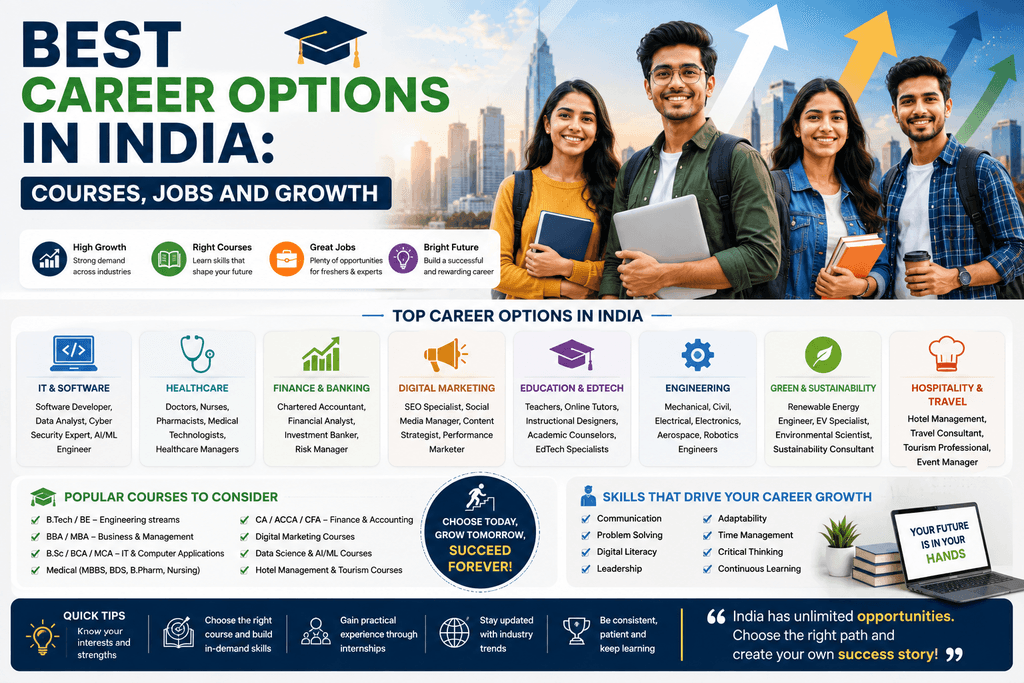
Choosing the best career options in India is not about finding one magical job that pays the most. A good career should match your interests, ability, education, financial goals and willingness to keep learning. In 2026, technology is changing many occupations, but healthcare, education, sales, operations, engineering, finance, green energy and skilled work also remain important. The safest career decision is usually one that combines useful skills with real demand.
How to choose the best career options in India
Start with five questions: What subjects do I enjoy? What am I good at? What kind of work environment do I like? How much education can I afford? Which skills are employers likely to need?
Do not choose a career only because a friend or influencer says it is high paying. A career that fits your strengths is easier to learn and sustain.
Try a small project, short course, internship or job-shadowing experience before committing to a long and expensive programme.
1. Technology and software careers
Technology offers many paths beyond traditional software development. Options include software engineering, data analysis, cloud computing, cybersecurity, AI and machine learning, UI/UX, product operations and technical support.
AI is changing the work itself, so future-ready technology professionals need both technical ability and human skills. The World Economic Forum identifies AI and big data, networks and cybersecurity, and technological literacy among the fastest-growing skill areas.
2. Healthcare and life sciences
Healthcare is a broad field that includes doctors and nurses, but also medical laboratory professionals, healthcare administration, medical coding, health informatics, pharmacy, diagnostics and medical technology.
Healthcare can be a good choice for students who enjoy science and want work that directly helps people. The education path varies widely, so check the exact qualification and licensing rules for each role.
3. Finance, banking and insurance
Finance careers include accounting, auditing, banking operations, financial analysis, insurance, taxation, fintech and risk management.
Students who enjoy numbers, business and structured work can explore these careers. Professional qualifications can be useful, but many entry-level operations and analyst roles also accept general graduates.
4. Digital marketing and communication
Digital marketing includes SEO, social media, content, email marketing, paid advertising, analytics and online brand management.
It is a practical field because you can build a portfolio without waiting for a formal job. A student can create a sample website audit, content plan or campaign report to show employers what they can do.
5. Engineering and manufacturing
Engineering remains important in manufacturing, infrastructure, electronics, automobiles, energy, automation and supply chains.
Students should look beyond the degree title and examine the industries that hire for the specific branch. Practical projects, software tools, internships and communication skills can make a big difference.
6. Education and learning careers
Teaching is only one education career. Other roles include curriculum development, instructional design, academic counselling, EdTech operations, subject-matter work and learning support.
People who enjoy explaining ideas and helping others learn can find many paths in this area.
7. Green energy and electric mobility
Renewable energy, electric vehicles, battery systems, environmental engineering and sustainability are gaining importance as businesses respond to the energy transition.
These careers may require engineering, science, environmental studies or specialised technical training depending on the role.
8. Skilled and service careers
Electricians, technicians, mechanics, construction specialists, healthcare support workers, logistics professionals, hospitality staff and other skilled workers remain essential to the economy.
A career does not become less valuable simply because it does not require a desk job. Practical skills can lead to stable employment or self-employment when combined with quality training.
Career comparison: what to look at
Education time: How long will it take to become employable?
Cost: Can you afford the degree, course or certification?
Demand: Are employers hiring for this skill?
Fit: Do you enjoy the work enough to keep learning?
Growth: Can the role lead to better responsibilities later?
Flexibility: Can you work in different industries or locations?
Portfolio potential: Can you prove your skills with projects?
A simple career decision formula
Choose a broad field you like. Pick one job role inside that field. Read 20 real job descriptions. Note the skills employers repeatedly request. Learn the most important missing skill. Build one project. Then try an internship or entry-level role.
This process is much safer than choosing a career based only on salary lists.
Career choices should match the person, not just the trend
When people search for the best career options in India, they often expect one list with the highest salaries. Real life is more complicated. A career that is excellent for one student may be a poor fit for another.
Think about the kind of work you enjoy. Do you like solving problems, talking to people, building things, analysing numbers, writing, teaching or working with machines? Your answer can help narrow the field.
Also consider the cost and time required to become employable. A four-year degree, a professional qualification and a six-month skill programme are very different investments. Compare the full path before making a decision.
Career paths that combine skills
Many of the best career options in India now sit between traditional fields. For example, a finance professional who understands data tools can work in fintech analytics. A healthcare graduate who learns health informatics can move into digital health. A marketer who understands analytics and AI tools can work on performance campaigns.
These combinations are powerful because they make your skills harder to replace. You do not have to learn everything. Build one strong core skill and add one useful supporting skill.
How to test a career before committing
Try a small experiment. If you are interested in digital marketing, create a sample campaign or SEO audit. If you like coding, build a simple application. If teaching interests you, tutor one student. If finance interests you, build a personal budgeting model.
Real work gives you better information than a career quiz alone. You may discover that you love the subject but dislike the daily work, or you may discover a new strength you did not know you had.
More Practical Search Tips
The best career options in India are different for every student because interests, abilities, education costs and career goals are different.
Students comparing the best career options in India should read real job descriptions instead of depending only on salary lists.
One of the best career options in India for you is usually a field where you can build a strong skill and keep learning.
The best career options in India can include both traditional professions and newer roles created by technology and changing business needs.
Before choosing the best career options in India, test your interest through a small project, course, internship or conversation with a professional.
Do not choose the best career options in India only because a friend selected the same course; choose a path that fits your own strengths.
Quick Action Plan
1. Choose one clear target role.
2. Study current job descriptions and note repeated skills.
3. Update your resume for that target.
4. Create one practical project or portfolio sample.
5. Apply consistently and track applications.
6. Review interview feedback and improve each week.
Important Things to Remember
· Verify current information on official sources.
· Do not pay money for guaranteed jobs or scholarships.
· Do not claim skills, marks or experience you do not have.
· Use internal links naturally to help readers discover related Wisdomland content.
· Update time-sensitive information when official sources publish a new cycle.
Final Takeaway
The best career options in India are the ones that combine personal fit, useful skills and real market demand. Trends can change, but the ability to learn and solve problems stays valuable.
Take your time before paying for an expensive course. Study real job descriptions, talk to people in the field and test the work through a small project. A little research today can prevent a costly wrong turn tomorrow.
Frequently Asked Questions
What are the best career options in India in 2026?
Strong options exist across technology, healthcare, finance, engineering, digital marketing, education, green energy and skilled careers. The right choice depends on your interests, education, skills and the demand for the role.
Which career is best for the future?
No career is guaranteed forever. Roles that combine useful technical skills with communication, analytical thinking, adaptability and continuous learning are better positioned for change.
Should I choose a career based on salary?
Salary matters, but it should not be the only factor. Consider education cost, job demand, work style, skill fit and long-term growth.
How can I test a career before studying for it?
Try a small project, beginner course, internship, volunteer activity or conversation with someone already working in the field.
Useful Wisdomland Internal Links
· Wisdomland.in — Career Resources
· Top 10 High Salary Jobs in India 2026 Without an Engineering Degree
· Jobs in India: Latest Opportunities and Career Guide